
Traditional SEO taught teams to ask where a page ranks.
AI search forces a different question:
Which sources are shaping the answer?
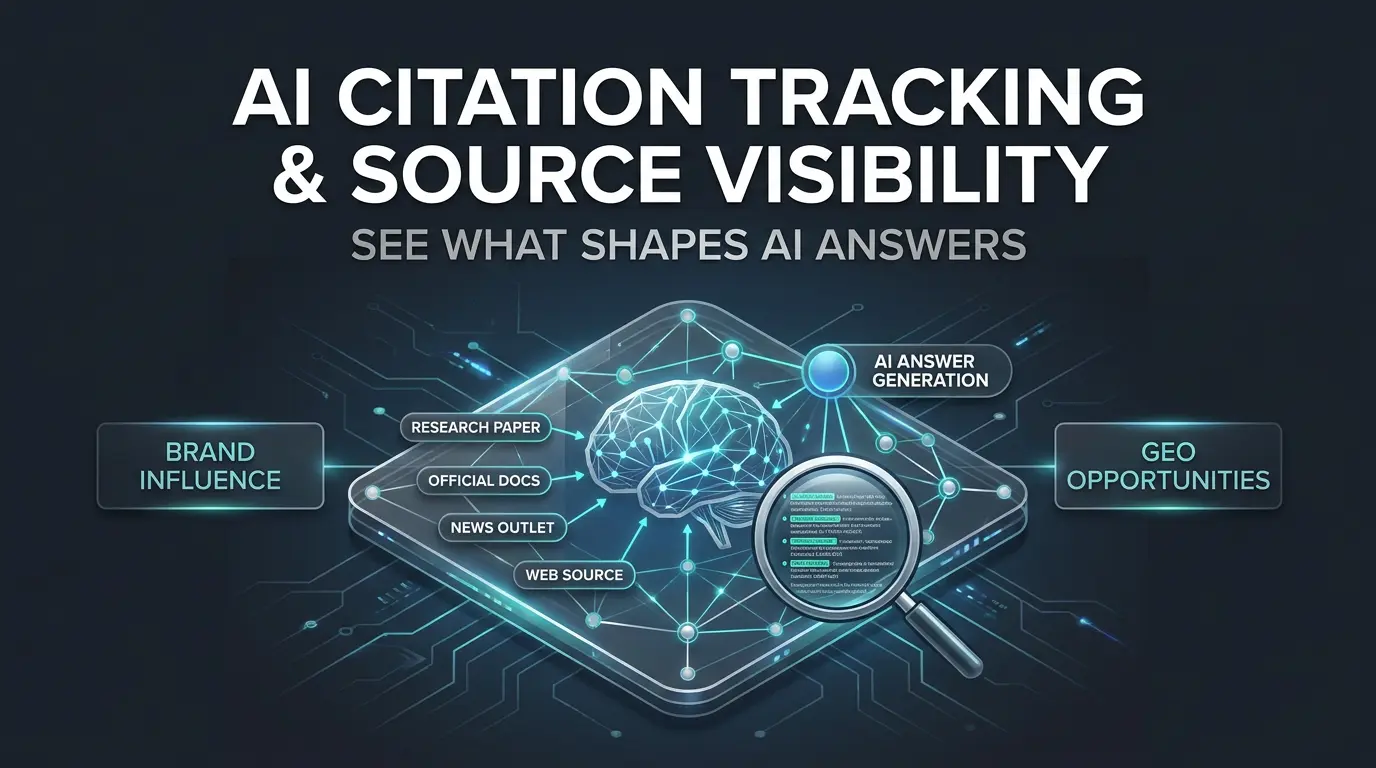
When ChatGPT, Perplexity, Gemini, Google AI Overviews, AI Mode, Copilot, or another answer engine responds to a user's question, the visible answer is only the final surface. Behind it is a source layer: pages retrieved, sources cited, facts selected, competitors compared, and sometimes pages used without sending meaningful traffic back to the publisher.
That is why AI citation tracking matters.
AI citation tracking is the practice of monitoring which domains, URLs, and source types appear as citations or supporting evidence inside AI-generated answers. AI source tracking goes one layer wider: it asks which sources seem to influence the answer, whether or not they become the visible citation a user clicks.
For marketing, SEO, content, and brand teams, this is a new kind of visibility work. It is not just about ranking. It is about being part of the evidence layer that answer engines use to explain, recommend, and compare.
Why citations matter in AI search
In classic search, the result page was the interface. Users saw ranked links, snippets, site names, and sometimes rich results. A high ranking could directly create traffic.
In AI search, the answer itself becomes the interface.
Google says AI Overviews and AI Mode can help users with complicated topics, nuanced questions, reasoning, and complex comparisons. Google also says these features may use query fan-out, issuing multiple related searches across subtopics and data sources before generating a response with supporting links (Google Search Central).
That changes what visibility means.
A source can matter in several ways:
- it can be cited directly;
- it can support a claim in the answer;
- it can shape which brands are recommended;
- it can give the model a definition, price, comparison, or process;
- it can reinforce a competitor's positioning;
- it can be visible to the user as a link;
- it can influence the answer without producing a visit.
This is why source visibility is becoming a core GEO metric. A brand may not receive the click, but the cited source can still help decide whether the brand appears credible, current, relevant, or absent.
Google's documentation also explains an important reporting limitation: AI feature traffic is included in Search Console's standard Web search type, not separated as a clean citation-level report. That means site owners can see traffic, but not a full map of which AI answers cited which pages, how often, or in what context (Google Search Central).
AI citation tracking fills that gap.
What is AI citation tracking?
AI citation tracking measures which sources answer engines cite for a defined set of prompts.
A simple version tracks:
- prompt;
- AI engine;
- generated answer;
- cited URLs;
- cited domains;
- citation position;
- brand mentions;
- competitor mentions;
- whether your own domain was cited;
- whether a competitor or third-party source was cited;
- the answer snapshot and date.
For example, a team might test the prompt:
"What are the best platforms for tracking brand visibility in AI search?"
An AI citation tracking report would show:
- whether the brand appears in the answer;
- which competitor brands appear;
- whether the brand's site is cited;
- whether a competitor's site is cited;
- whether a third-party list, review page, documentation page, Reddit thread, or news article is cited;
- whether the answer recommends the brand or only mentions it;
- whether the citation supports a positive, neutral, or negative claim.
The goal is not to collect screenshots for their own sake. The goal is to understand which sources answer engines trust enough to show, summarize, or use as evidence.
AI citation tracking vs AI source tracking
AI citation tracking and AI source tracking overlap, but they are not identical.
| Concept | What it tracks | Main question | Example |
|---|---|---|---|
| AI citation tracking | Visible citations and supporting links inside AI answers | Which URLs and domains are cited? | A Google AI Overview cites your documentation page |
| AI source tracking | The broader source layer that may shape the answer | Which sources appear to influence the answer? | A third-party list shapes the answer even when your own site is not cited |
| Brand mention tracking | Whether the brand is named in the answer | Does the answer include the brand? | The answer recommends your product |
| Answer position tracking | Where the brand appears in a list or narrative | How prominent is the brand? | The brand is listed second in a recommended tools section |
Citation tracking focuses on the visible proof.
Source tracking focuses on the evidence ecosystem.
Both are needed because AI answers can separate visibility from influence. A brand may be mentioned because a third-party article discusses it. A domain may be cited because it provides a definition, even if the brand is not recommended. A competitor may win the recommendation because its source evidence is fresher, clearer, or more directly aligned with the prompt.
That is why AIvsRank features are framed around the answer evidence layer: brand mentions, citations, answer positions, competitor visibility, AI engines, and saved snapshots over time. Citation tracking is strongest when it is connected to the full answer context.
What source visibility really means
Source visibility is not just "did our website get a link?"
A source can be visible in different ways:
- cited as a supporting link;
- quoted or paraphrased in the answer;
- used to verify a factual claim;
- used to define a concept;
- used to compare options;
- used to support a recommendation;
- used to describe a competitor;
- used to frame the category itself.
This matters because a source can shape demand without being the final destination.
For example, imagine an AI answer about "best tools for AI search visibility." The answer might mention your brand, cite a third-party list, cite a competitor's documentation, and cite a general SEO guide. The user sees a short answer. But behind that answer, several sources are quietly deciding which brands look credible.
Source visibility asks:
- Which domains are repeatedly cited for our category?
- Are our owned pages cited, or are third-party pages doing the explaining?
- Which competitor sources appear when our brand is absent?
- Which pages shape the answer but do not send traffic?
- Are cited sources accurate, current, and aligned with our positioning?
- Which source gaps should guide our GEO roadmap?
This is a more precise way to think about AI search visibility. Ranking is only one surface. Source visibility is the evidence behind the surface.
The core metrics for AI citation tracking
A practical AI citation tracking workflow should not rely on one number. It should separate several signals.
Citation share
Citation share is the percentage of tracked prompts where a domain or URL is cited.
Citation share = prompts where your domain is cited / total prompts tested
This is useful for seeing whether your site is being used as evidence across a prompt set. It can be reported overall, by engine, by prompt type, by product line, or by competitor group.
Owned citation rate
Owned citation rate measures how often your own site is cited when your brand appears.
Owned citation rate = prompts where your brand appears with an owned citation / prompts where your brand appears
This is important because brand visibility and owned-source visibility are not the same. If AI answers recommend your brand but cite only third-party pages, your site may not be controlling the facts users see.
Competitor citation share
Competitor citation share shows which competitor domains or competitor-friendly sources are shaping answers.
This is often where the most useful insights appear. A competitor may be cited because its docs answer the question better, because its comparison page is clearer, because a review platform includes it in a category list, or because a publisher has written a fresh roundup.
Source diversity
Source diversity measures how many types of sources appear across the prompt set.
Useful source types include:
- owned website;
- documentation;
- blog or guide;
- pricing page;
- third-party review site;
- media article;
- analyst report;
- marketplace listing;
- community thread;
- social or forum discussion;
- competitor page.
Low source diversity can be risky. If one third-party page dominates a category, a brand's AI visibility may depend heavily on how that page describes the market.
Citation position
Citation position asks where the citation appears in the answer.
First citations can matter more than later citations, especially when the answer uses citations to support key claims. Research on competitive GEO has found that topical relevance and list position can be major drivers of which source gets cited first in controlled answer-engine tests (arXiv).
That does not mean every platform behaves the same way, but it does mean citation position deserves attention.
Citation context
Citation context describes what the citation supports.
For example:
- definition;
- product claim;
- price;
- feature comparison;
- "best for" recommendation;
- risk or limitation;
- customer evidence;
- setup instructions;
- factual statistic.
Two citations can have very different value. A citation that supports "this product is best for enterprise teams" is more valuable than a citation that supports a generic definition of the category.
Citation freshness
Citation freshness measures whether answer engines cite current pages.
This is especially important in fast-moving categories. If an AI answer cites an old pricing page, outdated documentation, or an old third-party list, the answer can misrepresent the brand.
Unsupported mentions
An unsupported mention happens when the answer names the brand but does not cite a source for the claim.
Unsupported mentions are not always bad, but they are fragile. If the answer says something inaccurate, the team needs to know whether the claim came from an owned page, a third-party page, old training data, or no visible source at all.
Why single-run citation checks are not enough
AI answers are not static SERPs.
The same prompt can produce different sources across time, engines, locations, and wording. A single screenshot can be useful evidence, but it is not a measurement program.
A 2026 paper on generative search measurement argues that citation visibility should be treated as a sample estimate rather than a fixed value. It found substantial citation variability across repeated samples on Perplexity Search, OpenAI SearchGPT, and Google Gemini, and warned that single-run visibility metrics can look more precise than they really are (arXiv).
For AI citation tracking, that means teams should measure:
- repeated runs;
- citation stability;
- citation share over time;
- engine-level variance;
- prompt-level variance;
- source changes after content updates;
- confidence ranges where possible.
The right question is not "what did one answer cite once?"
The better question is:
Which sources keep appearing when important users ask important prompts?
Citation selection vs citation absorption
There is another subtle measurement problem.
Getting cited is not the same as shaping the answer.
A 2026 GEO measurement paper separates citation selection from citation absorption. Citation selection is when a platform triggers search and chooses sources. Citation absorption is when a cited page contributes language, evidence, structure, or factual support to the final generated answer (arXiv).
That distinction is useful for marketers because citation count alone can mislead.
A page might be cited but barely influence the answer. Another source might heavily shape the answer's wording, but the visible citation may point somewhere else. A page might provide a statistic, while another page provides the recommendation logic.
This is why AI source tracking should record both:
- what was cited;
- what the answer actually said.
The evidence is in the relationship between the source and the answer, not only in the URL list.
How to build an AI source tracking workflow
A simple workflow can start with six steps.
1. Define the prompt set
Start with prompts that reflect real user intent.
Include:
- category prompts;
- comparison prompts;
- "best for" prompts;
- problem-aware prompts;
- integration prompts;
- pricing prompts;
- alternatives prompts;
- implementation prompts;
- risk and trust prompts.
Do not track only short keywords. AI answers are shaped by natural-language questions, constraints, and context.
2. Choose the engines
Track engines separately before combining results.
Common surfaces include:
- ChatGPT search;
- Perplexity;
- Gemini;
- Google AI Overviews;
- Google AI Mode;
- Copilot;
- Claude, if relevant to the audience.
Google notes that AI Overviews and AI Mode may use different models and techniques, and therefore the set of responses and links they show can vary (Google Search Central).
That is why source visibility should be segmented by engine.
3. Save the answer snapshot
Citation tracking without snapshots becomes hard to trust.
For each run, save:
- prompt;
- engine;
- date;
- location or language if relevant;
- generated answer;
- cited sources;
- answer position;
- competitor mentions;
- screenshot or raw text evidence.
Saved snapshots make the report reviewable. They let content, SEO, PR, and product teams see the exact answer instead of debating a summary.
4. Classify the sources
Every cited source should be classified.
Useful labels include:
- owned;
- competitor-owned;
- third-party editorial;
- review platform;
- documentation;
- community or forum;
- marketplace;
- analyst or research;
- news;
- social;
- unknown or inaccessible.
This shows where the answer ecosystem is coming from.
If your brand is visible only through third-party pages, that is a different roadmap than if your own documentation is cited. If competitors are cited through strong docs and you are cited through old blog posts, that is a content quality signal. If AI answers cite community threads more than brand sites, that is a reputation and source-diversity signal.
5. Compare against competitors
AI source tracking becomes more valuable when it is competitive.
Track:
- your cited domains;
- competitor cited domains;
- third-party pages that mention competitors but not you;
- prompts where competitors are cited and you are missing;
- prompts where you are mentioned but competitors get the citation;
- prompts where answer engines cite old or inaccurate sources.
This turns source tracking into a gap analysis.
6. Connect findings to action
Every citation insight should point to a possible action.
| Source visibility finding | Possible GEO action |
|---|---|
| Brand appears but owned site is not cited | Build clearer source-ready pages for the prompt |
| Competitor docs are cited repeatedly | Improve documentation depth, structure, and internal linking |
| Third-party list cites competitors but not you | Prioritize PR, partnerships, review profiles, or category inclusion |
| AI answer cites outdated facts | Update canonical pages and make current facts easier to extract |
| Brand is cited for weak or generic claims | Add specific evidence, examples, comparisons, and proof points |
| Source set changes frequently | Increase sample size and monitor citation stability over time |
| Answer mentions brand but cites no source | Strengthen owned and earned evidence for that claim |
This is the real value of AI citation tracking: it turns vague AI visibility anxiety into a list of source-level actions.
How to improve source visibility
Source visibility is not about tricking answer engines. It is about making reliable evidence easier to discover, cite, and understand.
Make important pages crawlable and indexable
If an answer engine cannot access a page, the page cannot reliably become a source.
Google says pages must be indexed and eligible to be shown in Search with a snippet to be eligible as supporting links in AI Overviews or AI Mode. Google also recommends the same SEO fundamentals for AI features: allow crawling, make content findable through internal links, provide important content in text, and ensure structured data matches visible content (Google Search Central).
OpenAI's crawler documentation makes a similar practical point for ChatGPT search visibility: OAI-SearchBot is used to surface websites in ChatGPT search features, and sites opted out of OAI-SearchBot will not be shown in ChatGPT search answers, though they may still appear as navigational links (OpenAI).
Technical access is not a complete visibility strategy, but it is the floor.
Create source-ready pages
A source-ready page is easy for both people and answer engines to use.
It should include:
- a clear answer near the top;
- definitions;
- feature details;
- comparison criteria;
- pricing or plan facts when appropriate;
- current dates where freshness matters;
- screenshots or examples where helpful;
- FAQs;
- internal links to supporting pages;
- structured data that matches the visible content.
The goal is not to stuff keywords. The goal is to provide extractable evidence.
Separate claims from proof
AI answers need evidence.
If a page says "we are the best," that is not strong evidence. If it explains who the product is best for, what it does, what limitations it has, what integrations it supports, and how it compares with alternatives, the page becomes more usable as a source.
Good source visibility comes from specific, verifiable content.
Build third-party evidence
Owned pages matter, but AI answers often use third-party sources to support recommendations and comparisons.
Third-party evidence may include:
- review platforms;
- partner pages;
- editorial lists;
- analyst notes;
- customer stories;
- marketplace listings;
- documentation mentions;
- community discussions;
- integrations pages.
AI source tracking should show which third-party sources are shaping the category. Then teams can decide which relationships, profiles, or content assets need attention.
Keep documentation current
Documentation is often a strong source because it provides direct facts. But outdated documentation can damage source visibility.
If AI answers cite old integration pages, deprecated feature names, or outdated setup instructions, the brand may be visible for the wrong reason.
This is where the AIvsRank docs fit naturally into the broader visibility stack: documentation and API references are not only support assets. They can become structured evidence that users, teams, and answer engines rely on when interpreting a product or category.
Where AIvsRank fits into citation tracking
AI citation tracking needs repeatable evidence.
The AIvsRank features page describes an AI visibility tracker that monitors brand mentions, citations, answer positions, competitor visibility, AI engines, and saved snapshots. That matters because source visibility is not a one-time check.
Teams need to see:
- which prompts triggered citations;
- which engines cited which sources;
- whether competitors were cited instead;
- whether owned pages or third-party pages shaped the answer;
- whether citations changed after GEO work;
- what the exact answer said at the time of the run.
For teams building reporting or category benchmarks, the AIvsRank docs also give a path toward programmatic workflows through the API reference and leaderboard endpoints. That is useful when citation and source visibility need to become recurring reporting instead of manual spot checks.
The practical role is simple:
AI citation tracking gives the evidence. AI source tracking explains what to do next.
Common mistakes in AI citation tracking
The first mistake is counting citations without reading the answer.
A citation only matters in context. It may support a strong recommendation, a weak mention, a definition, or a negative claim. The cited URL alone does not tell the whole story.
The second mistake is treating one run as truth.
AI answers can vary. Citation tracking should use repeated measurements, saved snapshots, and trend analysis.
The third mistake is mixing brand mentions and citations.
A brand mention means the answer names the brand. A citation means the answer links to or references a source. A brand can be mentioned without being cited, and a source can be cited without the brand being recommended.
The fourth mistake is tracking only owned domains.
Source visibility includes third-party pages, competitor pages, community discussions, and review platforms. If a third-party page shapes the answer, it belongs in the report.
The fifth mistake is optimizing only the page, not the evidence ecosystem.
Sometimes the best GEO action is not another blog post. It may be clearer docs, better pricing information, updated product pages, customer proof, third-party listings, or correcting outdated descriptions.
Final takeaway
AI search visibility is not only about whether your brand appears.
It is also about which sources explain the answer.
AI citation tracking shows the visible evidence. AI source tracking shows the broader source ecosystem that shapes recommendations, comparisons, and trust. Together, they help teams understand why an answer mentions one brand, ignores another, cites a third-party page, or repeats an outdated claim.
The strongest GEO programs will not stop at traffic or rankings. They will ask:
- Which sources are cited?
- Which sources are trusted?
- Which competitors are supported by stronger evidence?
- Which owned pages are missing from the answer layer?
- Which third-party sources shape the category?
- Which citations are stable over time?
- Which source gaps should guide the roadmap?
That is the shift from search rankings to answer evidence.
FAQ: AI Citation Tracking and Source Visibility
What is AI citation tracking?
AI citation tracking is the process of monitoring which URLs, domains, and source types are cited inside AI-generated answers for a defined set of prompts and answer engines.
What is AI source tracking?
AI source tracking is broader than citation tracking. It looks at the source ecosystem that appears to shape AI answers, including visible citations, third-party pages, competitor sources, owned content, documentation, and community discussions.
Why does AI citation tracking matter?
It matters because AI answers can influence users before they click. A cited source can shape recommendations, comparisons, and trust even when the website does not receive much traffic from the answer.
What is the difference between a brand mention and a citation?
A brand mention means the answer names the brand. A citation means the answer links to or references a source. A brand can be mentioned without an owned citation, and a domain can be cited without the brand being recommended.
Which AI citation metrics should teams track?
Useful metrics include citation share, owned citation rate, competitor citation share, source diversity, citation position, citation context, citation freshness, unsupported mentions, and citation stability over time.
How often should AI citations be monitored?
Important prompts should be monitored repeatedly because AI answers and citations can vary across time, engines, wording, and location. A single run is useful evidence, but recurring snapshots create a more reliable trend.
How can teams improve source visibility?
Start with crawlable, indexable, text-accessible pages. Then improve source-ready content: clear definitions, current facts, documentation, comparison pages, examples, proof points, FAQs, internal links, and third-party evidence that supports how the brand should be understood.