
A search result used to be easy to define.
It was a link.
Maybe it had a title, a URL, and a snippet. Maybe it appeared with sitelinks, an image, a star rating, or a short preview. But the basic idea was stable: the search engine returned a set of pages, and the user chose where to go next.
AI in search engines changes that definition.
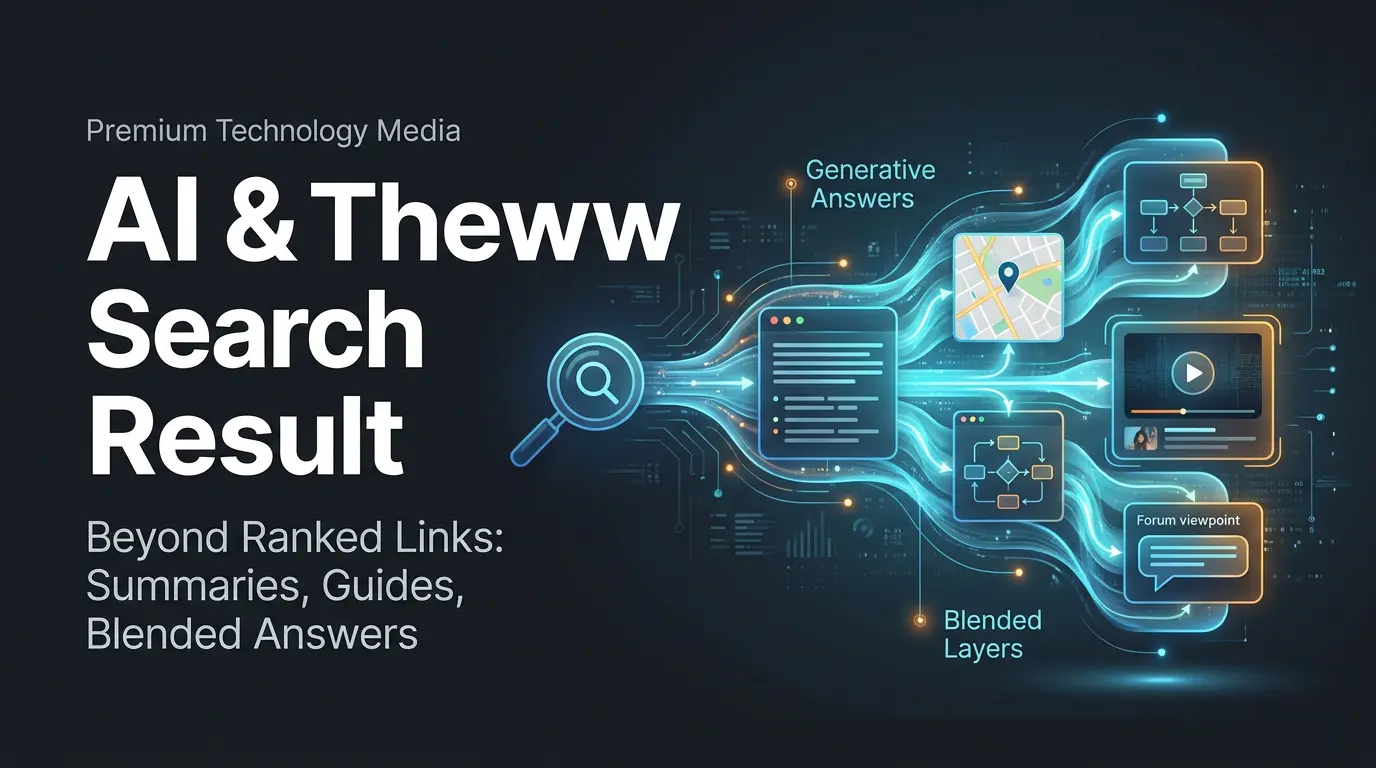
A search result can now be a generated summary, a comparison table, a recommendation, a step-by-step plan, a map pack, a video carousel, a product module, a forum excerpt, a local answer, or a blended response that mixes several of these at once.
The result is no longer just a pointer.
It is becoming an interface.
The old search result pointed outward.
Traditional search was built around navigation.
The user searched. The search engine returned ranked links. The user clicked one or more pages. The actual act of understanding happened after the click.
This created a familiar mental model:
search result = possible destination
The search engine did not usually claim to be the full answer. It organized the web and sent the user outward.
That model shaped the entire SEO industry.
Rankings mattered because they controlled which destinations were most visible. Snippets mattered because they persuaded users to click. Links mattered because they transferred authority. Pages mattered because they were where the real answer lived.
Even when rich results appeared, the core relationship remained recognizable. A recipe card, product snippet, video result, or local pack still usually pointed to something outside the result page.
The result was a doorway.
The new search result can answer before it points.
AI in search engines changes the search result from a doorway into a partial destination.
Google says AI Overviews help people get the gist of complicated topics more quickly and provide a jumping-off point to explore links. Google also says AI Mode is useful for nuanced questions, reasoning, and complex comparisons, producing a comprehensive AI-powered response with links to supporting websites (Google Search Central).
That phrasing matters.
The link is still there.
But it is no longer the whole result.
The AI-generated response can answer enough of the question that the user may not need to open a page immediately. It can summarize, compare, recommend, explain, and sequence the next steps before the user ever visits a website.
The result becomes:
search result = answer plus sources plus possible next actions
That is a very different object.
Search results are becoming composite answers.
The biggest conceptual change is that a search result is no longer one format.
It is a composite.
A single AI-influenced search experience may include:
- a direct answer;
- a short explanation;
- source links;
- comparison criteria;
- pros and cons;
- a recommended option;
- step-by-step instructions;
- map results;
- product details;
- video suggestions;
- forum or social perspectives;
- follow-up questions;
- ads or commercial modules.
This is why "ranking number one" does not describe the whole search surface anymore.
Number one in what?
The blue link list? The AI answer? The cited sources? The map pack? The product carousel? The forum excerpt? The video result? The recommended brand? The follow-up prompt?
The search result has become multi-layered.
AI Mode turns a query into several hidden searches.
One reason the result has changed is that the query itself is changing behind the scenes.
Google says AI Overviews and AI Mode may use a "query fan-out" technique, issuing multiple related searches across subtopics and data sources to develop a response. Google says this can identify supporting web pages and display a wider, more diverse set of helpful links associated with the response than classic web search (Google Search Central).
In its AI Mode announcement, Google described the same idea: AI Mode can issue multiple related searches concurrently across subtopics and data sources, then bring the results together into an easier-to-understand response (Google).
That means one visible query may produce many invisible searches.
The user asks:
best CRM for small real estate teams
The AI system may internally explore:
- CRM tools for real estate;
- small team pricing;
- lead routing;
- email automation;
- integrations;
- reviews;
- implementation difficulty;
- local brokerage workflows;
- comparison criteria.
The final result may not look like a list of pages for the original query.
It may look like a synthesized buying guide.
The search result is no longer just what matched the typed phrase. It is what the system constructed from a bundle of related intent.
The result can be a summary.
The most obvious new form is the AI summary.
The user asks a question, and the search engine returns a compact explanation.
For informational queries, that summary can act as the result itself. It may define a concept, explain a process, compare options, or answer a factual question.
This changes the user's relationship to source pages.
In traditional search, the source page was where the user went to find the answer.
In AI search, the source page may become material used to generate the summary.
That does not mean source pages stop mattering. It means their role changes. They are not only destinations. They are also inputs into an answer layer.
This is why AI visibility requires a different mental model. A page can influence a result even when the user never sees the page as a classic blue link.
The result can be a comparison.
Many searches are not asking for one fact.
They are asking for judgment.
Examples:
- best AI writing tools for agencies;
- HubSpot vs Salesforce for startups;
- should I use Shopify or WooCommerce;
- ChatGPT vs Perplexity for research;
- best neighborhoods for remote workers.
In classic search, the result page would show comparison articles, product pages, forums, videos, and ads. The user would open several sources and build a judgment manually.
With AI in search engines, the result itself may become the comparison. It may create categories, list trade-offs, recommend an option, and cite a few sources.
The result is no longer just "which pages discuss this comparison?"
It becomes "what should the user conclude from this comparison?"
That is an editorial shift.
The search engine is not only ranking information.
It is shaping interpretation.
The result can be a recommendation.
Recommendations are even more consequential than summaries.
When a search result recommends a product, route, restaurant, tool, destination, doctor, course, or workflow, it moves from information retrieval into decision support.
The user may treat the recommendation as a shortcut through research.
That raises new questions:
- Which sources informed the recommendation?
- Was the recommendation based on current data?
- Did it favor large brands, aggregators, or official sites?
- Were user reviews, expert sources, and local context weighed differently?
- Did the result explain its criteria?
- Did it mention uncertainty?
In a link-based result, the user saw options and chose the source.
In a recommendation-style result, the AI search engine may choose the short list before the user sees the wider web.
That is why answer context matters as much as rank.
AIvsRank's AI search visibility checker is useful for this kind of question because visibility is not only about whether a page ranks. It is about whether the brand appears in the generated recommendation, how it is framed, and which sources support the answer.
The result can be a set of steps.
For how-to searches, the result may become a workflow.
The user asks how to fix an error, plan a trip, compare insurance, migrate a website, write a contract outline, or diagnose a software problem. The AI answer may return a sequence of steps.
That is different from returning pages about the topic.
A step-by-step result tells the user what to do next.
This creates a new kind of responsibility. If the steps are incomplete, outdated, or unsafe, the result can mislead users even if it cites pages that contain parts of the correct answer.
It also changes what users click.
If the generated steps are enough, the user may only click when they need a template, tool, screenshot, product page, or deeper explanation.
The result has become procedural.
The result can include maps, videos, and visual answers.
Search results were already multimedia before generative AI.
Maps, images, videos, shopping modules, recipes, news cards, local packs, and knowledge panels had already made the results page more than ten links.
AI makes that blend more fluid.
Google's AI Mode updates describe multimodal capabilities and a deeper role for visual search. Google said Lens is used more than 1.5 billion times per month to search what people see, and that AI Mode can support more advanced visual search experiences (Google).
This matters because "search result" no longer means text result.
A result may be:
- a map with nearby options;
- a video clip that demonstrates a step;
- an image-based answer;
- a product card;
- a visual comparison;
- a local recommendation;
- a generated summary with supporting media.
The user's search path may start with a camera, a voice prompt, a map, or a natural-language question.
The result adapts to the task.
The result can include human perspectives.
Not every question is best answered by a formal article.
Sometimes users want experience:
- what it feels like to live in a city;
- whether a product breaks after six months;
- how people solved a niche technical issue;
- what professionals actually do in practice;
- why a community prefers one workflow over another.
Google's Perspectives feature was designed to surface content from discussion boards, Q&A sites, social media platforms, videos, images, and written posts when users benefit from other people's experiences (Google).
This is part of the same larger shift.
The search result is not only an authoritative document.
It can also be a bundle of viewpoints.
AI in search engines may further blend these human perspectives into the generated answer. A future result may summarize official documentation, review sites, Reddit discussions, YouTube videos, and local sources in one response.
That can be useful.
It can also be risky if the result blurs the difference between expert evidence, user opinion, anecdote, marketing, and consensus.
The result can be a conversation.
Classic search results were mostly one-turn.
The user searched. The engine returned results. The user clicked or searched again.
AI search makes the result more conversational.
The answer can invite follow-up questions. The user can refine the task without starting over. The system can keep context from the previous question and continue exploring.
That changes the boundary of the result.
Is the result the first answer?
The cited links?
The follow-up prompt?
The whole session?
In conversational search, the result becomes a sequence. The user may never return to a static results page. They may move through the topic by asking follow-ups inside the AI interface.
This is why the meaning of search result is changing from a page element to an interaction.
The click becomes one possible outcome, not the default.
When the result becomes a summary, comparison, recommendation, workflow, or conversation, clicking a link becomes optional.
Pew Research Center found that Google users clicked a traditional search result in 8% of visits when an AI summary appeared, compared with 15% of visits when no AI summary appeared. Pew also found that users clicked links inside AI summaries in only 1% of visits to pages with such a summary (Pew Research Center).
This does not mean links are dead.
It means links have a new job.
They are no longer only the result. They are supporting evidence, next-step resources, transaction paths, verification points, or deeper dives.
In other words:
the link is no longer the whole result.
It is a component inside a larger result.
This changes what visibility means.
If the result is no longer just a ranked list, visibility cannot mean only rank.
A brand can be visible in several ways:
- named in the AI answer;
- cited as a supporting source;
- included in a comparison;
- recommended as an option;
- shown in a map pack;
- surfaced in a video result;
- represented by a forum discussion;
- included in a product module;
- used as evidence without a visible click.
Some of these are measurable in classic analytics.
Many are not.
Google says sites appearing in AI features are included in overall Search Console Performance reporting under the Web search type (Google Search Central). That is useful, but it does not fully answer whether a brand was cited, how it was framed, which competitors appeared nearby, or whether the AI answer used the right source.
That is why AI visibility and citation tracking matter.
AIvsRank's leaderboard helps frame category-level visibility. The free tools hub is useful for quick checks. For recurring monitoring, AIvsRank features, AIvsRank Docs, and geoskills can help teams track prompts, entities, citations, and answer context over time.
This is not only an optimization story.
It is tempting to turn every search change into an optimization checklist.
But the deeper issue here is conceptual.
The search result is no longer a stable unit.
It used to mean:
a ranked link that points to a page.
Now it can mean:
a generated answer that cites pages;
a comparison that summarizes options;
a recommendation that shapes a choice;
a workflow that tells the user what to do;
a map, video, image, forum quote, product module, or follow-up prompt;
a conversation that continues beyond the first query.
That is the bigger change.
AI in search engines is not merely changing how results are ordered.
It is changing what a result is.
The new search result is a layer.
The best way to understand the shift is to stop thinking of the result as a single item.
Think of it as a layer.
The new search result layer sits between the user and the web. It retrieves, summarizes, compares, recommends, cites, and invites further exploration.
Sometimes that layer sends the user outward.
Sometimes it satisfies the query by itself.
Sometimes it gives the user enough confidence to act.
Sometimes it compresses away source diversity, uncertainty, or context.
That is why the future of search will be defined by more than rankings.
It will be defined by how answers are assembled, how sources are credited, how users verify claims, how publishers receive value, and how brands are represented inside mixed answer experiences.
The phrase "search result" once meant a link.
With AI in search engines, it increasingly means the answer environment around the link.
FAQ: AI in Search Engines and the Meaning of Search Result
How is AI in search engines changing search results?
AI in search engines is changing search results from ranked links into blended answer experiences. A result can now include summaries, comparisons, recommendations, steps, maps, videos, product modules, forum viewpoints, citations, and follow-up questions.
Is a search result still a link?
Sometimes. Links still matter, but they are no longer the only result. In AI-powered search experiences, links often function as supporting sources, verification points, or next-step resources inside a larger generated answer.
What is a blended search result?
A blended search result combines multiple formats in one experience, such as an AI summary, source links, map results, product information, videos, forum discussions, and suggested follow-up questions. The result becomes an interface rather than a single destination.
Why do AI search results reduce clicks?
AI search results can reduce clicks because they answer part of the question before the user opens a source page. Pew Research Center found that users clicked traditional results less often when an AI summary appeared, and clicked links inside AI summaries very rarely.
Why does this matter for SEO?
It matters because ranking alone no longer captures the full search surface. A brand may be cited, recommended, compared, shown in a map, represented by a third-party forum post, or included in an AI answer without receiving a classic click.
What should teams measure if search results are changing?
Teams should measure rankings, clicks, AI mentions, cited URLs, citation context, competitor presence, answer accuracy, map and video visibility, product visibility, and whether the brand appears in the answer layer for important prompts.
Is this article about optimizing for AI search?
Not mainly. The point is to explain that the concept of a search result has changed. Optimization matters, but the first step is understanding that a result is no longer just a ranked link. It is becoming a mixed answer environment.