
When people talk about AI and jobs, the conversation usually jumps straight to replacement.
Which roles are safe? Which roles are exposed? Which professions will disappear first?
Those questions are understandable, but they can also be misleading, because they skip over the first place where change usually becomes real. In most organizations, AI does not begin by removing the title. It begins by changing the way the work gets done inside the title.
That is the shift worth paying attention to.
Workflow Change Usually Arrives Before Structural Change
A job title is a formal category. It helps define reporting lines, responsibilities, hiring plans, and compensation. A workflow is something more practical. It is the actual sequence of steps a person follows to move from task to outcome. Titles belong to the organizational layer. Workflows belong to the execution layer.
And execution is easier to change than structure.
A company does not need to redesign its org chart in order to change how work starts. It does not need to rename the editor, the designer, the marketer, or the analyst in order to change what those people do first, what they do manually, and what they now hand to AI.
That is why workflow change shows up before title change.
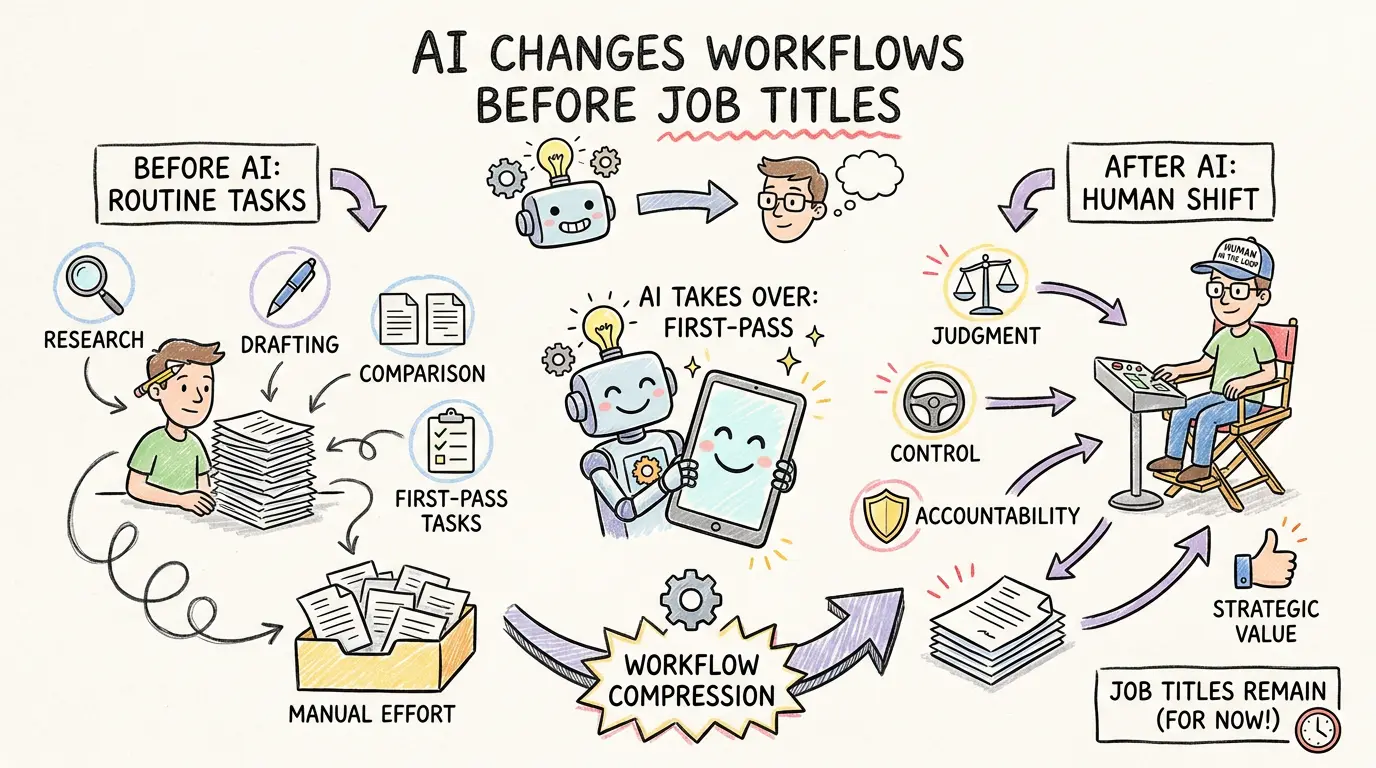
You can already see this in knowledge work. A role that once began with manual research, rough structuring, first-draft writing, option comparison, and repetitive formatting now often begins somewhere else. It begins with an AI-generated summary, a first-pass draft, a comparison table, a set of options, or a narrowed problem space. The person still does the work, but the sequence has shifted.
That may sound like a small operational detail, but it is not.
Once the sequence changes, the role changes from the inside.
AI Is Moving Into the Operating Flow
The strongest current signal is not that companies are talking about AI. It is that they are placing it directly inside day-to-day execution.
OpenAI's April 8, 2026 note on enterprise adoption, The next phase of enterprise AI, points directly at this transition. The emphasis is no longer on AI as a side experiment. The emphasis is on embedding agents into everyday work across teams and systems. That matters because it frames AI not as a standalone tool, but as part of the operating flow of the business.
Adobe's April 17, 2026 survey, Creatives say AI is helping them meet growing demand for content ??and improving their work, shows the same pattern from the creative side. Creative professionals reported using AI in more than 40% of their projects on average, and most said it improved both speed and quality. That is not best understood as evidence of immediate job elimination. It is evidence that AI has entered the workflow itself.
Microsoft has been pointing in the same direction through the idea of the Frontier Firm. In Microsoft Ignite 2025: Copilot and agents built to power the Frontier Firm, the emphasis is again not only on model capability, but on how agents and copilots become part of how organizations actually run.
Why The First Impact Is Easy to Misread
This is why the first impact of AI is often misunderstood.
People look for visible structural change, such as layoffs, title changes, or role consolidation. But long before any of that happens, the practical mechanics of the work may already be different. The human is still there. The title is still there. But the job no longer starts in the same place, and the expectations attached to the role begin to shift.
That shift usually follows a recognizable pattern.
The repetitive and first-pass parts of work get compressed first. Research. Summarization. Formatting. Basic drafting. Option generation. Routine comparison. Once those become cheaper, faster, and more available, human effort moves upward toward interpretation, selection, prioritization, quality control, and accountability.
So AI often does not replace the role in one move. It reallocates effort inside the role.
That is a much more useful way to understand what is happening now.
The Pressure Often Appears Before the Title Changes
This also explains why the first people under pressure are not always the people in the most obviously automatable jobs. Sometimes they are simply the people still using an older workflow while others around them have adopted a faster one.
In that situation, the title remains unchanged, but performance expectations move anyway.
That is the deeper point: organizations can keep the same roles while quietly changing what good performance inside those roles looks like.
An analyst may still be called an analyst, but now be expected to start from AI-assisted synthesis rather than raw manual aggregation. A content lead may still have the same title, but now be expected to review, redirect, and sharpen more than draft from zero. A designer may still own the same output, but now be evaluated partly on how effectively they steer AI-assisted variation rather than how long they spend building first-pass concepts by hand.
None of that requires a title change. But it absolutely changes the work.
The Better Question to Ask
So if we want to understand how AI changes work, the first question should probably not be, "Which job titles disappear?"
The better question is: "Which workflows are already being rewritten?"
That is usually where the real shift begins.