
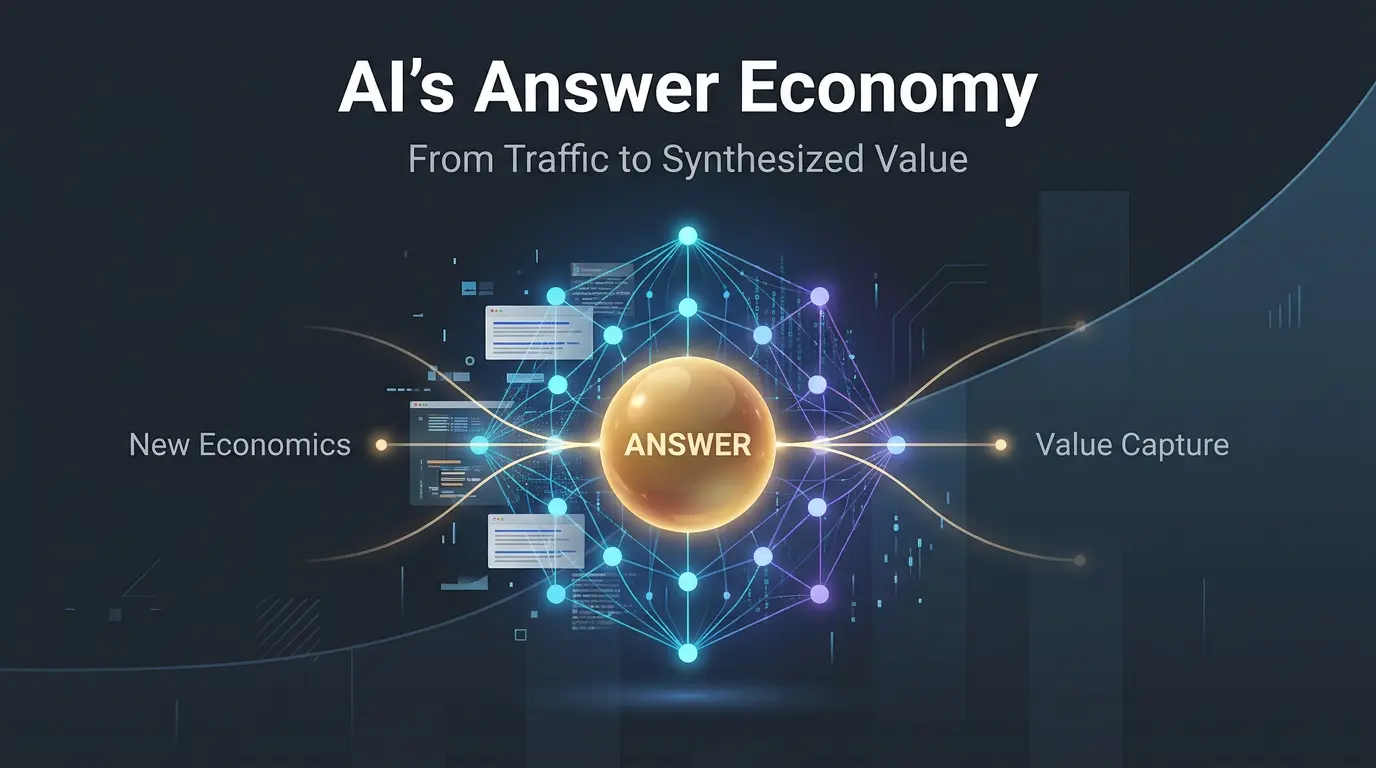
AI search engines are not just changing how people find information.
They are changing how value moves across the web.
Traditional search was mostly a traffic economy. Search engines crawled the web, ranked pages, showed links, and sent users outward. Publishers, brands, creators, forums, and documentation sites produced the information. Search engines organized it. Users clicked through. The website had a chance to earn the pageview, the ad impression, the subscription, the lead, the sale, or the brand relationship.
AI search changes that bargain.
The user asks a question. The AI system retrieves information, summarizes it, and generates an answer. The answer may include citations, but the user may not need to click. The website still bears the cost of producing the information, but the value may be captured inside the answer layer.
That is the beginning of the answer economy.
What is the answer economy?
The answer economy is the emerging system where value is created, distributed, and monetized through generated answers rather than through visits to source pages.
In the traffic economy, the key unit was the click.
In the answer economy, the key unit is the answer.
That answer may include:
- facts from public web pages;
- product details from brand sites;
- explanations from blogs and documentation;
- reviews from forums and communities;
- data from publishers and research organizations;
- comparisons from affiliate sites;
- source links that may or may not receive clicks.
The important shift is that the answer sits between the user and the web.
The user no longer has to open several pages to assemble the answer. The AI search engine does much of that work first.
That creates a new economic question:
If websites supply the information, but AI search engines deliver the answer, who receives the value?
Traditional search distributed traffic. AI search distributes answers.
Traditional search had problems, but its basic exchange was understandable.
Websites allowed crawlers to index their pages. Search engines displayed links and snippets. Users clicked. Website owners could monetize attention through ads, subscriptions, ecommerce, lead generation, community growth, or brand trust.
The exchange was imperfect, but it created a visible path:
content production -> search visibility -> click -> website value
AI search changes the path:
content production -> AI retrieval -> generated answer -> possible citation -> possible click
The word possible matters.
Google says AI Overviews and AI Mode can surface relevant links and may use query fan-out to issue multiple related searches across subtopics and data sources before generating a response (Google Search Central). That means links still exist in AI search experiences.
But the link is no longer the center of the experience.
The generated answer is.
This is why ai search engines create a different kind of visibility. A page may influence the answer without receiving a visit. A brand may be mentioned without being cited. A source may be cited but not clicked. A competitor may receive the citation even when your content helped shape the topic.
The answer becomes the economic surface.
The click is becoming optional.
The answer economy becomes visible in click data.
Pew Research Center analyzed 68,879 unique Google searches from 900 U.S. adults during March 2025. Of those searches, 12,593 produced an AI summary when Pew collected the results in April 2025. Pew found that users clicked a traditional search result in 8% of visits when an AI summary appeared, compared with 15% of visits when no AI summary appeared. Links inside the AI summary were clicked in only 1% of visits to pages with such a summary (Pew Research Center).
That data does not mean nobody clicks after AI search.
It means the answer can satisfy enough intent that the click becomes less automatic.
For users, this is convenient.
For websites, it is destabilizing.
If fewer users visit source pages, the old measurement system weakens. Ranking, impressions, and citation visibility may no longer map cleanly to sessions, revenue, or audience growth.
This is the central tension of the answer economy:
AI search engines need source material, but source owners may receive less downstream attention.
Who provides the information?
The answer economy depends on a broad supply chain of information.
Some information comes from official sources: documentation, government pages, standards, product pages, company sites, academic institutions, and public databases.
Some comes from publishers: newsrooms, trade publications, review sites, tutorials, explainers, newsletters, and research organizations.
Some comes from communities: forums, Q&A sites, social platforms, user reviews, developer discussions, and niche blogs.
Some comes from commercial pages: pricing pages, comparison pages, feature pages, ecommerce listings, and marketplace profiles.
AI search engines can make this supply chain feel invisible because the final output is a single answer.
But the answer is not free.
Someone paid to create the underlying material:
- journalists reported stories;
- experts wrote guides;
- developers maintained documentation;
- users contributed forum posts;
- researchers collected data;
- brands updated product pages;
- creators built tutorials;
- editors reviewed and improved content.
When AI search compresses that work into an answer, the cost does not disappear.
It is simply separated from the click.
Who gets the click?
In the traffic economy, the click usually went to one of the ranked pages.
In the answer economy, the click may go to:
- no one, because the answer is enough;
- the AI product, because the user asks a follow-up;
- one cited source;
- a large authority site;
- a marketplace or aggregator;
- the brand's own page;
- a third-party page about the brand;
- a commercial result or ad surface.
This makes citation context more important than ranking alone.
If an AI search answer cites your official page, you may gain trust even if the click rate is low.
If it cites a third-party comparison page instead, the user may learn about your brand through someone else's framing.
If it mentions your brand without a link, you may receive awareness but not measurable traffic.
If it answers the user's question without citing you at all, your content may have influenced the category while your brand receives no visible credit.
AIvsRank's AI search visibility checker is useful because this is no longer a simple ranking question. The practical question is whether ai search engines mention the brand, cite the right URL, and represent the source in a useful context.
Who pays for content production?
The answer economy becomes fragile if the people producing information cannot capture value from it.
Publishers have the clearest problem. They invest in reporting, editing, photography, investigations, audience development, and archives. If AI answers summarize the article while reducing visits, the publisher can lose ads, subscriptions, newsletter signups, and reader relationships.
But publishers are not the only affected group.
Software companies maintain documentation that helps users solve problems. Review sites test products. Communities answer questions. Independent experts publish tutorials. Researchers release datasets. Brands maintain product facts that AI systems use to answer commercial queries.
If those sources are used but not visited, the incentive structure changes.
The web has always depended on a rough bargain:
make useful information public, and discovery can send value back.
AI search makes the return path less certain.
That is why crawler policy, licensing, and attribution are becoming part of SEO strategy rather than legal side issues.
OpenAI's crawler documentation shows one version of this split. OAI-SearchBot is used to surface websites in ChatGPT search features, while GPTBot is associated with crawling content that may be used for training OpenAI's generative AI foundation models. OpenAI says site owners can allow OAI-SearchBot for search visibility while disallowing GPTBot to indicate that content should not be used for training (OpenAI).
That distinction matters because search visibility and model training are different economic acts.
One may create answer visibility.
The other may create model value without a direct referral path.
Who profits from the answer?
The answer economy has several possible profit centers.
AI platforms can profit by keeping users inside their interface, selling subscriptions, improving engagement, adding ads, powering commerce flows, or increasing product dependence.
Search engines can profit by making search more useful, defending query share, expanding ad formats, and controlling more of the user journey.
Brands can profit if AI answers recommend them, cite their pages, or move users closer to purchase.
Publishers can profit only if the answer layer produces enough citations, traffic, licensing revenue, subscriptions, or brand value to compensate for the loss of direct visits.
Users profit through speed and convenience.
But not every participant profits equally.
The key question is whether the answer economy becomes a fair exchange or an extraction layer.
If AI systems depend on public content but weaken the business models that produce that content, the web may become thinner, more closed, or more licensing-driven.
Licensing is the market trying to catch up.
Licensing proposals are emerging because the old crawl-for-traffic bargain no longer covers every use case.
Cloudflare's Pay Per Crawl product is one example. Cloudflare describes it as a way for site owners to require payment from AI crawlers when they access content, allowing owners to control and monetize how AI systems use their content (Cloudflare).
RSL, or Really Simple Licensing, takes a broader standards approach. The RSL 1.0 specification defines a machine-readable framework for usage, licensing, payment, and legal terms for digital assets, with discovery through mechanisms such as robots.txt, HTTP headers, RSS, and HTML link elements. It includes examples for prohibiting AI use, requiring custom licenses, pay-per-crawl, and attribution-only licensing (RSL).
These systems are still developing.
They will not instantly solve attribution, enforcement, or business model problems.
But they reveal the direction of travel.
The web is moving from a world where crawling mostly implied indexing and traffic, toward a world where crawling can mean training, grounding, summarization, answer generation, commercial recommendations, or agentic workflows.
Each use may need a different value exchange.
Brands should think beyond traffic.
For brands, the answer economy is not only a threat.
It is also a new visibility surface.
If users ask ai search engines for category recommendations, vendor comparisons, implementation advice, product alternatives, or troubleshooting steps, the answer may shape demand before the user ever visits a website.
That means brands need to track more than rankings.
They need to know:
- whether they appear in AI answers;
- whether they are cited or only mentioned;
- which pages are cited;
- whether competitors are cited more often;
- whether the answer context is positive, neutral, or negative;
- whether the AI answer uses official information or third-party summaries;
- whether visibility converts into branded search, direct traffic, trials, demos, or revenue.
AIvsRank's leaderboard helps frame answer visibility at the category level. The free tools hub is useful for one-off checks. For teams that need repeatable monitoring, AIvsRank features, AIvsRank Docs, and geoskills support recurring prompt, entity, and citation workflows.
In the answer economy, the question is not only "Did we get traffic?"
It is also "Did we shape the answer?"
Publishers need a different scorecard.
Publishers have to be especially careful because pageviews are not just vanity metrics. They support advertising, subscriptions, reader relationships, editorial investment, and public accountability.
If AI search reduces clicks, a publisher may need to measure value in more layers:
- direct referral traffic from AI search;
- citation frequency;
- citation quality;
- licensing revenue;
- branded search lift;
- newsletter signups after AI exposure;
- source attribution inside answers;
- whether original reporting is cited or replaced by summaries.
The answer economy does not eliminate the need for SEO.
It expands it.
Classic SEO asks whether the page can rank and earn clicks.
AI visibility asks whether the work becomes part of the answer, whether the source is credited, whether the context is accurate, and whether any value returns to the producer.
What content still earns value?
Not every type of content suffers equally.
Content that merely restates common information is easy to absorb into an AI answer.
Content that creates new value is harder to replace.
Websites have a stronger position when they offer:
- original data;
- primary reporting;
- interactive tools;
- calculators;
- templates;
- product workflows;
- expert interpretation;
- current documentation;
- community depth;
- direct transactions;
- unique visuals, examples, or benchmarks.
AI can summarize these assets, but it often cannot fully substitute for using them.
This is why AIvsRank's guide on how to optimize for AI search engines emphasizes retrievability, extractability, credibility, and measurement. The goal is not only to be readable by AI systems. It is to create source value that remains useful after the summary.
The Google-focused guide on AI optimization for website owners makes the same practical point: AI search optimization is not magic. It is clearer technical SEO, better content quality, structured data discipline, internal linking, and accessible source material.
The answer economy needs measurement.
The answer economy will be difficult to manage because much of it happens outside the website.
A page can influence an answer without a click.
A source can be cited without measurable referral traffic.
A brand can be recommended without a trackable session.
A competitor can become the default answer before the buyer ever reaches a comparison page.
This is why answer visibility needs its own measurement layer.
Teams should track:
- prompt coverage;
- AI mentions;
- cited URLs;
- citation context;
- competitor presence;
- answer accuracy;
- source diversity;
- changes after content updates;
- relationship between AI visibility and branded demand.
Search rankings still matter.
But rankings measure where a page sits in a list.
The answer economy measures whether the page becomes part of the answer, whether it receives credit, and whether that credit creates value.
The real question is value exchange.
AI search engines make information easier to consume.
That is valuable.
But if the answer layer captures too much value while the source layer bears too much cost, the open web has a problem.
The future of search will depend on whether the answer economy can produce a workable exchange:
- users get faster answers;
- AI platforms get useful products;
- websites get visibility, attribution, traffic, licensing, or revenue;
- publishers and creators keep enough incentive to produce original work;
- brands can monitor and correct how they are represented.
The answer economy is not automatically good or bad.
It is a redistribution of attention, credit, and money.
The winners will be the organizations that understand that redistribution early.
They will not only ask how to rank in ai search engines.
They will ask how answers are built, which sources are credited, which clicks still happen, and where value returns.
FAQ: AI Search Engines and the Answer Economy
What is the answer economy?
The answer economy is the emerging system where value is created and captured through AI-generated answers rather than only through clicks to source pages. It describes how information, citations, traffic, licensing, and revenue are redistributed when AI search engines answer questions directly.
Why do ai search engines create an answer economy?
AI search engines create an answer economy because they sit between the user and the web. Instead of only ranking pages, they retrieve information, synthesize it, and present an answer. That makes the answer itself the main user experience, while the click becomes optional.
How is the answer economy different from traditional SEO?
Traditional SEO focuses on rankings, snippets, and clicks. The answer economy adds new questions: whether a source is cited, whether the brand is represented accurately, whether the user still clicks, and whether the content producer receives any value from the answer.
Do AI answers reduce website traffic?
They can. Pew Research Center found that Google users clicked traditional search results less often when an AI summary appeared. In its dataset, users clicked a traditional result in 8% of visits with an AI summary, compared with 15% without one.
Who pays for content in the answer economy?
Content is still paid for by publishers, brands, communities, researchers, creators, and users who contribute information. The problem is that AI systems may use that information to generate answers without sending proportional traffic or revenue back to the source.
Can citations replace clicks?
No. Citations can provide visibility and trust, but they do not fully replace traffic, subscriptions, ads, leads, or customer relationships. A citation is useful only if it produces some form of value: trust, demand, traffic, conversion, licensing, or brand authority.
What should websites do in the answer economy?
Websites should make important content crawlable, clear, current, and easy to cite; monitor AI mentions and citations; protect content that needs licensing or authentication; create original assets that AI cannot fully replace; and measure AI visibility alongside classic SEO performance.