
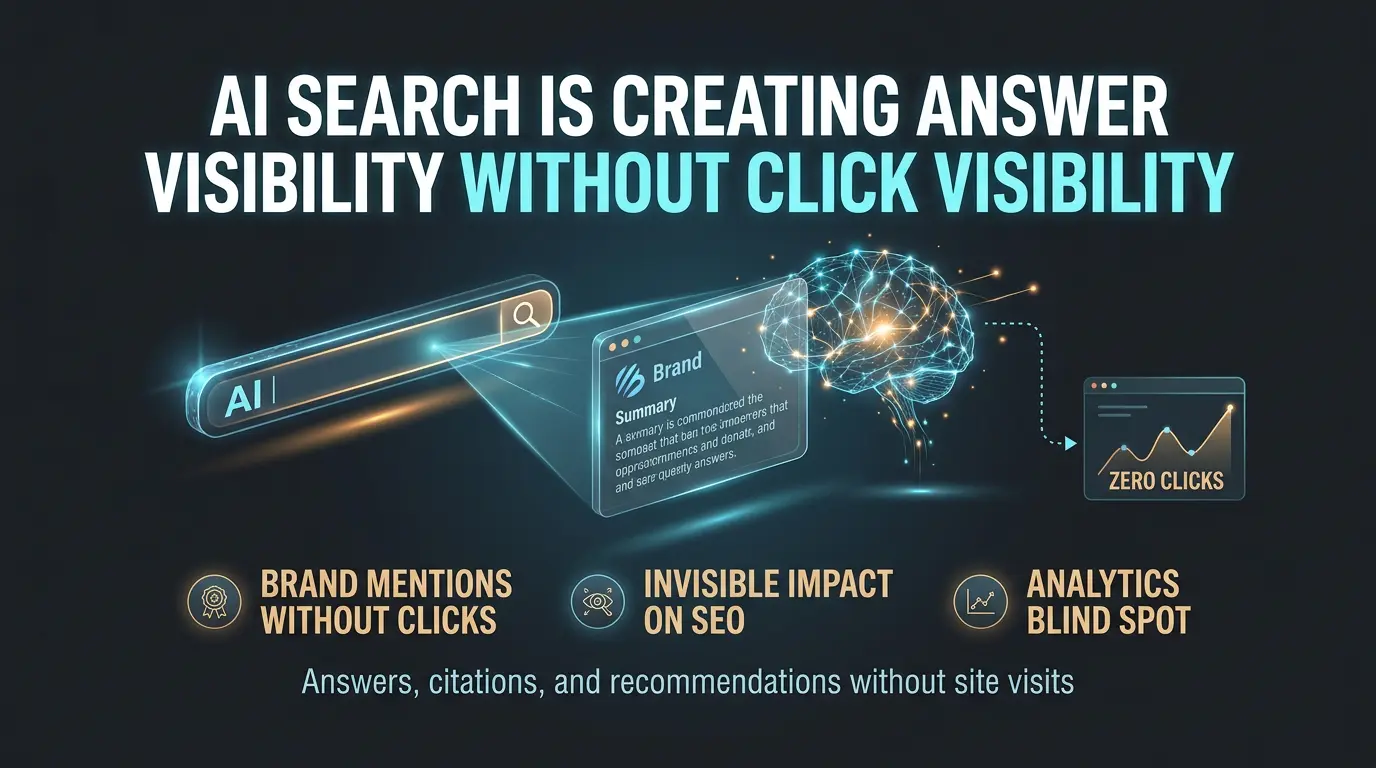
AI search can recommend your brand without sending you a click.
Imagine a user asking an AI search engine:
"best AI coding agents for enterprise teams"
The answer lists five products, explains pros and cons, compares use cases, mentions price ranges, and cites sources. The user reads the answer, clicks no official website, and still forms a purchasing shortlist.
That is not "no exposure."
It is exposure that never turned into a click.
Traditional Google Analytics cannot see that influence, and Search Console may not fully explain it either. The brand impact happened inside the answer, not after the click.
In AI search engines, visibility can happen inside the answer.
That creates a new measurement problem for brand and growth teams:
answer visibility without click visibility.
What Happens When Users See Your Brand But Never Click
Start by separating two concepts.
Answer visibility means a brand, product, page, or point of view is mentioned, cited, summarized, recommended, or compared inside an AI answer.
Click visibility means a user clicks an official website, documentation page, blog post, or product page and leaves a visit in traditional analytics.
In traditional search, these two forms of visibility were tightly connected. A user saw a blue link on the search results page, then decided whether to click. Ranking, impressions, clicks, and traffic formed a relatively clear SEO measurement loop.
AI search engines are separating those two things.
An AI answer can explain, filter, and recommend before the user ever visits your site. The user may already understand what your brand is, who it is compared with, what scenario it fits, and whether it belongs on the shortlist, without opening your website.
The old metrics still matter, but they are no longer complete.
| Traditional search | AI search engines |
|---|---|
| Ranking appears as blue links | Ranking may be embedded inside answer paragraphs |
| Clicks are the main behavior | Reading the answer may be the main behavior |
| Traffic is trackable | Influence may happen off-site |
| SEO looks at CTR | GEO looks at mention, citation, and answer position |
| The website is the first touchpoint | The AI answer may be the first touchpoint |
For brands, the biggest risk is not simply that no one clicks.
The quieter risk is that AI describes you incorrectly, or does not mention you at all, without your team seeing it in analytics.
Google Is Already Redesigning Links Inside AI Answers
On May 6, 2026, Google announced updates to AI Mode and AI Overviews. The core direction is to make websites, original content, public discussion, and source links more visible inside AI search experiences.
These updates include recommended links for deeper reading at the end of AI responses, feed-style highlights for news articles, previews of public discussion and social perspectives, inline links beside answer text, and desktop hover previews with site information.
Google is not simply restoring the old blue-link experience. It is redesigning how links appear inside answers.
That means answer visibility without click visibility is not only a theoretical issue. Google is also working through a practical challenge: when more user understanding happens inside AI answers, how should websites, sources, and original content become visible within the answer itself?
For brands, the competitive surface changes.
You are not only competing for search-result ranking. You are also competing for:
- whether you are mentioned in the AI answer
- whether you are cited by the AI answer
- whether you appear in the right context
- whether you appear beside the right competitors
- whether the answer gives users enough context to trust you
This is the middle layer AIvsRank GEO is designed to measure.
Whether a brand is mentioned, where it appears, whether the description is accurate, whether citations are usable, and whether it is placed in the right competitive context are all closer to real influence in the AI search era than clicks alone.
Google Also Acknowledges That Some Quick Questions Can Be Satisfied By The Initial Answer
In August 2025, Google published an article responding to the effect of AI in Search on website traffic.
Google's position is that overall organic clicks are relatively stable, average click quality has improved, and AI responses create more links and support more complex questions.
The same article also acknowledges that for some quick-answer questions, users may be satisfied by the initial answer and may not click. Google's example is a question like "when is the next full moon?"
That matters because even under Google's optimistic framing, clicks are no longer a complete measurement standard.
An AI answer may first give users the lay of the land. A click may happen only when the user wants to research further, explore more deeply, or make a purchase.
For brands, the real question becomes:
Has AI already shaped the user's judgment correctly, even when it did not generate a click?
A traditional SEO dashboard cannot fully answer that question.
It requires a new measurement layer: mention rate, average rank, core-function recognition, product-layer match, competitive context, and citation usability inside AI answers.
Citations Are Becoming A Visibility Layer Of Their Own
On May 5, 2026, Google updated Gemini API File Search with multimodal RAG, custom metadata filtering, and page-level citations.
This suggests citations are becoming a product capability, not just a reference layer after the answer.
In the future, users may not click a full web page, but they may see that a page, PDF, or document snippet was used as evidence inside an AI answer.
If AI search answers increasingly depend on citations, being citeable becomes a form of visibility.
Pages do not only need to rank. They need to be extractable, attributable, and verifiable.
For brand content, that changes the optimization target.
We used to ask:
Can this page rank?
Now we also need to ask:
- Can this page be extracted correctly by AI?
- Does it have clear definitions and structured paragraphs?
- Are the facts and product descriptions verifiable?
- Can AI place this content into the correct category?
- After citation, will the user understand the brand more accurately?
This maps directly to the citability view inside AIvsRank GEO.
GEO is not only about whether a brand is mentioned. It also asks whether brand pages are easy for AI systems to cite, extract, verify, and use to form accurate product understanding inside answers.
AI Search Is Moving From Answer Engine To Work Engine
Perplexity's Computer update from May 4, 2026 points in the same direction.
Computer does not only return search answers. It works inside environments such as Teams, Snowflake, Databricks, Workflows, and Spaces Skills to perform research, analysis, reporting, website audits, sales preparation, and data queries.
This widens the click-visibility gap.
A user may not be looking for web pages inside AI search. They may ask an agent to produce a report, spreadsheet, audit result, sales-preparation brief, or publishable page.
Inside those work outputs, brands, competitors, data sources, and citations may already influence the final decision, even if the user never visits the official website.
AI search engines are not only answer engines. They are also becoming work engines.
Brand exposure may happen inside reports, spreadsheets, workflows, Teams conversations, and data-analysis outputs, not inside a website session.
This means GEO has to move from asking:
Did AI visit my website?
To asking:
Did AI use my brand correctly inside answers and work outputs?
Source Tracking Is Becoming Infrastructure
Perplexity's Search API and Sonar documentation point to a similar trend.
Perplexity's Search API exposes structured search result fields such as title, URL, and date. Sonar filters expose controls such as domain filters, date filters, academic filters, and SEC filings filters.
This means answer sourcing is not only a UI element. It is also becoming an API-level data structure.
For GEO tools, this is important.
Future monitoring will not stop at page rank. It will move toward answer provenance:
- which sources enter the search context
- which pages the model uses as evidence
- which brands appear in the final answer
- which sources are cited without generating clicks
- which brands are mentioned but described incorrectly
AIvsRank GEO can combine source presence and brand presence.
In other words, it can look at whether a page is used by AI search and whether the brand is expressed correctly in the final answer.
Why Traditional SEO Dashboards Miss AI Answer Influence
Traditional SEO dashboards are still valuable.
But in AI search, they miss several new influence paths.
| Scenario | What traditional data sees | What actually happens |
|---|---|---|
| AI answer directly summarizes the brand | No click | The user already knows who you are |
| AI answer recommends a competitor list | No session | You may enter or miss the shortlist |
| AI answer cites your page | Low CTR | The content is used as evidence |
| AI agent generates a report | No official-site visit | Brand influence happens inside the workflow |
| AI answer misclassifies the brand | Traffic looks normal | Brand understanding is quietly distorted |
That is why brands cannot only ask:
How much traffic did AI search send me?
They also need to ask:
Does AI search understand, mention, rank, cite, compare, and describe my brand correctly?
How AIvsRank GEO Measures Answer Visibility
AIvsRank GEO focuses on the answer layer that traditional click data cannot see.
It breaks brand performance inside AI answers into dimensions that can be monitored over time.
This measures how a brand appears in AI answers. It does not replace conversion tracking, and it should not be read as a complete attribution model.
| AIvsRank GEO metric | What it answers |
|---|---|
| Mention rate | How often the brand is mentioned across a set of AI searches |
| Average rank | Where the brand usually appears when it is mentioned |
| Core-function recognition | Whether AI understands what the product actually does |
| Capability clarity | Whether AI can explain product capabilities instead of describing them vaguely |
| Product-layer match | Whether AI places the brand in the correct category |
| Recognition stability | Whether answers stay consistent across repeated queries and multiple models |
| Competitive-context readability | Whether AI compares the brand with the right competitors |
| Citation usability | Whether brand pages are easy for AI to cite, extract, and verify |
Traditional SEO focuses on rank to click.
AIvsRank GEO focuses on prompt to answer to brand perception.
For customers, these metrics do not replace SEO. They fill in the layer that an SEO dashboard cannot see: brand visibility, recommendation position, product understanding, and competitive context inside AI answers.
A Practical GEO Dashboard For The AI Search Era
Companies can extend an SEO dashboard into a GEO dashboard.
| Old metric | Added GEO metric |
|---|---|
| Organic traffic | AI answer mention rate |
| CTR | Answer inclusion rate |
| Average position | Average answer rank |
| Backlinks | Citation and source presence |
| Keyword ranking | Prompt-level visibility |
| Branded search volume | Brand recognition stability |
| Competitor traffic gap | Competitor answer share |
Such a dashboard can monitor several recurring questions.
Whether the brand is recommended:
What are the best tools for AI product ranking?
Whether the brand is classified correctly:
Is [brand] a GEO platform, SEO tool, or AI ranking platform?
Whether competitors are mentioned first:
Compare [brand] with alternatives for AI search visibility tracking.
Whether the official website is cited:
Which sources explain [brand]'s product features best?
Whether AI misunderstands the product:
What does [brand] do, and who is it for?
The value of these questions is that they do not only ask whether there was a click. They ask whether the AI answer is correctly shaping user judgment.
Conclusion: Clicks Still Matter, But They No Longer Tell The Full Story
AI search engines will not make websites disappear.
But they will change the role of websites.
Websites will move from being the required user entry point to being citeable, verifiable, and explainable sources of truth for AI systems.
Clicks still matter. Traffic still matters. Search Console and analytics still matter.
But they are no longer complete evidence.
If your brand is visible in the answer but invisible in analytics, you do not have a traffic problem first. You have a measurement problem.
AIvsRank's value is not to replace the SEO dashboard. It is to add the layer the SEO dashboard cannot see:
brand visibility, recommendation position, product understanding, citation usability, and competitive context inside AI answers.
The new SEO problem is not only losing clicks.
It is being seen, summarized, and judged without knowing it happened.
Sources:
- Google: 5 new ways to explore the web with generative AI in Search
- Google: AI in Search is driving more queries and higher quality clicks
- Google: Gemini API File Search is now multimodal
- Perplexity: Improved Computer Models and Enterprise Updates
- Perplexity Docs: Search API
- Perplexity Docs: Search Filters
- Perplexity Docs: Changelog