
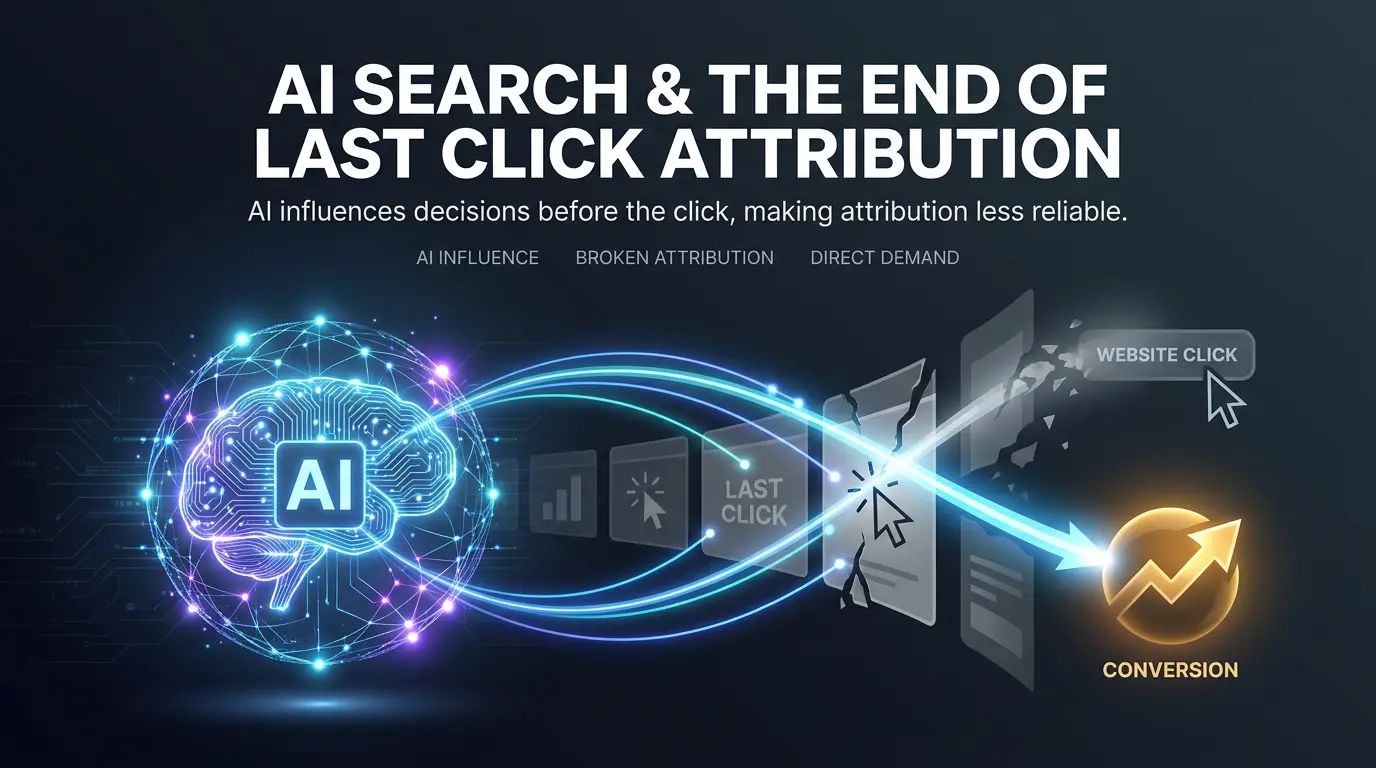
Last click attribution assumes the final click deserves the credit.
AI search makes that assumption weaker.
When a user asks an AI engine for options, compares vendors, reads a generated summary, and later converts through branded search or direct traffic, the final click may hide the real influence. The AI answer may have created the shortlist, shaped trust, and introduced the brand before any visit appeared in analytics.
That is why AI search and last click attribution are on a collision course.
AI search creates influence without a visit
AI answers can answer the user's question before the user clicks.
In Pew's analysis of Google AI summaries, users clicked traditional results less often when an AI summary appeared. That matters for attribution because a channel can influence a decision without receiving the final click.
Google's AI features documentation also explains that AI Overviews and AI Mode can synthesize across sources and supporting links. The answer can become the research experience.
For attribution, this creates a blind spot:
- AI search creates awareness;
- the user does not click;
- the user later searches the brand;
- analytics credits branded search, direct, or another final channel.
The first influence disappears.
Last click was built for a different journey
Last click works best when the journey is visible and linear.
AI search makes the journey less visible and less linear.
A user might ask:
- "What are the best CRM tools for a startup?"
- "Compare HubSpot alternatives for a small sales team."
- "Which CRM is easiest to migrate to?"
- "What are the risks of using a cheap CRM?"
After that, the user may visit a review site, search a brand, ask a colleague, or type the URL directly. Last click captures the final motion, not the judgment already formed.
What to measure instead
Last click should not be deleted overnight, but it should be joined by answer-layer metrics.
Useful metrics include:
| Metric | What it captures |
|---|---|
| Answer share | How often the brand appears in AI answers |
| Recommendation share | How often the brand is recommended |
| Citation share | How often the brand's domain is cited |
| Prompt coverage | Which buyer questions include the brand |
| Competitor answer share | Which competitors appear instead |
| Branded search lift | Whether AI visibility correlates with later brand demand |
| Direct traffic changes | Whether no-click discovery may be turning into later direct visits |
AIvsRank's AI search monitoring features fit this measurement gap because they preserve answer evidence: mentions, citations, answer positions, competitor visibility, engines, and snapshots. The public AI leaderboard can also help teams think in category benchmarks rather than only channel clicks.
Measure pre-click AI influence
The CTA for this topic is: measure pre-click AI influence.
Start with the prompts most likely to create demand:
- category discovery prompts;
- competitor comparison prompts;
- alternatives prompts;
- pricing prompts;
- risk and trust prompts;
- "best for" prompts.
Then compare AI visibility with downstream signals:
- branded search;
- direct visits;
- demo requests;
- review-site traffic;
- sales conversations;
- self-reported attribution;
- pipeline by segment.
The goal is not to prove that every conversion came from AI search. The goal is to stop pretending the final click tells the whole story.
FAQ: AI Search and Last Click Attribution
How can B2B SaaS teams measure AI search influence without clicks?
Track answer share, recommendation share, citation share, prompt coverage, branded search, direct visits, demo requests, and self-reported attribution. Look for patterns across prompt groups rather than one-to-one click paths.
What AI visibility metrics should replace last click for CRM tools?
CRM teams should track visibility across startup, enterprise, migration, automation, and competitor alternative prompts. Useful metrics include answer share, competitor answer share, citation share, and branded search lift.
How should agencies report AI search attribution to clients?
Agencies should separate traffic from influence. A good report shows AI answer visibility, competitor mentions, citations, prompt gaps, and downstream changes in branded search, direct traffic, and leads.
Can AI search create demand without referral traffic?
Yes. A user can discover, compare, and shortlist brands inside an AI answer, then convert later through branded search, direct traffic, a sales call, or another channel.
What is the connection between zero-click search and dark funnel attribution?
Zero-click search hides the visit. Dark funnel attribution hides the influence path. AI answers can create both: the user is influenced, but the analytics system sees only a later channel.