
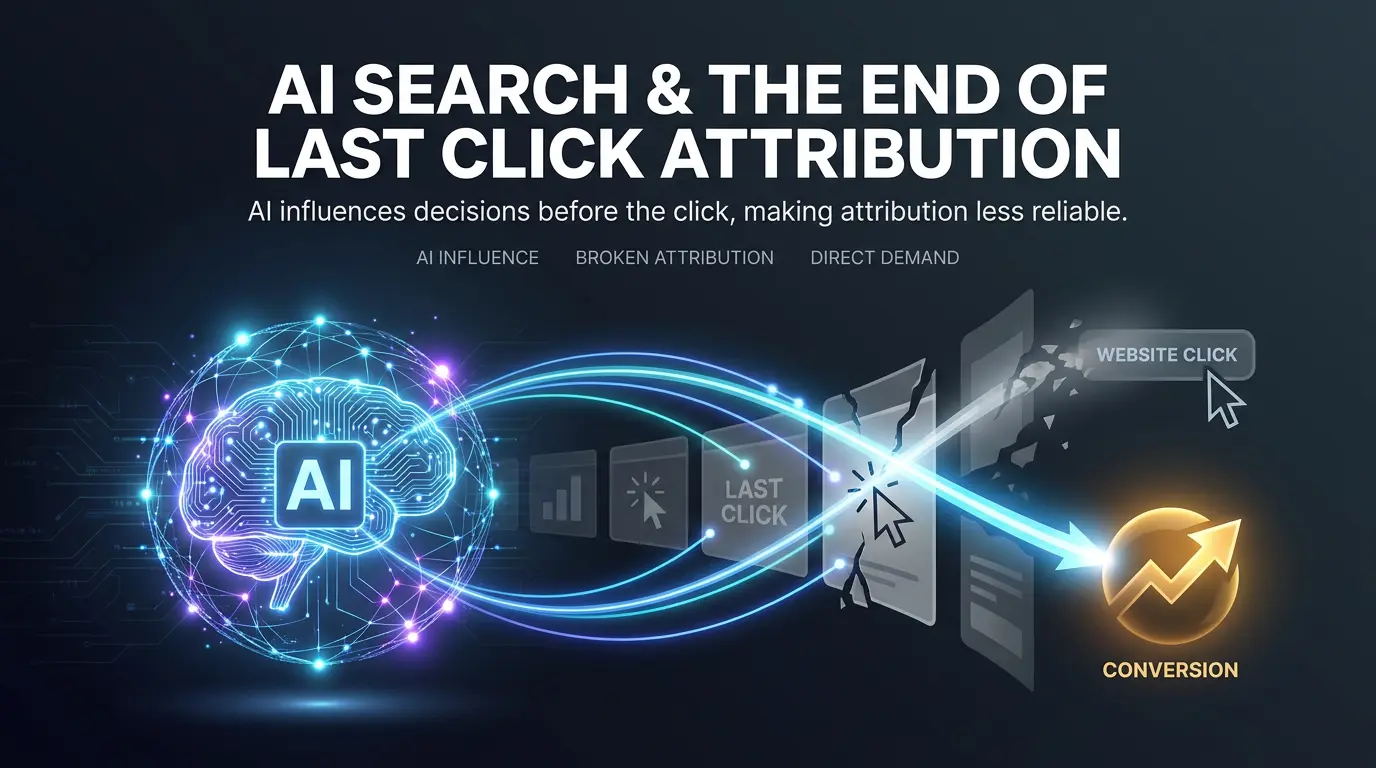
Last click attribution was built for a simpler web.
A user searched, clicked an ad or organic result, landed on a website, and converted. The analytics system gave credit to the final click because the final click was visible, trackable, and close to the conversion.
AI searches break that assumption.
The user may ask ChatGPT, Perplexity, Gemini, or another AI search engine for recommendations. They may read a generated answer, compare vendors, absorb a brand impression, and narrow their shortlist without clicking any source. Days later, they may type the brand name into Google, visit the site directly, or click a retargeting ad.
The dashboard says:
direct
branded search
paid search
organic search
But the decision may have started inside an AI answer that left no clean click trail.
That is why AI search may be the end of last click attribution as a serious explanation of marketing influence.
Last click attribution assumes the last visible action matters most.
Last click attribution is not complicated.
It gives conversion credit to the last tracked touchpoint before the conversion.
Google Analytics describes attribution as the process of assigning credit to touchpoints along a user's path to completing important actions. In Google Analytics, the paid and organic last click model gives all credit to the last channel the customer clicked through before converting, while direct visits are ignored unless the whole path is direct (Google Analytics Help).
That model can be useful for operations.
It tells teams what closed the session.
But it was always a narrow view of influence. It worked best when the visible click path captured enough of the buyer journey to be a useful proxy.
AI searches make that proxy weaker.
The final click may still be real.
It just may not be where the decision was formed.
AI searches move influence before the click.
AI search changes the research journey from link navigation to answer consumption.
A user can ask:
- best project management tools for agencies;
- alternatives to HubSpot for small teams;
- which CRM is better for real estate agents;
- what should I know before buying cybersecurity insurance;
- compare Shopify, WooCommerce, and Webflow for a small store.
The AI answer may summarize the category, name vendors, explain trade-offs, cite sources, recommend a short list, and answer follow-up questions.
The user may not click.
But the user may still be influenced.
That influence can later appear as:
- direct traffic;
- branded search;
- a demo request;
- a sales email;
- a review-site visit;
- a marketplace search;
- a paid search click;
- a returning visitor conversion.
Last click attribution sees the last trackable step.
AI search influence may happen before that step, inside an answer layer that never generated a referral.
Zero-click search is now an attribution problem.
Zero-click search used to be discussed mostly as a traffic problem.
If the user gets the answer on the search results page, websites receive fewer visits.
That is still true.
But in the AI era, zero-click search is also an attribution problem.
Pew Research Center found that Google users clicked a traditional search result in 8% of visits when an AI summary appeared, compared with 15% when no AI summary appeared. Links inside AI summaries were clicked in only 1% of visits to pages with such a summary (Pew Research Center).
SparkToro and Datos estimated in their 2024 zero-click search study that for every 1,000 Google searches in the United States, only 360 clicks went to the open web. In the European Union, the estimate was 374 open-web clicks per 1,000 searches (SparkToro).
These are not the same study, but they point in the same direction.
A lot of search behavior does not create an external click.
AI searches make the issue deeper because the user may receive not only a fact, but a recommendation, comparison, or buying frame.
The missing click does not mean missing influence.
It means missing attribution.
The dark funnel now includes AI answers.
Marketers already had a name for invisible influence: the dark funnel.
6sense defines the dark funnel as buyer intent information and activity that revenue teams historically cannot access through normal tracking systems (6sense).
Traditionally, the dark funnel included private Slack messages, podcast mentions, word of mouth, analyst conversations, community discussions, social posts, review sites, and offline events.
AI searches now belong in that category.
A buyer may ask:
Which tools should I shortlist?
What do people dislike about this vendor?
Which platform is easiest to implement?
What is the safest choice for a mid-market team?
The AI answer may shape the shortlist before the buyer ever appears in analytics.
When that buyer later converts through branded search, last click will credit the branded search.
But branded search may be the symptom, not the source.
AI search can create demand that looks like demand capture.
AI search engines can influence without referral traffic.
Traditional attribution systems depend heavily on detectable events:
- a click;
- a referrer;
- a UTM parameter;
- an ad impression;
- a cookie;
- a form fill;
- a session;
- a campaign touch.
AI search engines can influence users without producing many of those events.
The user may read an answer, remember a brand, close the app, and return later through another path.
The answer may cite a third-party review instead of the brand's own site.
The answer may mention the brand without a clickable source.
The answer may shape the user's language, causing them to search a branded or category phrase later.
The answer may eliminate competitors from consideration before a site visit ever happens.
An arXiv paper titled "The Attribution Crisis in LLM Search Results" analyzed roughly 14,000 real-world LMArena conversation logs with search-enabled LLM systems. The paper reported patterns such as responses generated without explicit online fetching, answers without clickable citations, and cases where systems visited many relevant pages but cited only a few (arXiv).
That is not marketing attribution in the dashboard sense.
But it describes the same structural problem.
AI systems can use, summarize, or shape information in ways that do not map cleanly to clicks, citations, or referrals.
Branded search may become a lagging indicator of AI influence.
If AI searches affect discovery, one of the most important downstream signals may be branded search.
A user asks an AI search engine for the best options in a category. The answer names a brand. The user later searches that brand on Google.
Analytics credits branded organic search.
But the brand search may not be the first moment of demand.
It may be the moment the buyer tried to verify a recommendation that was formed elsewhere.
This matters because branded search has often been treated as bottom-funnel demand capture. In the AI era, branded search may increasingly reflect upstream answer exposure.
That does not make branded search less valuable.
It makes it less explanatory.
If branded search rises after a brand starts appearing more often in AI answers, last click attribution may still credit branded search, but the causal story has changed.
The real source of influence may be AI visibility.
Direct traffic may become even darker.
Direct traffic has always been messy.
Some direct visits are true direct visits. A user typed the URL or used a bookmark.
Some are not. Dark social, broken referrers, privacy settings, mobile apps, email clients, PDFs, and untagged links can all collapse into direct traffic.
AI searches add another reason direct traffic can be misleading.
A user may discover a brand in an AI answer, remember it, and type the domain later. The analytics system sees direct. The marketer sees brand strength. But the unseen influence was the answer.
This creates a dangerous budgeting error.
If teams take last click at face value, they may overcredit direct and branded search while underinvesting in the content, citations, and visibility that made those visits happen.
The channel that closes the visit is not always the channel that created the belief.
The decision is moving into the conversation.
AI searches do not only answer one query.
They can host a decision process.
A buyer can ask follow-up questions:
- Which option is cheaper?
- Which one is better for a small team?
- What are the drawbacks?
- Which one integrates with Salesforce?
- Which one has better reviews?
- What should I ask on a demo call?
- Which one would you choose for my use case?
By the time the user clicks, the evaluation may already be mostly complete.
This is the core attribution shift.
Attribution used to ask:
Who brought the last click?
AI search forces a better question:
Who influenced the judgment?
That judgment may be shaped by citations, summaries, competitor comparisons, product facts, review snippets, forum opinions, and the AI system's own framing.
The click is only the visible end of a longer invisible conversation.
Last click will undercount AI visibility.
AI visibility can create value in ways last click cannot see.
It can:
- introduce a brand into a shortlist;
- reinforce a buyer's existing preference;
- explain a category in language the brand later benefits from;
- make a competitor look risky;
- cite the brand as a trusted source;
- summarize product strengths;
- answer objections before a sales conversation;
- cause a user to search the brand later.
None of these necessarily produces a referral.
That is why AIvsRank's AI search visibility checker is useful for a first pass. It helps answer whether AI systems mention the brand, cite it, ignore it, or frame it in a useful context. The leaderboard helps compare category-level visibility, while AIvsRank features, Docs, and geoskills are better suited for recurring prompt sets, entity tracking, and citation workflows.
This is not a replacement for analytics.
It is the missing layer above analytics.
What marketers should measure instead.
The answer is not to delete attribution.
The answer is to stop treating last click as the full truth.
For AI searches, marketers need a blended measurement model.
Track AI visibility.
Measure whether the brand appears in AI answers for important prompts.
Track:
- brand mentions;
- cited URLs;
- citation context;
- competitor mentions;
- recommendation position;
- answer sentiment;
- prompt variants;
- changes over time.
This shows whether AI search engines are shaping the category in ways that include or exclude the brand.
Track branded demand.
Watch branded search volume, direct traffic quality, branded paid search, demo requests, pricing-page visits, and sales conversations.
If AI visibility rises before branded demand rises, that is not proof by itself.
But it is a signal worth investigating.
Ask buyers directly.
Self-reported attribution is imperfect, but it often captures influences that analytics cannot.
Ask:
How did you first hear about us?
What sources did you use to evaluate us?
Did you ask ChatGPT, Perplexity, Gemini, or another AI tool about this category?
Which brands did AI tools recommend?
The answers will not be perfectly clean.
Neither is last click.
Compare exposed and unexposed prompts.
Track prompts where the brand appears and prompts where it does not.
Look for differences in branded search, direct traffic, pipeline quality, conversion rates, sales language, and demo questions.
This turns AI visibility from a vanity metric into a hypothesis about demand creation.
Use multi-touch, incrementality, and qualitative evidence together.
No single model will solve AI attribution.
Teams should combine:
- multi-touch attribution where click paths exist;
- marketing mix modeling for larger patterns;
- incrementality tests where possible;
- AI visibility tracking;
- search trend analysis;
- self-reported attribution;
- sales call notes;
- customer interviews.
The goal is not perfect credit.
The goal is better judgment.
The SEO dashboard needs a new row.
Classic SEO dashboards track rankings, impressions, clicks, CTR, and conversions.
AI searches require another row:
answer influence.
That means:
- are we mentioned?
- are we cited?
- are we recommended?
- are we compared fairly?
- are competitors cited instead?
- are users likely to click?
- does visibility correlate with branded demand?
- does AI answer language show up in sales conversations?
Google says sites appearing in AI features such as AI Overviews and AI Mode are included in overall Search traffic in Search Console's Performance report under the Web search type (Google Search Central).
That reporting is useful, but it does not fully answer whether an AI answer influenced a later direct visit, branded search, or offline conversation.
The SEO dashboard needs to measure both traffic and influence.
Last click is not dead as a log. It is dead as a worldview.
Last click still has practical value.
It can tell teams which channel closed a measurable session. It can help with tactical reporting. It can show where conversions entered the site.
But it should no longer be treated as the story of why the conversion happened.
AI searches make that story too narrow.
The future of attribution is not:
which channel got the last click?
It is:
which sources shaped the buyer's understanding before the last click existed?
AI search may not kill last click as a metric.
It may kill it as a belief system.
FAQ: AI Searches and Last Click Attribution
Why might AI search end last click attribution?
AI search may end last click attribution as a reliable explanation because many decisions now happen inside no-click AI conversations. A user may be influenced by ChatGPT, Perplexity, Gemini, or AI search engines, then later convert through direct traffic, branded search, paid search, or another final-touch channel.
How do AI searches create demand without clicks?
AI searches can mention a brand, recommend it, cite its content, compare it against competitors, or answer objections without sending the user to the website. The user may remember the brand and return later through another channel, leaving no direct referral trail from the AI answer.
What is the connection between zero-click search and attribution?
Zero-click search means the user can get information without clicking an external website. In attribution, this means influence may occur without a trackable session. AI summaries and AI answers can shape decisions even when analytics records no referral.
How does AI search overlap with the dark funnel?
The dark funnel includes buyer research and influence that standard tracking cannot easily see. AI search belongs in the dark funnel when users ask AI tools for recommendations, comparisons, and explanations before they ever visit a vendor site.
What channels can get overcredited by last click?
Direct traffic, branded organic search, branded paid search, retargeting, and final-session organic clicks can be overcredited when AI searches created the initial awareness or shortlist but did not produce a trackable click.
What should marketers measure instead of only last click?
Marketers should measure AI visibility, prompt coverage, brand mentions, cited URLs, citation context, competitor mentions, branded search lift, direct traffic quality, self-reported attribution, and sales conversation patterns alongside traditional analytics.
Is last click attribution useless now?
No. Last click still helps identify the final tracked session before conversion. The problem is treating it as the full explanation of influence. In the AI search era, last click should be one operational signal, not the main source of truth.