
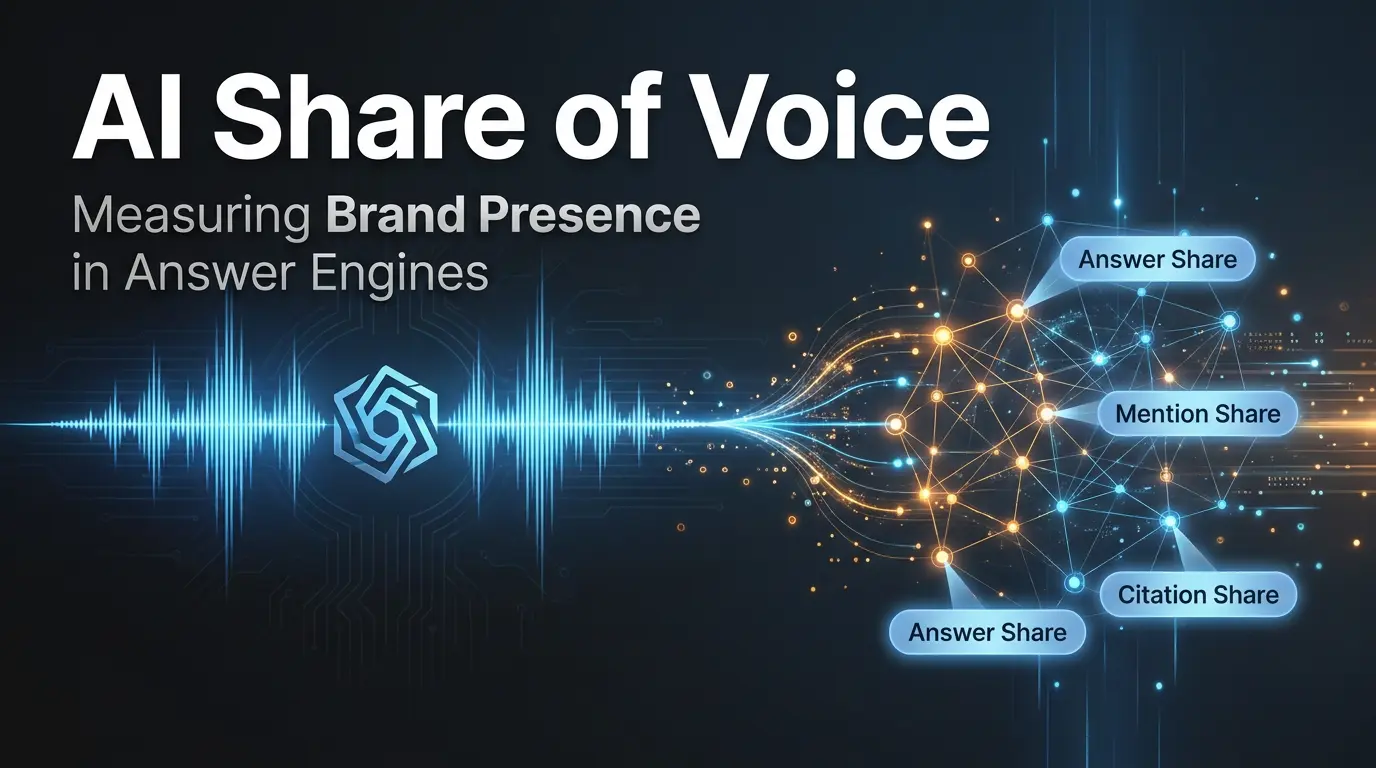
Traditional share of voice measures how much of a market conversation a brand owns.
AI share of voice asks a sharper question:
How much of the answer engine conversation does your brand own when users ask for recommendations, comparisons, and buying advice?
This matters because AI answers do not always send traffic. They can still shape awareness, trust, and shortlists. A brand can win influence inside an answer before the user reaches a website.
AI share of voice is not one metric
AI share of voice is a bundle of signals.
| Signal | What it measures | Why it matters |
|---|---|---|
| Answer share | How often the brand appears in answers | Shows answer-layer presence |
| Mention share | How much of all brand mentions belong to you | Shows category visibility |
| Citation share | How often your domain or pages are cited | Shows source visibility |
| Recommendation share | How often the brand is recommended | Shows preference, not just presence |
| Prompt coverage | Which prompt groups include the brand | Shows where in the journey visibility exists |
The mistake is treating all mentions as equal. A brand that is recommended first for high-intent prompts has a stronger share of voice than a brand mentioned in passing for broad informational prompts.
Build the category before calculating share
AI share of voice depends on the category definition.
Start by defining:
- competitor group;
- prompt set;
- engines;
- geography or language;
- sample period;
- source types;
- weighting rules.
AIvsRank's public AI leaderboard is useful as an example of category-based visibility benchmarking. It frames visibility by industry and category, which is closer to how share of voice should be measured than a single generic AI visibility score.
Do not present a sampled benchmark as the entire market. Treat it as a category snapshot.
Measure by prompt type
Prompt type decides what the metric means.
A brand can have strong share of voice for discovery prompts and weak share of voice for comparison prompts. Another brand may dominate "best for enterprise" questions but disappear in startup or budget prompts.
Segment by:
- category prompts;
- use case prompts;
- comparison prompts;
- alternative prompts;
- problem-aware prompts;
- pricing prompts;
- source and citation prompts.
Google's AI features documentation explains why segmentation matters: AI systems may synthesize across multiple subtopics and sources. A broad average can hide where the brand actually wins or loses.
Connect share of voice to citations
AI share of voice should include source visibility.
A brand can be talked about because its own pages are cited. It can also be talked about because a third-party list, review page, or competitor comparison shaped the answer.
A 2026 paper on competitive GEO citations is useful here because it studies what gets cited first in AI answer engines. For marketers, the lesson is that share of voice is not only about brand names. It is also about the sources answer engines use to justify those names.
AIvsRank's AI visibility features are relevant because share of voice reporting needs brand mentions, citations, answer positions, competitor visibility, AI engines, and snapshots.
See category benchmarks
The CTA for AI share of voice is: see category benchmarks.
Before setting a target, compare your brand against a category. Which brands appear most often? Which sources are cited? Which competitors dominate high-intent prompts? Which prompt groups are missing your brand?
If the team is starting from zero, run a free GEO audit first, then build a share-of-voice prompt set around the category.
FAQ: AI Share of Voice
What AI share of voice benchmarks should CRM teams track?
CRM teams should track answer share, recommendation share, citation share, and prompt coverage for startup, enterprise, migration, automation, and competitor alternative prompts. Segmenting by buyer type matters more than one broad score.
How can SEO tools measure share of voice in AI answers?
SEO tools should measure visibility across rank tracking, technical SEO, backlink analysis, content optimization, AI visibility, and agency reporting prompts. The report should show which brands are recommended and which sources are cited.
How is AI share of voice different from answer share?
Answer share measures how often a brand appears in answers. AI share of voice compares that presence against competitors and may include recommendation strength, citation share, sentiment, and prompt coverage.
What should agencies include in an AI share of voice report?
Agencies should include prompt groups, competitor visibility, recommendation share, citation sources, top missing prompts, changes over time, and saved answer examples. The report should end with content, citation, or positioning actions.
Can a brand have high citation share but low AI share of voice?
Yes. A brand's pages may be cited as sources without the brand being recommended. That is why citation share and answer share should be reported separately.
Data Notes
- Use leaderboard data as a public benchmark or category snapshot, not as an absolute market-share claim.
- If a specific leaderboard category is cited in a future article, record the category, checked date, tracked brands, leaders, and visible scores.