
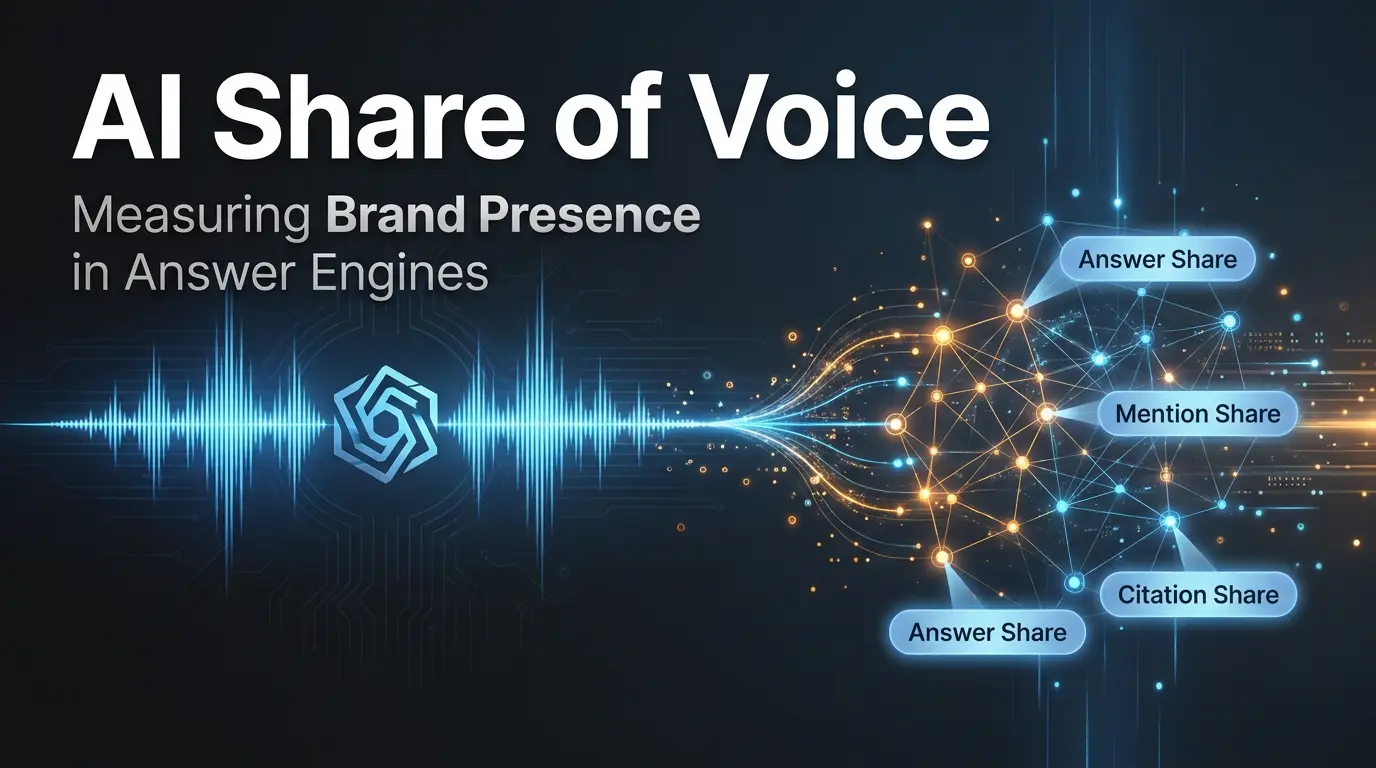
Share of voice used to be about attention.
How much of the market's visibility did your brand capture compared with competitors?
In traditional marketing, that could mean ad spend, impressions, media mentions, search rankings, or organic visibility. In SEO, share of voice often became a way to estimate how much organic search visibility a domain captured across a keyword set.
AI search changes the unit of visibility.
In answer engines, the user may not see ten ranked links. They may see a generated answer, a short recommendation, a comparison, a citation panel, or a conversation. That means the real question is no longer only:
Where do we rank?
It is:
How often are we part of the answer?
That is AI share of voice.
What is AI share of voice?
AI share of voice is the share of AI-generated answer visibility your brand captures across a defined set of prompts, topics, competitors, and answer engines.
It measures whether your brand appears when users ask AI systems about a category, use case, problem, product, or comparison.
It should also measure how the brand appears:
- is the brand mentioned?
- is the brand recommended?
- is the brand cited?
- is the brand compared against competitors?
- is the context positive, neutral, or negative?
- is the cited source your own site or a third-party page?
- does the answer position the brand as a leader, niche option, risk, alternative, or default choice?
Traditional share of voice usually measured visible presence in a known channel.
AI share of voice measures participation in generated answers.
That is a bigger shift than it sounds.
Traditional share of voice vs. AI share of voice.
Ahrefs defines share of voice broadly as how visible a brand is in the market and explains SEO share of voice as a way to estimate the proportion of organic search visibility a site receives for tracked keywords (Ahrefs).
That model works when visibility can be tied to rankings, traffic estimates, or SERP positions.
AI search engines make visibility less linear.
The result is not always a list. It can be a synthesized answer.
Google says AI Overviews and AI Mode can show supporting links and may use query fan-out, issuing multiple related searches across subtopics and data sources before generating a response (Google Search Central).
That means one visible answer may be built from many hidden retrieval steps.
Traditional SEO share of voice asks:
What share of organic visibility do we capture across a keyword set?
AI share of voice asks:
What share of answer visibility do we capture across a prompt set?
That distinction matters because a brand can rank but not be mentioned, be mentioned but not cited, be cited but not clicked, or be recommended without receiving a measurable referral.
Why AI share of voice matters.
AI share of voice matters because users may make decisions inside answers before visiting websites.
AI search engines can summarize a category, name vendors, compare options, explain trade-offs, and recommend next steps. The brand that appears in that answer may gain influence even if the user never clicks the source.
Pew Research Center found that Google users clicked a traditional search result in 8% of visits when an AI summary appeared, compared with 15% when no AI summary appeared. Links inside AI summaries were clicked in only 1% of visits to pages with such a summary (Pew Research Center).
That is why AI visibility cannot be measured only by clicks.
If AI searches influence awareness, trust, shortlists, and buying criteria before the click, then share of voice has to move upstream.
AI share of voice is an attempt to measure that upstream influence.
The four core signals in AI share of voice.
AI share of voice should not be one vague score.
It should be built from several measurable signals.
1. Answer share
Answer share measures how often your brand appears in AI answers across a defined prompt set.
For example, if you track 100 prompts in a category and your brand appears in 34 answers, your basic answer share is 34%.
This is the simplest form of AI share of voice.
But it is not enough by itself.
A brand can be mentioned in a weak context, buried after competitors, or named only as an alternative. Answer share tells you whether you are present. It does not tell you whether that presence helps.
2. Mention share
Mention share compares your brand's mentions against competitor mentions.
If a prompt asks for "best AI meeting note tools" and the answer names five brands, mention share helps measure which brands appear most often across the full prompt set.
Mention share should usually be measured at several levels:
- brand mentioned anywhere;
- brand mentioned in the first answer paragraph;
- brand listed as a recommended option;
- brand mentioned in a comparison;
- brand mentioned as a limitation or risk.
This prevents teams from treating every mention as equal.
Being mentioned as "not ideal for enterprise teams" is not the same as being mentioned as "the safest default."
3. Citation share
Citation share measures how often your owned pages are cited as supporting sources in AI answers.
This matters because AI answers can mention a brand while citing someone else.
For example:
- your brand is recommended, but the citation goes to a review site;
- your product is described, but the source is an outdated comparison page;
- a competitor is cited as the source for a category claim you explain better;
- your official documentation is missing even when the answer discusses your product.
Citation share should separate:
- owned citations;
- third-party citations about the brand;
- competitor-owned citations;
- neutral authority citations;
- uncited mentions.
The goal is not only to be named.
The goal is to become an authoritative source inside the answer.
4. Competitor presence
Competitor presence measures which competitors appear beside you, above you, or instead of you.
This is where AI share of voice becomes strategic.
A brand may have strong answer share but still lose the category if every answer frames a competitor as the better fit.
Competitor presence should track:
- which competitors appear most often;
- which competitors are recommended first;
- which competitors are cited;
- which competitors are described as cheaper, safer, faster, easier, or more complete;
- which competitors dominate specific subtopics or buyer intents.
This turns AI share of voice from a visibility metric into a positioning map.
Prompt sets define the market.
AI share of voice is only as useful as the prompt set behind it.
A weak prompt set creates a weak metric.
Traditional SEO starts with keywords. AI share of voice starts with prompts.
But prompts are not just longer keywords.
They include intent, context, comparison, and decision language.
For example:
- best CRM for small real estate teams;
- alternatives to Salesforce for nonprofits;
- which AI SEO tools are best for ecommerce brands;
- compare Brand A and Brand B for enterprise reporting;
- what should I use if I need accurate meeting transcripts;
- which vendor is easiest to implement for a small marketing team?
A good prompt set should include:
- discovery prompts;
- comparison prompts;
- alternative prompts;
- problem-solution prompts;
- buyer-intent prompts;
- category education prompts;
- objections and risk prompts;
- local or industry-specific prompts;
- prompts that include competitor names;
- prompts that do not include any brand names.
If the prompt set is too narrow, AI share of voice becomes a vanity number.
If the prompt set reflects real buyer questions, it becomes a useful visibility signal.
Category definition matters as much as prompt volume.
Before measuring AI share of voice, define the category.
This sounds obvious, but it is where many visibility projects go wrong.
A brand may compete in several answer categories at once.
For example, one tool might appear in:
- AI SEO tools;
- GEO platforms;
- answer engine optimization tools;
- AI visibility monitoring;
- citation tracking software;
- brand monitoring tools;
- SEO analytics platforms;
- content optimization workflows.
Each category has a different competitor set and different user intent.
If you mix them into one score, the metric becomes blurry.
A useful AI share of voice report should define:
- the category;
- the target audience;
- the answer engines being tested;
- the geography or language;
- the prompt set;
- the competitor set;
- the measurement cadence;
- the scoring rules.
Without category definition, share of voice is just a chart.
With category definition, it becomes a strategy tool.
How to compare competitors in AI answers.
Competitor comparison in AI share of voice should go beyond counting names.
You need to understand how competitors are framed.
For each competitor, track:
- answer share;
- mention share;
- citation share;
- average position inside the answer;
- first-mentioned frequency;
- recommendation frequency;
- source ownership;
- sentiment or framing;
- associated strengths;
- associated weaknesses;
- prompt clusters where they win;
- prompt clusters where they disappear.
This reveals patterns classic rankings often miss.
One competitor may dominate broad discovery prompts.
Another may dominate comparison prompts.
Another may appear only when price is mentioned.
Another may be cited heavily because its documentation is clearer, even if its brand awareness is lower.
This is why AIvsRank's leaderboard can be useful for category-level comparison. It helps teams see visibility as a competitive landscape rather than a single brand score.
AI share of voice needs context, not just math.
A pure percentage can mislead.
Imagine two brands:
Brand A appears in 50% of answers, but often as an expensive option with limited fit.
Brand B appears in 35% of answers, but is usually recommended as the best choice for the target buyer.
Which brand has stronger AI visibility?
The answer depends on context.
That is why AI share of voice should include qualitative fields:
- positive context;
- neutral context;
- negative context;
- buyer-fit context;
- citation accuracy;
- source quality;
- recommendation strength;
- competitor proximity.
AI share of voice should measure presence and interpretation.
The answer layer is not a billboard.
It is a generated judgment.
How to turn AI share of voice into GEO action.
AI share of voice is only useful if it changes what the team does next.
The goal is not to admire a dashboard.
The goal is to improve answer presence, citation quality, and brand representation.
If answer share is low
The brand may not be associated strongly enough with the category.
Useful actions include:
- create category pages that clearly define the use case;
- strengthen entity signals around the brand and product;
- publish comparison and alternative pages where appropriate;
- earn third-party mentions in sources AI systems already use;
- improve crawlability and indexability;
- make product facts easier to extract.
If mention share is low
The brand may be absent from buyer-language prompts.
Useful actions include:
- map the language buyers use in AI searches;
- create content around use cases, jobs-to-be-done, and alternatives;
- connect blog content to canonical product and feature pages;
- clarify who the product is best for;
- build topical authority around the category.
If citation share is low
The brand may be mentioned but not trusted as a source.
Useful actions include:
- improve official documentation;
- add clear facts, dates, tables, and comparison criteria;
- make feature and pricing pages more citation-ready;
- add internal links from blog posts to canonical source pages;
- monitor whether third-party pages are becoming the default citation.
If competitor presence is high
The market may already have a dominant answer narrative.
Useful actions include:
- identify which competitor claims are repeated;
- publish stronger evidence around differentiators;
- create side-by-side comparison assets;
- address objections directly;
- improve review, community, and third-party source coverage;
- track whether AI answers change after content updates.
This is where a GEO audit becomes useful. A good audit should not only say whether a brand is visible. It should show where the answer layer is missing the brand, citing the wrong source, or repeating competitor framing.
Where AIvsRank fits into the workflow.
AI share of voice needs a repeatable workflow.
One-off checks are useful, but they are not enough.
Teams need to define prompt sets, run recurring checks, compare competitors, review citations, and connect findings to content, technical SEO, PR, documentation, and product marketing.
AIvsRank's features are built around that kind of recurring AI visibility work. The free tools hub is useful for quick diagnostics. AIvsRank Docs and geoskills can help teams structure repeatable workflows around prompts, entities, categories, and GEO tasks.
The point is not to replace SEO analytics.
It is to add an answer visibility layer that traditional analytics cannot see.
Common mistakes in AI share of voice measurement.
The first mistake is tracking too few prompts.
If a report uses ten prompts to represent an entire market, it will be fragile.
The second mistake is mixing categories.
A brand may have strong visibility in one category and weak visibility in another. Averaging them together hides the real problem.
The third mistake is counting all mentions equally.
A recommendation, neutral mention, negative comparison, and citation are different signals.
The fourth mistake is ignoring sources.
If the brand is mentioned but third-party sites get all citations, the brand does not control its own answer narrative.
The fifth mistake is treating AI share of voice as a static score.
AI answers can change with prompt wording, geography, model updates, source freshness, and competitor content. Measurement has to be repeated.
The new share of voice is answer influence.
Traditional share of voice measured market visibility.
AI share of voice measures answer influence.
That influence can show up as:
- being named;
- being recommended;
- being cited;
- being compared favorably;
- being used as a source;
- shaping the answer's criteria;
- appearing beside or above competitors.
This is why AI share of voice belongs in the content strategy conversation.
It connects SEO, GEO, product marketing, competitive intelligence, PR, documentation, and analytics.
The old question was:
How visible are we in search?
The new question is:
How much of the answer do we own?
FAQ: AI Share of Voice
What is AI share of voice?
AI share of voice measures how often and how prominently a brand appears in AI-generated answers across a defined prompt set, category, competitor group, and answer engine. It includes answer presence, mentions, citations, recommendations, and competitor context.
How is AI share of voice different from SEO share of voice?
SEO share of voice usually measures organic visibility across keywords and rankings. AI share of voice measures brand presence inside generated answers, where visibility may come from mentions, citations, recommendations, and answer context rather than only ranked links.
What is answer share?
Answer share is the percentage of tracked AI answers in which your brand appears. It is the simplest AI visibility signal, but it should be combined with context, citation, and competitor data.
What is citation share?
Citation share measures how often your owned pages are cited as sources in AI answers. It helps reveal whether AI systems use your official pages or rely on third-party sources when explaining your brand or category.
Why does prompt set design matter?
Prompt set design matters because AI share of voice depends on the questions you test. A useful prompt set should represent real buyer questions, category discovery, comparisons, alternatives, objections, and competitor-aware searches.
How can AI share of voice guide GEO action?
AI share of voice can show where to act: low answer share may require category content, low mention share may require buyer-language pages, low citation share may require better source pages, and high competitor presence may require stronger differentiation and third-party authority.
What should a brand track besides AI share of voice?
Brands should also track answer sentiment, citation accuracy, competitor positioning, prompt coverage, source ownership, branded search lift, direct traffic quality, sales conversation language, and changes after content updates.