
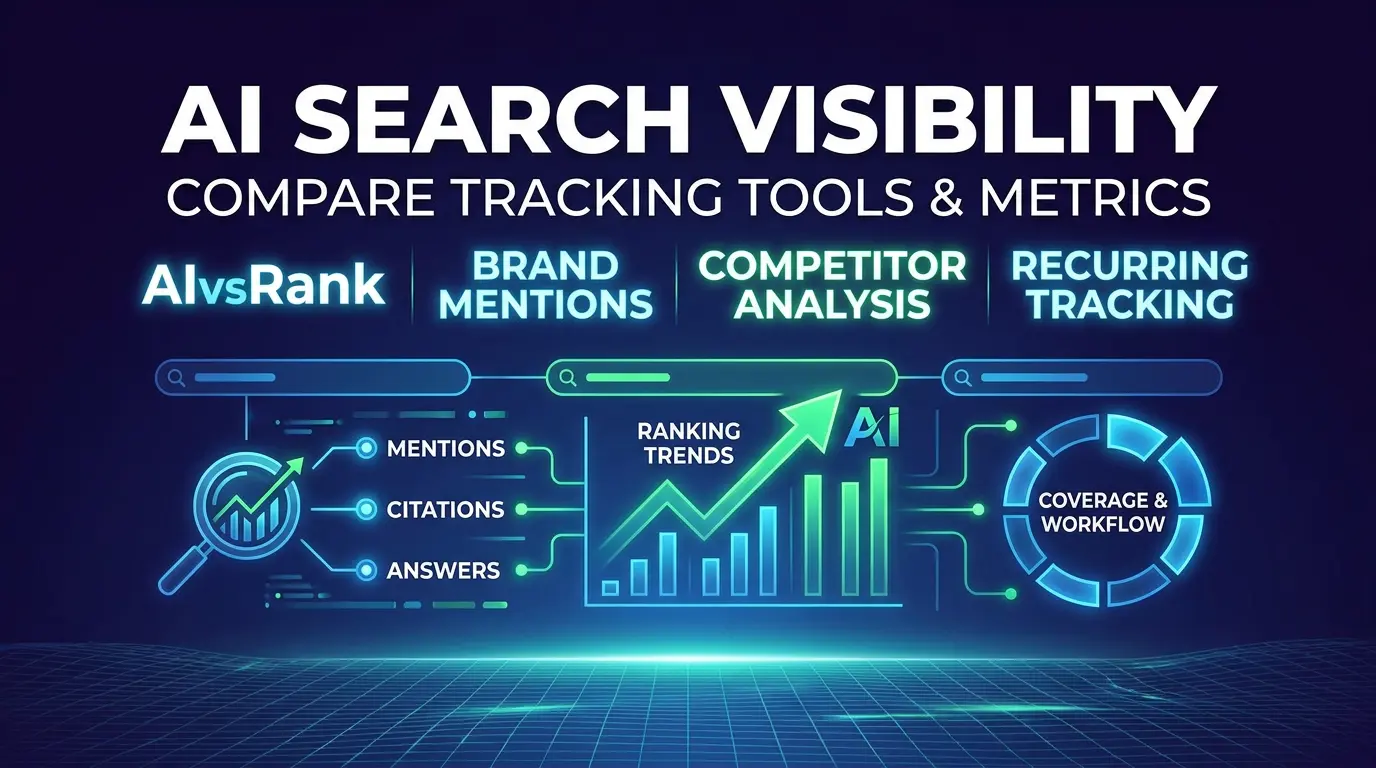
The best AI search visibility tool is not always the one with the longest feature list.
It is the one that answers the right question for your team.
For some teams, the question is simple:
Does our brand appear in AI answers at all?
For other teams, the question is more operational:
Are we gaining or losing visibility across ChatGPT, Claude, Perplexity, Gemini, Google AI Overviews, competitors, prompts, citations, and time?
Those are different jobs. A free checker, a recurring AI rank tracker, an AI search monitoring platform, and a GEO platform should not be evaluated the same way.
This guide is based on public product pages and documentation available in June 2026. It is not a live benchmark, and it does not claim that one tool is universally best. The goal is to help you compare AI search visibility tools by use case.
What should an AI search visibility tool measure?
A useful AI search visibility tool should measure how a brand appears inside AI-generated answers.
At minimum, teams should look for:
| Capability | Why it matters |
|---|---|
| Engine coverage | AI answers vary across ChatGPT, Claude, Perplexity, Gemini, Google AI Overviews, Copilot, and other systems |
| Prompt coverage | Visibility depends on what buyers ask, not only brand-name searches |
| Mention rate | Teams need to know how often the brand appears |
| Answer position | Being listed first is different from being mentioned as an alternative |
| Description accuracy | A brand can be visible but misunderstood |
| Competitor visibility | AI answers often form shortlists with competing brands |
| Citation/source tracking | Sources shape how AI systems justify answers |
| Saved snapshots | AI answers change, so teams need historical evidence |
| Reporting workflow | Visibility data should help teams decide what to improve |
The most common mistake is treating a single prompt result as the whole market.
One answer can be useful, but recurring patterns are more reliable.
Tool categories to compare
The AI search visibility market is still forming, so tools use overlapping labels: AI visibility, AI search monitoring, GEO, AEO, AI rank tracking, citation tracking, and answer engine optimization.
A practical way to compare them is by job:
| Tool category | Best for |
|---|---|
| Free checker | Quick discovery and first-pass diagnosis |
| Recurring AI rank tracker | Mention rate, answer position, competitor visibility, and snapshots |
| AI search monitoring platform | Ongoing prompt monitoring across engines |
| GEO platform | Visibility plus optimization workflow and source/content improvements |
| SEO suite with AI visibility | Teams that want AI visibility next to traditional SEO data |
| Citation/source tracker | Teams focused on which pages and domains AI answers cite |
Before choosing a tool, decide which job matters most.
AIvsRank
AIvsRank is designed for teams that want to move from one-time checking into recurring AI rank tracking and GEO analysis.
It is useful when the team needs to compare:
- buyer prompt pools
- AI search engines
- brand mentions
- average answer rank
- product-layer recognition
- competitor visibility
- citation and source presence
- saved snapshots
- optimization priorities
AIvsRank also connects public discovery with private monitoring. A team can start with the free AI search visibility checker, review public market context through AIvsRank Leaderboard, and then move to recurring workflows on AIvsRank features.
Best fit:
- B2B brands tracking AI answer visibility
- teams that need recurring prompt pools, not one-off screenshots
- marketers who need competitor visibility and average rank
- product marketing teams that care about category fit and description accuracy
OtterlyAI
OtterlyAI describes itself as an AI search monitoring and optimization platform. Its public help pages say it helps teams understand how a brand appears or does not appear across AI-powered search engines such as ChatGPT, Google AI Overviews, Perplexity, Gemini, and Microsoft Copilot.
OtterlyAI is most relevant when a team wants monitoring across major AI search surfaces, with recurring checks and reports.
Best fit:
- teams starting with AI search monitoring
- marketers who want brand visibility across major AI answer engines
- agencies that need a simpler monitoring workflow
Watch for:
- whether the plan covers the engines and check frequency your team needs
- whether the tool gives enough detail for content and source-level action
Peec AI
Peec AI positions itself as AI search analytics for marketing teams. Its public site emphasizes visibility insights, brand discovery, and strategic content decisions in generative search.
Peec is most relevant for teams that want a marketing-oriented view of AI visibility rather than only a technical prompt-testing workflow.
Best fit:
- marketing teams
- teams that want AI search analytics in a cleaner executive workflow
- brands tracking category visibility and AI search presence
Watch for:
- how much prompt-level detail and answer evidence is available
- whether it supports the specific AI engines and markets your buyers use
Scrunch
Scrunch positions itself as an AI customer experience platform for AI search visibility and optimization. Its public pages describe monitoring, auditing, optimization, and content delivery through an Agent Experience Platform.
Scrunch is relevant when the job is not only "track visibility," but also "make the site more AI-ready and improve how agents experience the brand."
Best fit:
- teams thinking beyond monitoring into AI-ready content delivery
- brands that want audit plus optimization workflow
- larger teams exploring how AI agents interact with web content
Watch for:
- whether the team needs the broader agent experience layer or a narrower rank tracker
- whether the workflow fits your current SEO and content operations
Semrush AI Visibility Toolkit
Semrush's AI Visibility Toolkit is designed for teams that already think in SEO workflows and want to add AI visibility measurement. Semrush documentation describes visibility overview, mentions, cited pages, citations, monthly audience, and distribution by LLM.
It is most useful when AI visibility needs to sit next to existing SEO, keyword, and competitive data.
Best fit:
- SEO teams already using Semrush
- teams that want AI visibility and traditional search data together
- agencies managing SEO and AI visibility in one platform family
Watch for:
- whether you need a dedicated AI search workflow or an SEO-suite extension
- whether the prompt limits, domains, and historical data fit your use case
Writesonic GEO
Writesonic's documentation describes GEO features for monitoring and improving brand presence across AI platforms, including visibility, citations, competitor benchmarks, sentiment, and prompt-level data.
Writesonic is relevant for teams that want AI visibility connected to content production and optimization.
Best fit:
- content teams
- agencies that need GEO plus content workflows
- marketers who want visibility data and content actions in one environment
Watch for:
- whether the content workflow is the main need
- whether the measurement layer is detailed enough for rank tracking and source analysis
MentionHQ
MentionHQ publicly describes tracking across AI platforms such as ChatGPT, Claude, Gemini, and Perplexity, with visibility scores, position tracking, sentiment, cited sources, and competitor comparisons on higher plans.
It is most relevant for teams that want a straightforward brand visibility dashboard across multiple AI platforms.
Best fit:
- startups and smaller teams
- teams that want visibility score, position tracking, and competitor comparisons
- brands testing whether AI mentions should become a recurring KPI
Watch for:
- whether the visibility score methodology fits your reporting needs
- whether the platform's source and competitor detail is enough for your team
Genwolf
Genwolf describes daily prompt monitoring, multi-LLM coverage, answer history, mentions, citations, sentiment, sources, and an open-source core.
It is relevant for teams that want more transparency or self-hosting flexibility.
Best fit:
- technical teams
- startups comfortable with prompt-based tracking
- teams that value open-source or self-hostable workflows
Watch for:
- whether engine coverage matches your market
- whether your team wants a lightweight tracker or a broader GEO workflow
Trakkr
Trakkr positions itself around AI search analytics, visibility, citations, and actions across multiple AI models. Its public site emphasizes not only dashboards, but prioritized action playbooks.
It is relevant for teams that want monitoring plus prescriptive next steps.
Best fit:
- teams that want action recommendations, not only tracking
- agencies or brand teams managing visibility gaps
- teams focused on citations, sources, and weekly improvement workflows
Watch for:
- whether the action layer aligns with your content and technical capabilities
- whether you need transparent measurement or a more guided playbook
How to choose the right tool
Use this decision path:
| If your main problem is... | Look for... |
|---|---|
| "We do not know if we appear at all" | Free checker or lightweight visibility scan |
| "We need to track AI answers over time" | Recurring AI rank tracker |
| "We need competitor visibility" | Prompt-level competitor comparison |
| "We need to see sources" | Citation and source tracking |
| "We need team reporting" | Saved snapshots, trend history, exports, and summaries |
| "We need to improve content" | GEO workflow and optimization guidance |
| "We already use SEO tools heavily" | SEO suite with AI visibility layer |
The best tool is the one that fits your workflow stage.
Start with a free checker when the problem is still unclear. Move to a recurring tracker when the team needs evidence, history, and decisions.
The bottom line
AI search visibility tools are not interchangeable.
Some are built for quick checks. Some are built for recurring monitoring. Some connect AI visibility to SEO. Some focus on citations. Some add optimization workflow.
Tool information can change, so teams should verify current pricing, engine coverage, prompt limits, integrations, and data retention before buying.
If your team only needs to know whether your brand appears once, start with a free AI search visibility checker.
If your team needs prompt coverage, mention rate, average answer rank, competitor visibility, citations, saved snapshots, and trend history, review AIvsRank features.
AI search visibility is less and less just a question of "are we known?"
It is a question of whether AI answers include, rank, describe, cite, and compare your brand correctly.
References:
- OtterlyAI: What is OtterlyAI and how does it work?
- Scrunch: AI search visibility and insights
- Peec AI: AI Search Analytics for Marketing Teams
- Semrush: Getting Started with the AI Visibility Toolkit
- Writesonic: GEO Getting Started
- MentionHQ: Track Your Brand Visibility Across AI Platforms
- Genwolf: AI Search Visibility Tracking Platform
- Trakkr: AI Search Analytics