
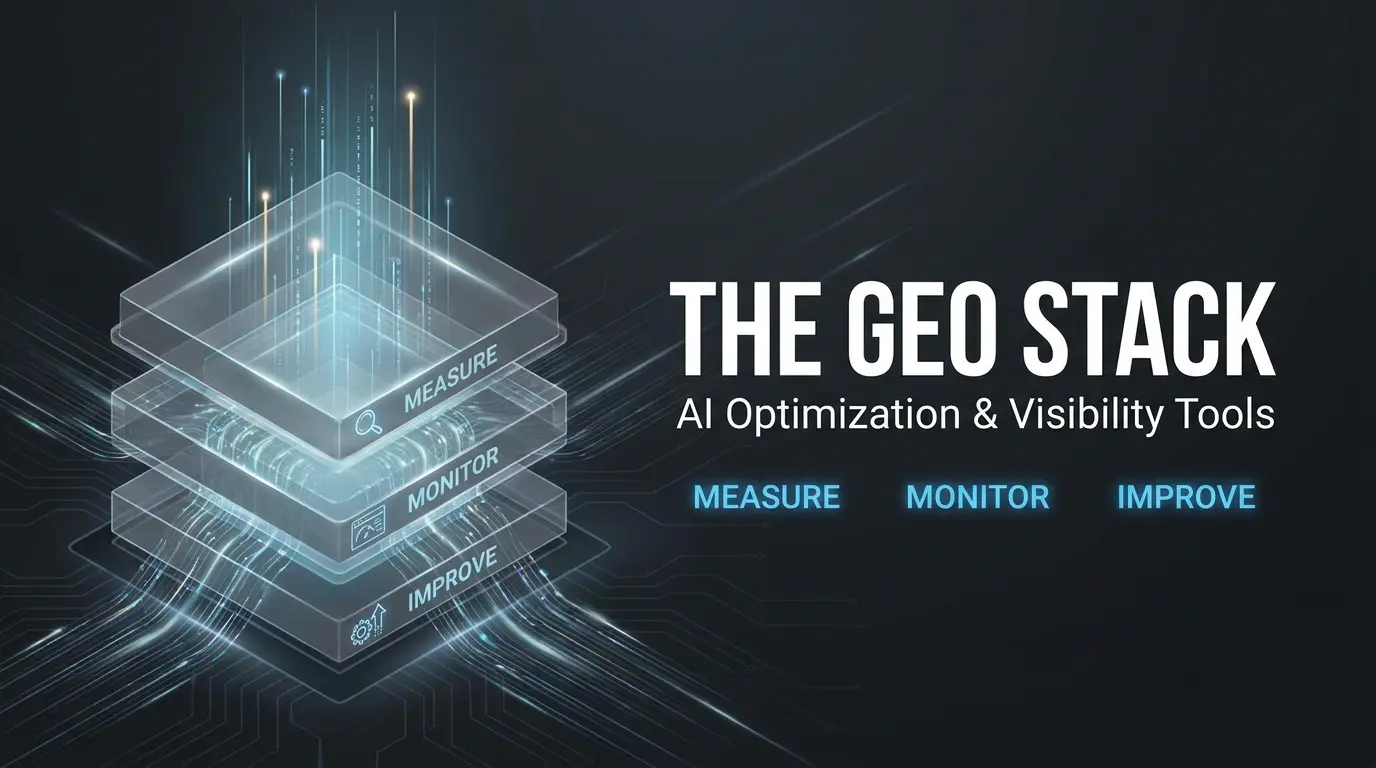
Generative Engine Optimization tools are not one single category yet.
Some tools track brand visibility in AI answers.
Some monitor citations and sources.
Some check technical readiness, such as crawler access, sitemaps, robots.txt, or llms.txt.
Some help rewrite content so AI systems can understand and cite it more easily.
That is why the better question is not:
What is the single best GEO tool?
It is:
What belongs in a Generative Engine Optimization stack?
This guide compares GEO tool categories based on public product pages and documentation available in June 2026. It is not a live benchmark and does not claim that one tool is universally best.
What is a Generative Engine Optimization tool?
A Generative Engine Optimization tool helps teams improve how AI systems understand, mention, cite, and position a brand in generated answers.
That can include:
- AI answer visibility
- brand mentions
- average answer rank
- citations and sources
- competitor visibility
- content structure
- technical crawler access
- source clarity
- prompt coverage
- recurring monitoring
GEO is broader than prompt tracking.
Prompt tracking shows what AI answers say.
GEO also asks what can be improved so future AI answers are more likely to understand, mention, cite, and classify the brand correctly.
GEO tools vs AI visibility trackers
AI visibility trackers are one part of the GEO stack.
They measure whether a brand appears in AI answers and how it is positioned.
GEO tools can include that, but they may also include technical and content optimization tasks.
| Tool type | Main job |
|---|---|
| AI visibility tracker | Measure mentions, answer position, competitors, and snapshots |
| AI search monitoring tool | Run recurring prompt checks and track changes |
| Citation/source tracker | Identify which sources AI answers use |
| Technical GEO tool | Check crawler access, sitemaps, robots.txt, llms.txt, and site structure |
| Content optimization tool | Improve pages so AI systems can parse, summarize, and cite them |
| GEO workflow platform | Connect measurement, diagnosis, optimization, and reporting |
A complete GEO strategy may need more than one tool type.
What a GEO stack should cover
A useful GEO stack should answer five questions:
- Can AI systems access the site?
- Can AI systems understand the brand and product category?
- Does the brand appear in relevant AI answers?
- Are citations and sources strong enough?
- What should the team improve next?
That means a GEO stack should include both measurement and action.
AIvsRank
AIvsRank fits the GEO stack at the intersection of free diagnostics, AI visibility measurement, and recurring AI rank tracking.
It is useful when teams need to track:
- whether the brand appears in AI answers
- how often the brand appears
- where the brand ranks when mentioned
- whether AI describes the brand correctly
- whether the product category is understood
- which competitors appear in the same answers
- which sources support answer visibility
- whether results change over time
AIvsRank also provides free tools for early diagnosis and AIvsRank features for recurring workflows.
Best fit:
- B2B teams measuring AI answer visibility
- brands moving from free checks to recurring GEO tracking
- teams that need prompt coverage, competitor visibility, and snapshots
- product marketing teams that care about category fit and answer description
Watch for:
- AIvsRank should be used as part of a GEO workflow, not as a replacement for every technical SEO or content production tool
- teams should still maintain strong site structure, sourceable facts, and crawlable pages
Scrunch
Scrunch is one of the more GEO-oriented platforms in this category. Its public site describes AI search visibility, audits, optimization, monitoring, analytics, and an Agent Experience Platform for improving how AI agents understand and interact with a brand.
Scrunch is relevant when the team wants a broader optimization layer, not just visibility monitoring.
Best fit:
- teams looking for AI-ready content and agent experience workflows
- larger brands exploring AI search visibility and optimization together
- teams that want audit, monitoring, and improvement guidance in one system
Watch for:
- whether your team needs the broader platform or a narrower tracker
- whether the implementation workflow fits your content and web operations
Writesonic GEO
Writesonic documentation describes GEO features for monitoring and improving brand presence across AI platforms, including visibility, citations, competitor benchmarks, sentiment, and prompt-level data.
Writesonic is relevant when GEO is connected to content creation and optimization workflows.
Best fit:
- content teams
- agencies that need AI visibility plus content production
- teams that want prompt-level visibility connected to writing workflows
Watch for:
- whether the content workflow is central to your GEO strategy
- whether measurement, citations, and competitor benchmarks are detailed enough for your reporting needs
Semrush AI Visibility Toolkit
Semrush's AI Visibility Toolkit brings AI visibility into an established SEO platform environment. Its documentation describes LLM visibility, prompts, mentions, citations, cited pages, monthly audience, and LLM distribution.
Semrush is relevant when teams want GEO-related visibility next to traditional SEO workflows.
Best fit:
- SEO teams already using Semrush
- agencies managing traditional SEO and AI visibility together
- teams that want SEO and AI visibility reporting in one tool family
Watch for:
- whether the GEO workflow needs deeper prompt, answer, and snapshot control
- whether the tool is being used as an SEO extension or a dedicated GEO platform
OtterlyAI
OtterlyAI is best understood as AI search monitoring and optimization. Its help center says it helps users understand how their brand appears or does not appear across AI-powered search engines such as ChatGPT, Google AI Overviews, Perplexity, Gemini, and Microsoft Copilot.
In a GEO stack, OtterlyAI is relevant for monitoring AI search visibility and recurring answer presence.
Best fit:
- teams beginning AI search monitoring
- marketers who need multi-engine visibility checks
- agencies watching client presence across AI search surfaces
Watch for:
- whether the workflow covers technical GEO and content optimization, or mainly monitoring
- how deeply it handles citations, sources, and competitor actions
Trakkr
Trakkr describes AI search analytics across multiple models, with visibility tracking, citations, source analysis, weekly reports, and prioritized action playbooks.
In a GEO stack, Trakkr is relevant when the team wants monitoring plus action recommendations.
Best fit:
- teams that want source and citation insights
- brands that need weekly reporting
- teams looking for recommended actions based on AI search visibility
Watch for:
- whether action recommendations are transparent and specific enough
- whether the workflow fits your team's ability to implement content or source updates
Peec AI
Peec AI positions itself as AI search analytics for marketing teams. Its public site emphasizes brand discovery, visibility insights, and content decisions in generative search.
In a GEO stack, Peec can support marketing-oriented visibility analytics.
Best fit:
- marketing teams
- teams that need AI search visibility insights for content decisions
- brands looking for executive-friendly generative search analytics
Watch for:
- whether the tool gives enough technical and source-level detail for GEO execution
- whether visibility insights translate into content or site improvements
Technical free tools
Not every GEO task requires a paid platform.
Technical checks are often the first step.
A GEO stack may include free tools for:
- AI crawler access
- robots.txt checks
- llms.txt generation
- sitemap inspection
- citation readiness
- AI search visibility checks
This is where AIvsRank free tools fit the workflow.
A free tool can help identify whether a site has basic access, structure, or visibility problems before the team moves into recurring tracking.
How to compare GEO tools
Use this checklist:
| GEO requirement | What to look for |
|---|---|
| Visibility measurement | Mentions, average answer rank, prompt coverage |
| AI search monitoring | Recurring checks, saved snapshots, trend history |
| Citation tracking | Sources, cited pages, official vs third-party domains |
| Competitor visibility | Competitor mentions, ranking, recommendation reasons |
| Technical readiness | Crawler access, robots.txt, sitemap, llms.txt, structured pages |
| Content optimization | Clear definitions, sourceable facts, comparison pages, answer-ready structure |
| Reporting | Team-ready summaries, exports, change review |
| Workflow fit | Whether the tool matches SEO, content, product marketing, or executive needs |
The right GEO tool depends on where the bottleneck is.
If AI systems cannot access or parse your site, start with technical readiness.
If your brand is absent from AI answers, start with visibility tracking.
If your brand appears but competitors dominate, start with competitor visibility and comparison content.
If your brand appears but is described incorrectly, start with category fit and source clarity.
Common mistake: treating GEO as only prompt tracking
Prompt tracking is important.
But it is not the whole GEO workflow.
GEO also requires:
- crawlable and understandable pages
- clear product definitions
- strong source pages
- comparison and use-case content
- citation-ready facts
- recurring monitoring
- competitor visibility analysis
If a tool only shows that the brand is missing, the team still needs a way to decide what to fix.
The bottom line
The right Generative Engine Optimization tool depends on which part of GEO you need to solve.
If you need quick diagnosis, start with AIvsRank free tools.
If you need recurring visibility tracking, review AIvsRank features.
If you need broader content or agent-experience optimization, compare GEO platforms by how they handle technical readiness, citations, source clarity, content workflow, and reporting.
Tool information can change, so teams should verify current pricing, engine coverage, prompt limits, integrations, and data retention before buying.
GEO is not one tactic.
It is a stack of measurement, monitoring, source improvement, technical readiness, and content clarity.
References: