
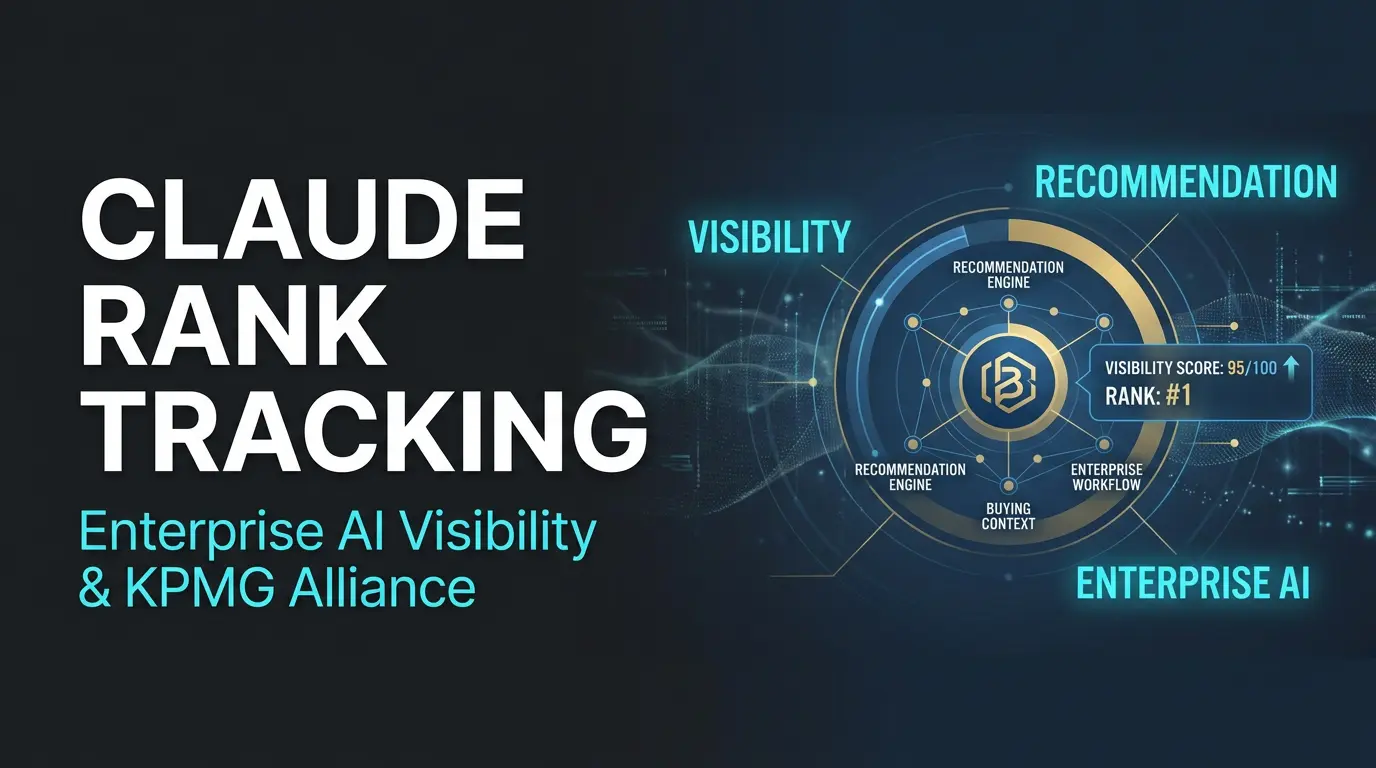
Claude is no longer only a model that people use in a chat window.
It is becoming part of enterprise work, consulting delivery, tax and legal workflows, cybersecurity, private equity value creation, and professional services platforms.
The Anthropic and KPMG alliance makes that shift easier to see.
On May 19, 2026, Anthropic and KPMG announced a global strategic alliance. KPMG is embedding Claude inside Digital Gateway, KPMG's client delivery platform, and providing Claude access to its 276,000+ global workforce. Anthropic also named KPMG a preferred partner for private equity, and the two companies plan to build Claude-powered products for PE portfolio companies.
That matters for AI visibility.
If Claude is moving deeper into enterprise decision workflows, B2B brands need to ask a new question:
When enterprise users ask Claude about vendors, partners, platforms, and solutions, does our brand appear?
That is where Claude rank tracking becomes relevant.
Claude is becoming an enterprise decision surface
The KPMG announcement is not just a large seat rollout.
It puts Claude inside a professional services environment where people advise clients, build workflows, evaluate risk, modernize systems, and support portfolio companies.
According to Anthropic, KPMG is embedding Claude inside Digital Gateway, the platform KPMG's people and clients use to do client work. KPMG says Claude Cowork and Managed Agents will be embedded inside Digital Gateway, where KPMG professionals and clients can build new AI capabilities directly in the platform.
The alliance also extends beyond KPMG's internal workforce.
Anthropic says KPMG becomes a preferred partner for private equity, helping deploy Claude and Anthropic agents into portfolio companies. KPMG's own announcement says the firms will co-develop new Claude-powered products for portfolio companies, including PE-focused offerings such as KPMG Blaze, which can embed Claude Code for IT modernization.
This does not mean Claude alone decides enterprise buying decisions.
But it does mean Claude-powered environments may become part of how enterprise work gets researched, framed, compared, and delivered.
For B2B brands, that creates a visibility question:
Are you present in the AI answers that enterprise teams may use before they build a shortlist?
What is Claude rank tracking?
Claude rank tracking measures whether and how a brand appears in Claude-generated answers for relevant business questions.
A Claude rank tracker should not only ask whether Claude "knows" a brand.
It should track how Claude positions that brand in specific enterprise contexts:
- Does the brand appear when the user asks about a category?
- Where does it appear in the answer?
- Is it recommended, mentioned neutrally, or treated as a weak fit?
- Is it described at the right product layer?
- Which competitors appear with it?
- What reasons does Claude give for recommending or not recommending it?
- Does Claude cite or rely on strong sources when search or retrieval is available?
- Does the answer stay stable across repeated checks?
In other words, Claude rank tracking is not just brand monitoring.
It is answer-level visibility tracking for Claude.
Why Claude visibility matters for B2B brands
B2B discovery is starting to move into AI answers.
Enterprise buyers, consultants, analysts, operators, and portfolio teams may ask Claude questions such as:
- What are the best enterprise AI transformation partners?
- Which companies help deploy AI into enterprise workflows?
- What are the top AI deployment companies for regulated industries?
- What are the best AI visibility checkers for B2B SaaS?
- Compare AI rank tracking tools for enterprise marketing teams.
- Which vendors help private equity portfolio companies modernize IT systems with AI?
- What should a mid-sized company use to evaluate AI search visibility?
These questions are not traditional search keywords.
They are buying-context prompts.
If Claude gives an answer that includes a shortlist, a comparison, or a recommended set of vendors, the buyer may form an early impression before visiting any website.
That is why Claude visibility matters.
A brand can be strong in Google search and still be absent from Claude answers.
A brand can appear in Claude and still be described incorrectly.
A brand can be included in the answer but placed behind competitors, put in the wrong category, or framed as a generic tool instead of an enterprise-ready solution.
These are different problems, and they require different actions.
What the Anthropic + KPMG alliance changes
The Anthropic + KPMG announcement signals that Claude is moving through a professional services channel, not only a direct software channel.
That matters because KPMG sits close to enterprise buying and implementation contexts:
- audit
- tax
- legal
- advisory
- private equity
- cybersecurity
- business transformation
- technology modernization
When a model becomes embedded in this kind of environment, the brand questions around it change.
The question is not only:
Does Claude answer consumer questions well?
It becomes:
How does Claude answer business questions inside enterprise and advisory workflows?
For example, a PE operating team may ask about AI tools for portfolio company modernization. A tax team may ask about workflow automation vendors. A consulting team may ask for AI transformation partners. A cybersecurity team may ask about vulnerability management tools. A marketing team may ask about AI visibility rank trackers.
In each case, the brand result matters.
Does Claude mention the right vendors? Does it separate categories correctly? Does it explain why one vendor belongs in the answer? Does it avoid mixing consulting firms, model providers, SaaS tools, and implementation partners into one unclear list?
That is the practical reason to track Claude visibility.
What queries should a Claude rank tracker monitor?
A useful Claude rank tracker should start with real buyer questions, not only branded prompts.
For enterprise AI and B2B visibility, example prompt groups might include:
| Query group | Example prompt |
|---|---|
| Enterprise transformation | best enterprise AI transformation partners |
| Deployment services | top AI deployment companies for enterprise workflows |
| AI visibility | best AI visibility checker for B2B SaaS |
| Rank tracking | compare AI rank tracking tools |
| GEO tools | what tools help brands track visibility in AI answers |
| Private equity operations | AI tools for PE portfolio company modernization |
| Consulting support | best AI tools for consulting firms working with clients |
| Vendor comparison | compare AIvsRank with other AI visibility rank trackers |
These prompts test different layers.
Some test whether Claude understands the category.
Some test whether Claude recommends the brand.
Some test whether Claude compares the brand with the right alternatives.
Some test whether Claude places the brand at the right product layer: platform, service provider, consulting partner, deployment company, rank tracker, GEO tool, or analytics product.
A single prompt is not enough.
The useful signal comes from repeated patterns across a controlled question pool.
What a Claude rank tracker should measure
A useful Claude rank tracker should measure more than whether a brand appears once.
It should separate visibility, ranking, description, category fit, and competitive context.
| Metric | What it tells you |
|---|---|
| Mention rate | How often the brand appears across relevant Claude prompts |
| Average answer rank | Where the brand appears when it is mentioned |
| Category fit | Whether Claude places the brand in the correct product category |
| Enterprise fit | Whether Claude recognizes the brand as suitable for enterprise or B2B use cases |
| Competitor co-mentions | Which competing brands appear in the same answer |
| Recommendation reason | Why Claude says the brand is relevant or not relevant |
| Risk description | Whether Claude raises limitations, risks, or caveats about the brand |
| Source presence | Whether official pages, docs, partner pages, or third-party sources support the answer |
| Recognition stability | Whether results stay consistent across repeated checks |
These metrics help teams separate common situations:
- The brand is absent from category prompts.
- The brand appears, but too low in the answer.
- The brand appears, but Claude describes it incorrectly.
- The brand appears beside the wrong competitors.
- Competitors appear more often or receive clearer recommendation reasons.
- Claude understands the brand in one category but not in another.
This is why "rank tracking" in AI answers is different from SEO rank tracking.
In traditional SEO, teams often begin with page position.
In Claude rank tracking, teams need to begin with answer inclusion, product understanding, category placement, and recommendation context.
Why this is strongly related to GEO
GEO, or Generative Engine Optimization, is about how AI systems understand, mention, cite, and position a brand in generated answers.
Claude rank tracking is one engine-specific slice of that larger problem.
For AIvsRank GEO, the key question is:
Does Claude correctly recognize the brand as a supplier in the right category?
That can include several checks:
- Is the brand mentioned in relevant category prompts?
- Is the brand description accurate?
- Is the product layer correct?
- Are core capabilities expressed clearly?
- Is the brand compared with reasonable alternatives?
- Does Claude recommend the brand for the right buyer intent?
- Do repeated answers show stable recognition or unstable positioning?
This matters because B2B brands often lose visibility in subtle ways.
They may not disappear completely.
Instead, Claude may describe them too generally, place them in the wrong category, omit them from high-intent prompts, or recommend competitors with clearer justification.
A Claude rank tracker should make those differences visible.
A public-safe AIvsRank workflow
AIvsRank can frame Claude visibility from two public-safe angles.
The first angle is market-view tracking.
This asks unbranded category questions, such as "best AI visibility checker for B2B SaaS" or "top AI deployment companies for enterprise workflows." The goal is to see which brands Claude naturally includes when the buyer has not already named a vendor.
The second angle is brand-view tracking.
This asks brand-aware questions, such as "what does [brand] do?" or "compare [brand] with alternatives for AI visibility tracking." The goal is to see whether Claude understands the brand's role, product layer, competitive set, and use cases once the brand is named.
Comparing these two tracks helps answer a practical question:
Is the brand visible because users already name it, or does Claude also surface it naturally in the category?
That difference matters.
A brand may be well understood when named, but absent from unbranded enterprise buying prompts. Another brand may appear often in category answers, but be described with weak or inaccurate positioning.
AIvsRank GEO is designed to turn those observations into a structured readout:
- where the brand appears
- where it is missing
- how it is described
- which competitors appear with it
- whether the product layer is accurate
- whether recommendation reasons are strong enough
- what content or positioning should be prioritized next
This keeps the analysis focused on observable answer patterns, not hidden prompt formulas or internal model chains.
A simple example
Suppose a B2B SaaS brand wants to be known as an AI visibility rank tracker.
In a Claude check, the team runs a controlled set of prompts around:
- AI visibility checker
- AI rank tracker
- GEO tool
- B2B SaaS brand visibility
- AI search monitoring
- enterprise marketing analytics
Three outcomes are possible.
First, the brand does not appear in unbranded category prompts. That suggests weak category association.
Second, the brand appears, but Claude describes it as a generic SEO tool. That suggests product-layer confusion.
Third, the brand appears in the right category, but competitors appear more often and receive clearer reasons. That suggests competitive pressure in Claude answers.
These are not the same problem.
The first may require stronger category pages and third-party references. The second may require clearer product positioning and structured explanations. The third may require comparison content, use-case pages, or stronger proof that explains why the brand belongs in the shortlist.
That is why Claude rank tracking should connect measurement to action.
What teams can do with Claude visibility results
Claude visibility results can help different teams make different decisions.
Marketing teams can see whether the brand appears in high-intent enterprise prompts.
Product marketing teams can check whether Claude understands the product layer, use case, and competitive set.
Content teams can identify pages that need clearer definitions, category language, comparison structure, and sourceable facts.
Sales and strategy teams can monitor which competitors are repeatedly grouped with the brand in enterprise buying answers.
Leadership teams can see whether the brand is becoming more or less visible in AI-generated shortlists.
The goal is not to chase every prompt.
The goal is to identify repeatable patterns that influence enterprise buying perception.
The bottom line
Anthropic and KPMG's alliance is a signal that Claude is moving deeper into enterprise work.
It is entering consulting delivery, client platforms, private equity portfolio workflows, tax and legal use cases, cybersecurity, and employee-level productivity.
For B2B brands, that means Claude visibility is becoming less of a niche measurement problem.
It is part of enterprise AI visibility.
A useful Claude rank tracker should not only tell teams whether Claude knows the brand.
It should show whether Claude recommends the brand in the enterprise buying situations that matter:
- the right category
- the right rank
- the right description
- the right competitors
- the right recommendation reasons
That is the real value of Claude rank tracking.
It is not "does Claude know you?"
It is:
Does Claude help place you in the buyer's enterprise shortlist?
References: