Introduction
The way information is discovered online is gradually shifting from document retrieval to answer generation. Traditional search engines primarily index and rank pages, allowing users to choose among links. In contrast, many modern AI systems synthesize responses directly from multiple sources. These systems often rely on large language models (LLMs) combined with retrieval mechanisms that locate relevant passages across the web.
Within this context, a concept often referred to as Generative Engine Optimization (GEO) has emerged. GEO focuses on how well a website’s content can be interpreted, retrieved, and reused by generative systems. While traditional Search Engine Optimization (SEO) emphasizes ranking visibility, and Answer Engine Optimization (AEO) emphasizes extractable answers, GEO examines whether a website’s information can be reliably incorporated into AI-generated responses.
Understanding GEO in the Context of Modern Information Retrieval
Before assessing GEO status, it is useful to clarify how generative systems typically process web content.
Traditional search engines follow a sequence of crawl → index → rank. Pages are collected, keywords are analyzed, and results are ordered based on relevance and authority signals.
Generative systems often add additional stages. A simplified workflow may include:
- Crawling or ingesting content
- Converting text into vector representations
- Retrieving semantically relevant passages
- Generating responses based on retrieved information
In this environment, visibility depends not only on indexing but also on how well content functions within retrieval and generation processes. GEO evaluation therefore focuses on the properties that make content interpretable and reusable by these systems.
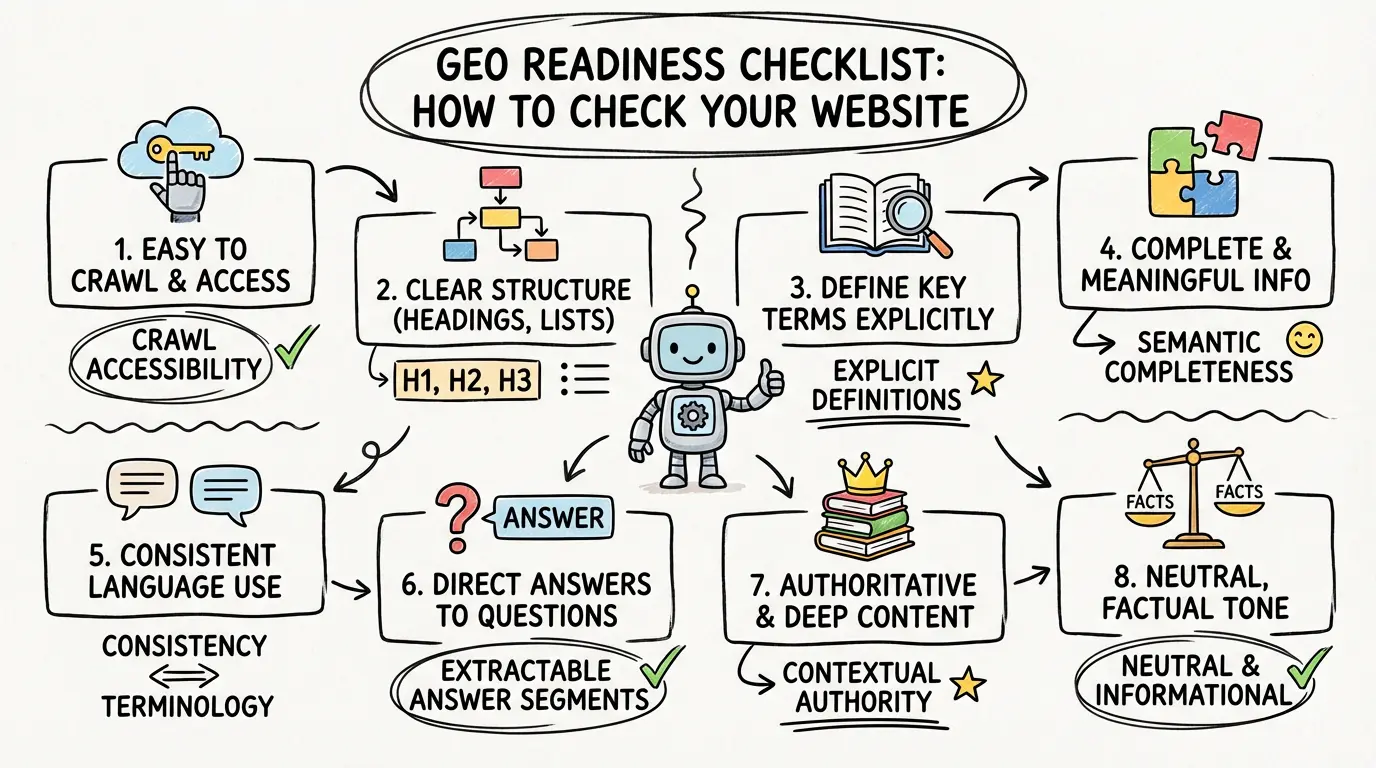
Indicator 1: Crawl Accessibility and Content Availability
The first prerequisite for GEO readiness is straightforward: generative systems must be able to access the content.
Technical elements affecting accessibility include:
robots.txtdirectives that may block crawlers- Login or paywall restrictions
- Excessive reliance on client-side rendering without accessible HTML
- Rate limiting or security rules that block automated access
If a page cannot be crawled or parsed, it cannot enter the retrieval pipeline of generative systems. For this reason, the technical foundations of SEO remain directly relevant to GEO.
Evaluating GEO status therefore begins with confirming that important content pages are publicly accessible and machine-readable.
Indicator 2: Structural Clarity of Content
Generative systems frequently retrieve information in sections rather than full documents. This means the internal structure of an article plays a significant role in how effectively it can be reused.
Content with strong structural clarity typically includes:
- Clear hierarchical headings
- Logical section progression
- Descriptive titles for subsections
- Short paragraphs centered on a single concept
When evaluating GEO readiness, examine whether individual sections of an article can stand alone as coherent explanations. If the meaning of a passage depends heavily on earlier paragraphs, retrieval systems may lose essential context.
Structured content improves both human readability and machine interpretability.
Indicator 3: Explicit Definitions of Key Concepts
A recurring characteristic of content frequently used by AI systems is the presence of clear definitions.
When an article introduces a concept, it should explicitly state:
- What the concept is
- What function it serves
- How it relates to other concepts
For example, a passage defining Generative Engine Optimization should clearly describe its purpose and scope. Definitions written in this way can be easily extracted as direct answers or explanatory statements.
During GEO evaluation, check whether key terms within the website are consistently defined rather than implied through context.
Indicator 4: Semantic Completeness of Information
Generative systems rely heavily on contextual cues. Content that presents isolated statements without explanation may be harder to interpret accurately.
A semantically complete passage typically contains:
- A claim or concept
- Supporting explanation
- Clarification of scope or context
For instance, instead of stating that a certain approach “improves visibility,” a semantically complete explanation would describe how and under what conditions visibility improves.
When assessing GEO status, review whether articles provide full explanations rather than brief or fragmented statements.
Indicator 5: Consistency of Terminology
Inconsistent terminology can reduce the clarity of semantic relationships within content.
For example, if a website alternates between terms such as:
- “AI search visibility”
- “LLM exposure”
- “generative discoverability”
without defining the relationships between them, generative systems may treat them as separate concepts. This can fragment semantic representation.
A GEO-friendly website tends to maintain stable terminology and define key terms consistently across articles.
Evaluating GEO status therefore includes examining whether the site uses coherent language when discussing related topics.
Indicator 6: Extractable Answer Segments
Because many generative systems rely on retrieval-based methods, they often identify passages that directly address user questions.
Articles that naturally support answer extraction often contain:
- Question-style subheadings
- Direct explanations immediately following headings
- Concise explanatory paragraphs
For example:
What is Generative Engine Optimization?
A short paragraph that clearly defines the concept provides a useful unit for retrieval systems.
When evaluating GEO readiness, consider whether the website contains sections that could function as standalone answers.
Indicator 7: Contextual Authority and Topic Depth
Generative systems frequently combine information from multiple sources. In this process, sources that provide deeper explanations of a topic may be retrieved more frequently.
Indicators of topical depth include:
- Multiple articles covering related concepts
- Internal linking between related topics
- Progressive explanations from basic definitions to advanced analysis
A website that addresses a topic comprehensively creates a richer contextual environment for generative retrieval.
Therefore, GEO evaluation should consider not only individual articles but also the broader topical coverage of the site.
Indicator 8: Neutral and Informational Tone
Content written primarily for marketing purposes may contain exaggerations, vague claims, or persuasive language that reduces factual clarity.
Generative systems tend to rely more heavily on content that demonstrates:
- Neutral tone
- Clear factual statements
- Measured claims
- Explicit explanations
When reviewing GEO status, examine whether articles prioritize information over promotion. Neutral writing tends to be easier for AI systems to interpret and reuse.
Bringing GEO Evaluation Together
Assessing a website’s GEO status involves examining several interconnected factors:
- Technical accessibility – whether content can be crawled and parsed
- Structural organization – whether articles are clearly segmented
- Concept definitions – whether key ideas are explicitly explained
- Semantic completeness – whether claims include sufficient context
- Terminological consistency – whether related ideas use stable language
- Answer-ready passages – whether sections can function as standalone explanations
- Topical depth – whether the site builds coherent knowledge coverage
Together, these indicators provide a practical framework for determining whether content is likely to function effectively within generative information systems.
Conclusion
Generative Engine Optimization reflects a broader transformation in how information is retrieved and presented online. While traditional SEO focuses on ranking visibility, GEO examines how well content integrates into systems that generate answers rather than simply list documents.
Checking a website’s GEO status therefore involves more than measuring search rankings. It requires evaluating whether content is accessible, structurally clear, semantically complete, and suitable for retrieval-based generation.
Websites that organize information carefully, define concepts explicitly, and maintain contextual clarity are more likely to be interpreted accurately by generative systems. As AI-driven search environments continue to develop, these qualities will play an increasingly important role in how online information is discovered and reused.