
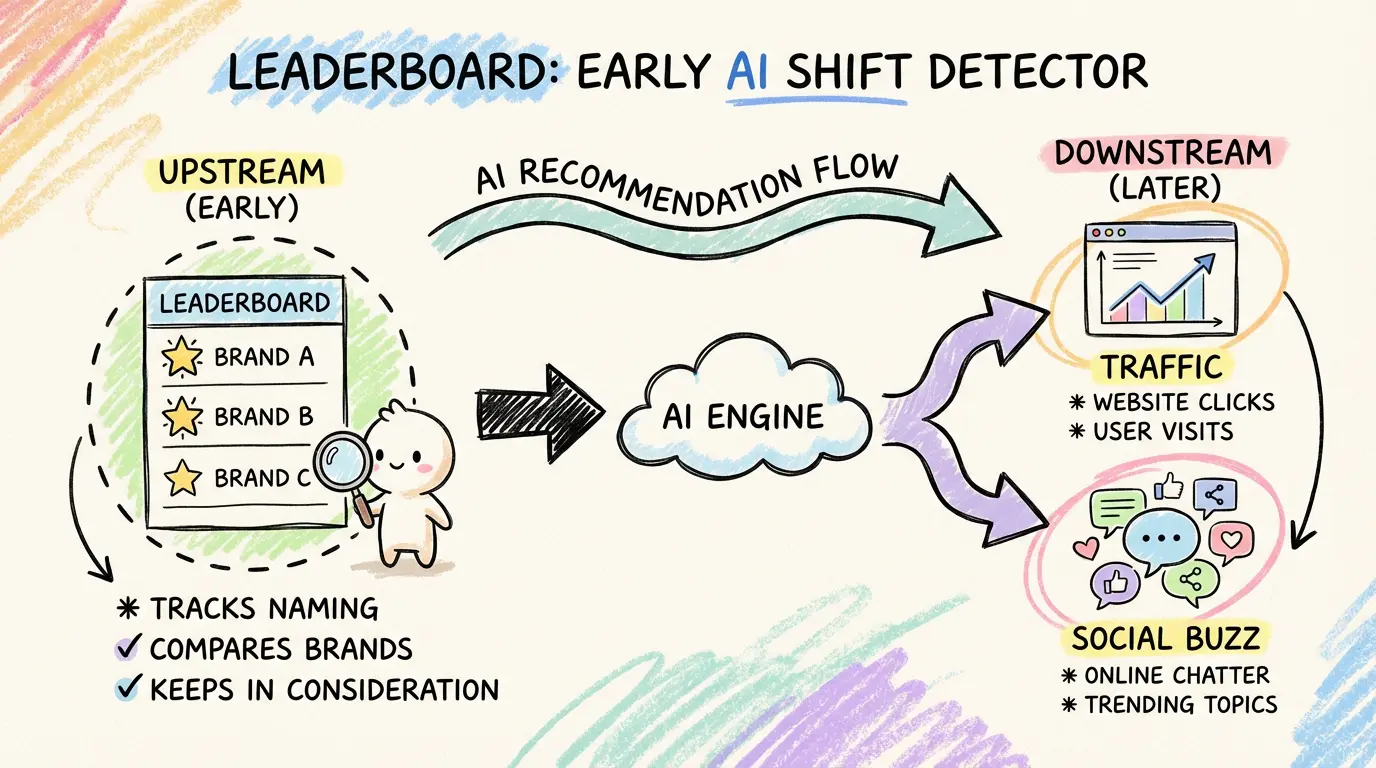
A Leaderboard can sometimes surface shifts in AI recommendation patterns before those shifts appear in traffic or social buzz. The reason is simple: traffic and buzz are downstream outcomes, while a Leaderboard can track whether a brand is still being named, compared, and kept in AI consideration sets upstream.
This is not an abstract trend. In Introducing ChatGPT search, OpenAI turned linked, real-time answers into an official product capability. In How Customers Are Using AI Search, Bain cites Sensor Tower data showing that ChatGPT prompts grew by nearly 70% in the first half of 2025. Adobe also noted in Adobe Analytics that retail traffic from generative AI sources in February 2025 was up 1,200% compared with July 2024, and that this traffic skews more toward the research and consideration stages than directly toward purchase.
Those public signals support one practical premise: brands are increasingly being discovered, compared, and added to the consideration set at the AI answer layer.
That does not mean any Leaderboard will always move earlier than traffic or buzz. A narrower and more defensible claim is this: when a leaderboard measures shifts in AI recommendation position before users arrive on-site or public discussion forms, it can reveal changes in brand position earlier than traditional downstream metrics can.
This article explains why that is possible, what kind of signal a Leaderboard actually captures, and why it should be treated as an early observation layer rather than a replacement for traffic or buzz.
Leaderboard Is Not a Traditional Ranking
AIvsRank's Leaderboard is not a sales ranking, a traffic ranking, or a social buzz ranking. It is an industry view of which brands AI is more likely to recommend first and how that position changes over time.
In practice, that means it is not trying to answer "Who sells the most?" It is trying to answer "Who is most likely to be surfaced first in AI recommendation contexts within this industry?"
For clients, that shifts the question from "Did this brand get attention recently?" to questions like:
- In this industry, who is AI more likely to recommend right now?
- Has the brand's position within AI recommendation patterns changed?
- Which competitors are rising?
- Which changes are already visible in the AI-results layer, even if they have not fully shown up in traffic or buzz metrics yet?
Why This Method Can Sometimes Detect Change Earlier
A Leaderboard can sometimes detect change earlier because it looks at the recommendation layer, not the outcome layer. Traffic and buzz usually show what happened after users clicked, discussed, or shared something. A Leaderboard is closer to what happens earlier, when users ask AI a category question and AI decides which brands belong in the answer.
Put more simply:
- Traffic is closer to what happens after users enter a site.
- Buzz is closer to what happens after outside discussion gets amplified.
- A Leaderboard is closer to how AI organizes brands in the first round of recommendations.
If a brand starts to lose recommendation position in AI answers, that change may not show up in traffic or buzz right away. This is especially true when users are still in the research and consideration stages. At that point, the first visible shift is often not clicks or public conversation. It is whether the brand is still being named early and still making it into the consideration set.
That is why a Leaderboard is best understood as an early observation window. In some scenarios, it can surface changes before traditional outcome metrics do. It should not be framed as a replacement for traffic or buzz.
Why This Ranking Is Not the Same as Asking AI Once
AIvsRank does not build the Leaderboard from one prompt and one answer. It uses a workflow designed to get closer to real user question patterns and to reduce one-off noise.
Based on our current method design, that workflow includes at least these steps:
- Manually selecting popular, high-traffic industries
- Building a pool of real user questions around the industry
- Manually reviewing those questions
- Asking AI each question one by one and collecting brand names and recommendation scores
- Running alias recognition, deduplication, and industry-assignment checks on the results
- Running a second round of validation to reduce the effect of anomalous recommendations on the overall ranking
That matters because the result is not based on one phrasing, one prompt, or one unusual answer. It is based on aggregated results across multiple real question scenarios, followed by cleaning and validation. Even without disclosing the exact formula, the high-level logic is still clear: reduce outliers, control noisy data, and make the ranking better reflect the broader pattern of AI recommendations in the category.
In that sense, "more stable" is not a vague marketing word. It points to three specific design choices:
- Multiple question scenarios instead of a single response
- Brand cleaning and industry-assignment checks instead of raw output
- A second validation pass instead of letting anomalously strong recommendations rewrite the overall ranking
What Clients Actually See in the Leaderboard
Clients do not just see a top list. Based on our current method design, they can see at least a few types of output:
- Overall industry brand ranking
- Brand names
- Mention rate
- AI Visibility Index
- Historical trends
The AI Visibility Index should be read as a business metric for how visible a brand is inside AI recommendation environments for a specific industry. It does not stand in for sales, total buzz, or business performance directly. It is closer to a composite view of whether a brand is being seen, mentioned, and able to hold position across relevant AI answers over time.
Taken together, these outputs help clients see more than who is near the top today. They also help answer questions like:
- Which brands are rising steadily?
- Which brands are still on the list but are weakening in mention rate?
- Which brands are starting to lose a stable position in the historical trend?
- Is the gap between a client and the category leaders narrowing or widening?
A Simple Scenario: Traffic Is Flat, but Recommendation Position Shifts First
A simple restaurant example makes the point. Imagine a brand that has not had any major reputation event recently, and whose website traffic has not moved much either. But in AI-related questions, it starts appearing less often in consideration sets such as "best casual dining" or "best family restaurant."
In that situation, traditional traffic metrics may not raise a strong alarm immediately, and buzz may still look stable. But if the mention rate, AI Visibility Index, and historical trend inside the Leaderboard have already started to move in the same direction, the team can spot the problem earlier. The issue may not be "Is there a traffic anomaly today?" It may be "Has the brand's position inside AI recommendation patterns already started to slip?"
That is the real point of the Leaderboard. It does not replace traffic or buzz. It adds a layer of observation that is closer to AI recommendation logic.
The Real Value for Clients
The practical value of the Leaderboard is not that it creates one more industry ranking. The practical value is that it gives teams an earlier way to see whether their position inside industry AI recommendations is strengthening or weakening.
Used that way, it helps teams answer a few operational questions faster:
- Is the brand rising or falling within industry AI recommendation patterns?
- Which competitors are entering AI consideration sets more frequently?
- Is the change one-off, or is it showing up repeatedly in the historical trend?
- Should the team look first at brand messaging, industry validation, or competitor-comparison context?
That is why the Leaderboard works best as a signal of changes in industry AI recommendation patterns, not as a traditional ranking table and not as a substitute for downstream performance metrics.