
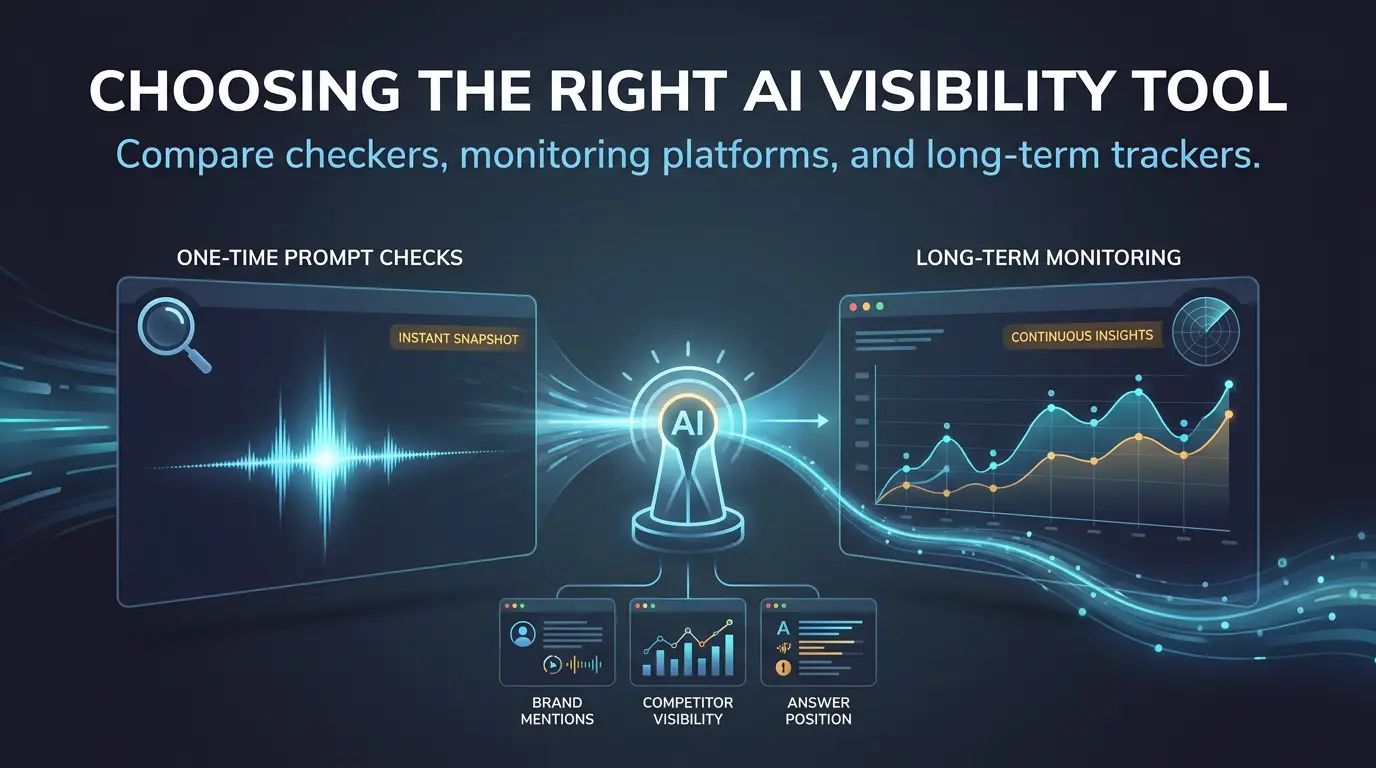
As AI answers become part of buyer research, more teams are looking for an AI visibility tool.
This guide is a buyer criteria framework: it explains how to compare tool capabilities, not which vendor should rank first.
Use it to route three decisions: start with the free AI search visibility checker for one-time diagnosis, use AIvsRank features for recurring monitoring, and review AIvsRank pricing when saved snapshots and team reporting matter.
The harder question is what kind of tool they actually need.
Some teams only need a quick check:
Does our brand appear in AI answers?
Other teams need a recurring workflow:
Are we gaining or losing visibility across AI search engines, competitors, prompts, and citations over time?
Those are different jobs.
A useful AI visibility tool should make that distinction clear instead of turning every use case into the same dashboard.
What problem should an AI visibility tool solve?
An AI visibility tool should help teams understand how their brand appears inside AI-generated answers.
That can include:
- whether the brand appears
- where the brand appears
- how the brand is described
- which competitors appear
- which sources are cited
- which prompts include or exclude the brand
- whether visibility changes over time
The point is not only to know whether an AI system has heard of your brand.
The point is to know whether AI answers present your brand correctly in the contexts that matter to buyers.
Checker, monitoring platform, or rank tracker?
"AI visibility tool" is a broad phrase.
It can describe several different product types.
| Tool type | Best for | Limitation |
|---|---|---|
| AI visibility checker | One-time discovery | Usually limited history and trend tracking |
| AI search monitoring platform | Recurring answer-level monitoring | Needs a clear prompt strategy |
| AI rank tracker | Tracking mention rate, answer rank, and competitor visibility | Should not be treated like traditional SERP rank tracking |
| Brand visibility tracker | Marketing and brand monitoring | May not cover full technical citation or prompt coverage |
This distinction matters because a free checker and a recurring tracker should not be judged by the same criteria.
A free checker should be fast and easy.
A recurring tracker should be repeatable, comparable, and useful for decisions.
Evaluation dimension 1: engine coverage
An AI visibility tool should make clear which AI systems it checks.
Depending on your market, that may include:
- ChatGPT or ChatGPT Search
- Claude
- Perplexity
- Gemini
- Google AI Overviews
- Copilot
- other answer engines or AI search interfaces
More engines are not automatically better.
What matters is whether the tool covers the AI answer environments your customers actually use.
The tool should also make test conditions visible when possible: date, engine, search mode, citation mode, language, region, or account context.
Evaluation dimension 2: prompt coverage
AI visibility is prompt-sensitive.
A brand may appear for a branded prompt and disappear for an unbranded category prompt.
It may appear for a broad educational query but not for a high-intent buying query.
A useful AI visibility tool should support prompt coverage across different intent types:
- branded prompts
- unbranded category prompts
- competitor comparison prompts
- use-case prompts
- industry prompts
- problem-aware prompts
- purchase-intent prompts
This helps teams see where the brand is actually visible.
Evaluation dimension 3: brand mentions
Mention tracking answers the first visibility question:
Does the brand appear?
But mention tracking should not stop at one screenshot.
Teams need to know:
- how often the brand appears across a prompt set
- whether mentions happen only in branded prompts
- whether mentions happen in high-intent prompts
- whether mention rate changes over time
- whether competitors are mentioned more often
This is where mention rate becomes more useful than a single manual prompt test.
Evaluation dimension 4: answer position
AI answers often create ranked or semi-ranked shortlists.
A brand may appear first, appear in a table, appear as a secondary option, or appear only as an alternative.
A useful AI visibility tool should track answer position when the brand appears.
It should also separate absence from low ranking.
A brand that does not appear should not be averaged into answer rank unless the methodology clearly says so.
Evaluation dimension 5: citations and source visibility
AI answers may cite, link, or reference sources.
Source visibility matters because AI systems may use official pages, documentation, third-party reviews, partner pages, public discussions, or outdated content to support an answer.
An AI visibility tool should help teams inspect:
- whether citations appear
- which sources are used
- whether official pages are cited
- whether source pages describe the brand accurately
- whether competitors have stronger source presence
This connects AI visibility with content strategy.
If AI answers cite weak or outdated sources, the issue may not be the prompt. It may be the source material available to the AI system.
Evaluation dimension 6: competitor visibility
AI visibility is relative.
A brand can appear and still lose the answer if competitors appear more often, rank higher, or receive clearer recommendation reasons.
A useful AI visibility tool should track:
- competitor mentions
- competitor answer position
- co-mentioned brands
- comparison context
- recommendation reasons
- competitor trend changes
This helps teams distinguish between a brand visibility problem and a competitive pressure problem.
Evaluation dimension 7: history and saved snapshots
One of the most common mistakes is checking a prompt once and treating the answer as a stable truth.
AI answers change.
They can vary by engine, time, search mode, source availability, prompt wording, and product rollout.
That is why history matters.
A useful AI visibility tool should preserve saved snapshots so teams can compare:
- current answers vs previous answers
- pre-content update vs post-content update
- brand visibility vs competitor visibility
- one AI engine vs another
- one category vs another
Without saved history, teams cannot tell whether AI visibility is improving or declining.
Evaluation dimension 8: reporting and workflow
The final question is whether the tool produces results that teams can actually use.
Different teams need different views.
Marketing teams need to know whether the brand appears in high-intent prompts.
Content teams need to know which pages or explanations should be improved.
Product marketing teams need to know whether AI answers understand the product category.
Leadership teams need trend summaries, not scattered screenshots.
A useful AI visibility tool should turn answer patterns into a workflow:
- identify visibility gaps
- diagnose category or description problems
- compare competitors
- review snapshots
- prioritize content or positioning updates
- track whether changes affect future AI answers
Common mistake: treating one prompt as the whole market
One prompt is not a market.
One answer is not a trend.
One AI engine is not the entire AI search environment.
This is one of the most common mistakes to avoid when choosing an AI visibility tool.
A one-time check can reveal a useful signal, but recurring tracking is needed to understand whether that signal repeats.
From free checker to recurring tracker
The best path is usually staged.
Start with a free AI search visibility checker when you need a fast discovery signal.
Use it to answer:
- Do we appear?
- Are we described correctly?
- Which competitors appear?
- Is this worth monitoring?
Then compare public market patterns with AIvsRank Leaderboard, and move to a recurring workflow through AIvsRank features when you need:
- controlled prompt sets
- recurring snapshots
- mention rate
- average answer rank
- competitor visibility
- citation tracking
- trend history
- team-ready reporting
This avoids overbuying before the problem is clear and under-measuring once AI visibility becomes important. For budget and plan evaluation, use AIvsRank pricing alongside this checklist.
The bottom line
A useful AI visibility tool should not only show whether your brand appears once.
It should help your team understand how AI answers present your brand across engines, prompts, competitors, citations, and time.
Start with a checker when you need discovery.
Use a recurring tracker when you need decisions.
References: