
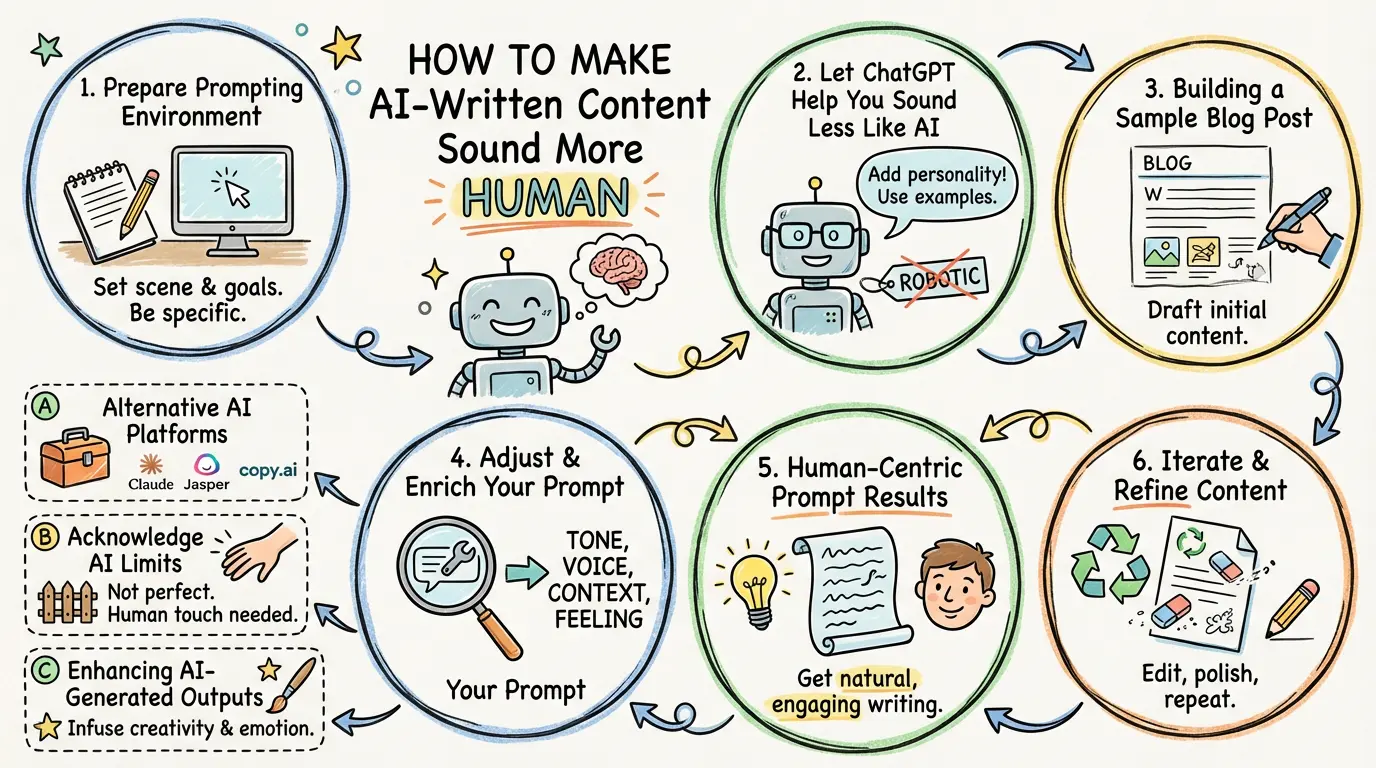
Most advice on this topic is too shallow. It tells you to vary sentence length, remove obvious AI phrases, and add a more conversational tone. That can help, but it misses the bigger problem.
In 2026, a page does not win just because it sounds less robotic. It also needs to be usable by search systems that summarize, compare, and cite sources. If the draft feels smooth but says nothing concrete, both human readers and answer engines move on.
That is why "make it sound human" is no longer a complete editing goal.
The better goal is this: make the content sound human, read like it came from a real operator, and stay structured enough to be extracted as a trustworthy source in AI search.
Google's own guidance points in that direction even without using AI-search language. Its helpful content documentation asks whether a page provides original information, substantial value, insightful analysis beyond the obvious, and enough depth that readers feel they learned what they needed (Google Search Central). Google also says indexing is not guaranteed and that low-quality content is one common reason a processed page may still not make it into the index (Google Search Central).
That matters here because a lot of AI-written articles fail twice at once: they sound generic to humans, and they are too vague to become strong retrieval or citation candidates.
Why "Sounds Human" Is Not Enough Anymore
A page can sound natural and still be weak.
Many edited AI drafts now avoid the most obvious tells. They no longer open every section with "In today's digital landscape." They use contractions. They vary sentence rhythm. They even tell a decent story.
But if the article still lacks a clear point of view, explicit claims, concrete examples, and stable entities, it is only cosmetically improved.
That is a problem because AI search systems do not reward tone alone. They reward usable source material. A page becomes more valuable when its claims are easy to identify, its structure is easy to parse, and its statements are specific enough to quote without heavy interpretation.
We covered the structure side of this in How to Write an Article That Large Language Models Prefer. The short version is that extractability matters. Content should not just be readable. It should be chunkable, semantically clear, and explicit about what each section is trying to answer.
So the real editorial challenge is not "make the prose warmer."
It is "make the content more human and more source-worthy at the same time."
What Usually Makes AI Writing Sound Artificial
The strongest signal is not grammar. It is emptiness.
AI-written content often sounds artificial when it has these patterns:
it uses polished but generic transitions that could fit any article
it makes soft claims without naming a mechanism, metric, or example
it repeats obvious advice with slightly different wording
it avoids committing to a judgment, so every paragraph sounds equally cautious
it talks about "businesses," "brands," or "users" without grounding the statement in a concrete context
it has no operator signal, meaning no evidence that someone has actually worked through the problem in practice
That last point matters more than many teams realize. Human writing does not always sound casual. Often it sounds decisive. It names tradeoffs. It knows which step is annoying. It tells you what usually breaks first.
Real expertise creates texture.
When that texture is missing, the article feels assembled rather than authored.
What Makes Content Citation-Ready for AI Search
At AIvsRank, we use a simple test. A good page should not just be pleasant to read. It should also be easy to retrieve, understand, and quote responsibly.
That usually means the content has five traits:
clear answerability: a reader or model can quickly tell what question the section answers
explicit claims: the page actually says something testable instead of circling around it
entity clarity: product names, concepts, tools, and comparisons are named consistently
evidence anchors: important claims are tied to examples, observations, sources, or concrete criteria
extractable structure: sections, bullets, and examples are organized so a system can lift the useful part without guessing
This is also the logic behind our AI Citation Readiness Checker. The tool does not promise citations, because no tool can. What it does surface is whether a page is easier or harder for answer engines to reuse based on answerability, evidence density, entity clarity, and extractability.
Notice that none of those factors require robotic writing. In fact, the best citation-ready content often feels more human because it is less padded and more deliberate.
The AIvsRank Rewrite Checklist
When an AI draft feels weak, we do not start by sprinkling in personality. We start by asking why the page would deserve to be cited at all.
Use this checklist during editing:
If a sentence could appear in ten other articles, rewrite it until it contains a specific claim, scenario, or constraint.
If a paragraph makes a recommendation without saying when it matters, add the condition.
If a section names a concept without naming the entity, define the entity directly.
If the article sounds balanced everywhere, allow a few stronger judgments where the evidence is clear.
If the draft uses examples that could belong to any industry, replace at least some of them with examples from the domain you actually serve.
If the page offers takeaways but no evidence path, add a source, observation, checklist, or before-and-after example.
If the article reads smoothly but cannot be quoted cleanly, break out the strongest idea into a tighter section or bullet list.
Another way to say it is this:
AI-sounding writing is often under-specified.
Non-citable writing is often under-structured.
Strong AI-search content fixes both.
Three Before-and-After Rewrites
Here are a few examples of what that looks like in practice.
Example 1: Generic encouragement
Before:
AI can help businesses create better content more efficiently.
Why it fails:
no clear audience
no mechanism
no usable claim
After:
AI speeds up first-draft production, but most teams do not gain much until they reduce the editing and orchestration work around the draft itself.
Why this is stronger:
it makes a specific claim
it introduces a tradeoff
it gives a reader or model something quotable
Example 2: Human-sounding but still weak
Before:
It is important to make AI content natural, engaging, and aligned with your brand voice.
Why it fails:
every content team already believes this
there is no diagnostic value
nothing in the sentence explains how to do it
After:
If an AI draft uses smooth transitions but no concrete judgments, readers may tolerate it, but answer engines still have little reason to extract it as a source.
Why this is stronger:
it names a common failure pattern
it ties tone to retrieval value
it gives the editor a real test
Example 3: Better for AI search, not just style
Before:
Sitemaps are helpful for SEO and should be part of your strategy.
Why it fails:
true, but generic
too broad to cite
no relevance to a modern AI-search workflow
After:
Sitemaps do not create AI visibility directly, but they strengthen discovery and recrawl signals, which affects whether updated pages are even available to answer systems in time to be cited.
Why this is stronger:
it clarifies the mechanism
it narrows the claim
it is easier to reuse in an AI-search explanation
A Practical Editing Workflow for AI Drafts
If you want a repeatable process, edit in this order.
1. Fix the thesis before the sentences
Do not start with tone. Start with the argument.
Ask: what is this page trying to help the reader understand, decide, or do? If you cannot answer that in one sentence, the draft is not ready for line edits.
2. Replace generic claims with explicit ones
Look for phrases like "improve performance," "enhance visibility," "build trust," or "create better content." These are usually placeholders. Replace them with a narrower claim that names what changes, for whom, and why.
3. Add operator evidence
This does not always mean original research. It can mean a concrete workflow observation, a diagnostic pattern, a real comparison, or a checklist that comes from actual use.
This is often the difference between an article that sounds edited and one that sounds experienced.
4. Tighten entity consistency
If you are discussing AI Overviews, citation readiness, robots.txt, grounding, answer engines, or schema, use the same terms consistently. Entity drift makes both readers and models work harder than they should.
5. Restructure for extraction
Strong ideas should not be buried in paragraph six of a section. Pull them up into headings, bullets, short examples, or compact explanation blocks. This is one reason list-heavy sections can be useful when they contain real distinctions instead of filler.
6. Only then smooth the voice
Once the draft is specific, structured, and evidence-backed, adjust rhythm and phrasing. Remove dead transitions. Cut padded openings. Keep some short sentences. Let a few sharper judgments stay sharp.
That is how you get prose that feels more human without weakening the informational core.
Do Not Ignore Eligibility and Technical Signals
One more caution: better writing does not override technical blockers.
If the page is difficult to crawl, marked noindex, canonicalized elsewhere, or missing the structure needed to surface clean answers, rewriting the prose alone may not solve the visibility problem. That is exactly why we separate content quality from eligibility checks.
Our AI Overview Eligibility Checker is useful for that second layer. It helps catch issues like noindex, nosnippet, canonical conflicts, missing structured data, and weak answer-block patterns. Eligibility is not the same thing as ranking, and ranking is not the same thing as citation readiness. You need all three layers working together.
The Standard to Aim For
If you want a simpler benchmark, use this one:
After editing, the article should feel like it was written by someone who has actually had to solve the problem, and structured by someone who understands how search systems reuse information.
That usually means the page can do three things at once:
hold a human reader because it has a real point of view
satisfy search quality expectations because it adds original value instead of recycled advice
increase its AI visibility potential because key ideas are explicit, quotable, and easy to extract
Google's people-first guidance is still a useful sanity check here. If the content is mainly trying to attract search visits, mostly summarizes what others already said, or leaves readers needing another search to get a real answer, the page is probably still underperforming its purpose (Google Search Central).
Final Takeaway
Making AI-written content sound human is worth doing, but it is not enough.
The better editorial target is to make it sound human, feel authored, and remain citation-ready for AI search. That means stronger claims, clearer entities, better examples, tighter structure, and more evidence of real experience. The pages that win in this environment are usually not the ones that hide AI involvement most successfully. They are the ones that turn rough AI output into something specific enough to trust and useful enough to quote.