
The contrast between human writing and AI writing does not become clear when both drafts are bad. It becomes clear when both are already competent.
At that point, grammar is no longer the issue. Fluency is no longer the issue either. The real question is why one piece feels merely finished while the other feels chosen.
That is where the difference starts to matter.
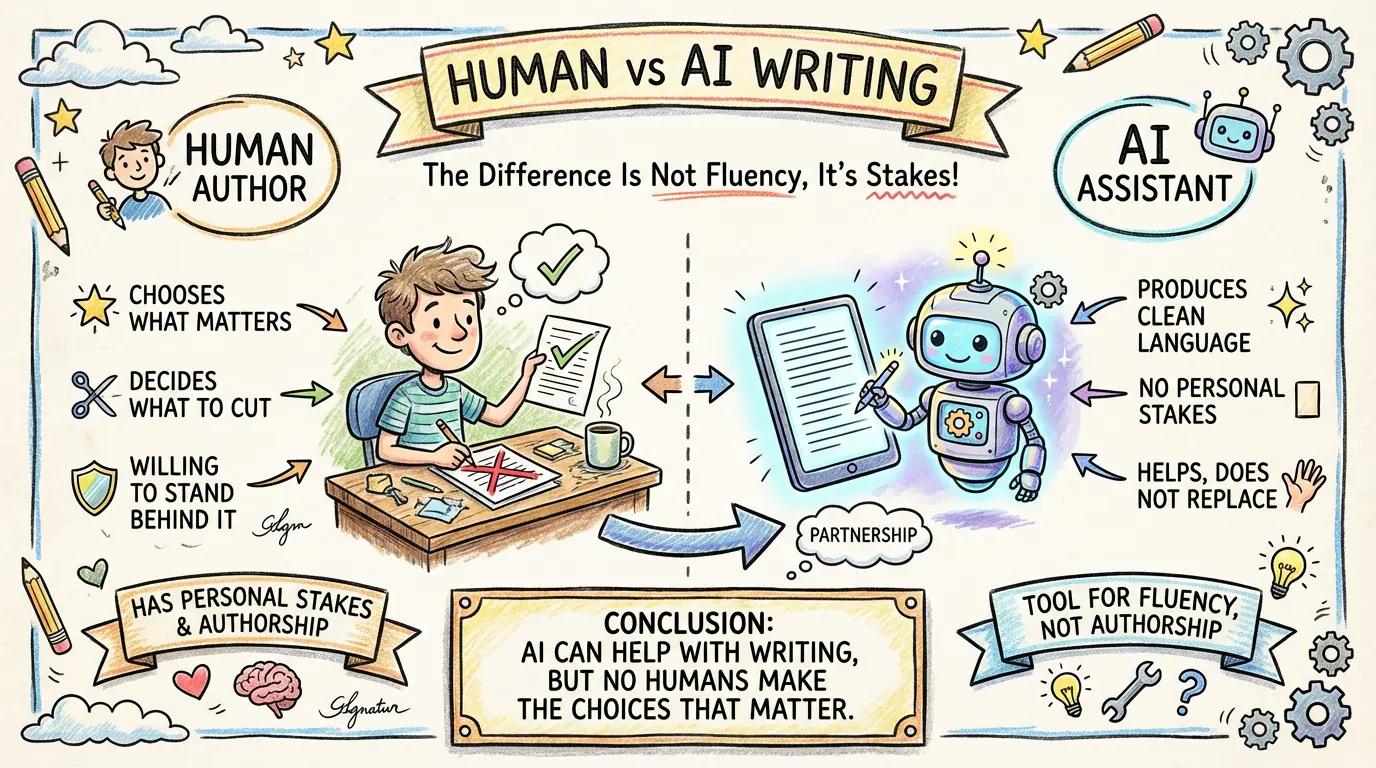
A strong human draft usually carries evidence of selection. Someone decided what the piece was really about, which angle deserved more weight, which paragraph had to go, and which sentence was too smooth to be trusted. An AI system can produce plausible language with surprising ease, but plausible language is not the same thing as judgment under consequence.
That is why AI can help with writing without fully occupying the writer's role. Wording is only part of the work.
The Part People Overrate
AI has become good enough at sentence-making that it confuses people about the real nature of writing.
If you ask it for a product summary, a list of headlines, or a fast rewrite in a different tone, it can be genuinely useful. In some of those tasks, it is faster than most humans and more consistent than tired ones.
That is why the wrong conclusion is so tempting. The text looks finished, so people assume the thinking must be finished too.
But clean language is not the same as authored meaning. A polished paragraph can still be hollow. Most editors know this feeling immediately. You read a draft and nothing is technically broken, but nothing is really chosen either. The piece seems to glide over its own subject.
That is one of the classic failure modes of AI writing. It often reaches readability before it reaches necessity.
Where Human Writing Actually Begins
Good human writing usually starts before the first sentence.
It starts in the narrowing.
A real writer asks things like: what is the live issue here, which part is interesting, what does this reader need first, which example earns the point, and which paragraph is only there because I am reluctant to cut it?
That last question matters more than people admit. A lot of good writing is removal. An experienced writer knows that one accurate but low-energy paragraph can drain the force out of an entire piece. So they cut it. Or move it. Or compress it into half a sentence.
AI does not make that kind of cut for the same reason a person does.
It can shorten text. It can simplify wording. It can reorganize a draft. But it does not have a felt sense that one sentence weakens the argument because it arrives too early, sounds too safe, or steals emphasis from the paragraph that should land harder.
That is a judgment call. Writing lives in judgment calls.
A Small Example
Imagine a founder writing to their team after a bad quarter.
An AI system can absolutely produce a competent memo. It can sound calm, structured, supportive, and clear. In many cases it will sound better than the founder's first raw draft.
But the real work is not in producing the memo shape. The real work is deciding whether to sound defensive or direct, whether to name the mistake plainly, whether to promise less and mean it, whether morale needs steadiness or honesty with more edge. Those are not wording choices in the narrow sense. They are leadership choices that happen to arrive through language.
The same thing happens in smaller settings.
A writer working on an article may decide to cut the clever opening because it delays the real point. An editor may remove a whole section that is technically solid but emotionally dead. A marketer may soften one claim because it overreaches. In each case, the writing improves because somebody chose what the piece should risk and what it should protect.
That is the kind of authorship people are usually pointing at, even if they do not phrase it that way.
Why AI Writing Often Feels a Little Airless
People often say AI writing feels generic. I think that is true, but still not precise enough.
What it often feels like is airless.
The prose is smooth. The transitions work. The shape is visible. But the draft does not seem to come from anywhere in particular. It has no real pressure behind it. You can feel that the language is solving for completion, not for emphasis.
That is why so much AI-written text sounds oddly over-explained. It keeps rounding out the argument. It keeps making the balanced version of the point. It keeps choosing the sentence that offends nobody, surprises nobody, and therefore sticks with nobody.
Human writers do this too, of course. Plenty of human writing is bland. But strong human writing usually leaves fingerprints anyway: an example that is a little too exact to be generic, a sentence cut shorter than rhythm alone would predict, a detail that receives more weight because the writer clearly thinks it matters, a tonal turn that reveals a real point of view rather than a balanced default. None of that is mystical. It is simply evidence that someone was selecting, not just producing.
AI Is Still Useful, Just in a Different Role
None of this means AI is bad at writing tasks. It means the role has to be named correctly.
AI is strong when the main problem is volume, variation, formatting, rephrasing, summarizing, or getting from a blank page to a rough structure. It is especially helpful when the writer already knows what the piece should do and simply wants speed.
It is much weaker when the real problem is deciding what matters, what can be omitted without loss, which claim quietly overreaches, or whether a paragraph is technically sound but lifeless. It is also weak at recognizing a draft that sounds persuasive while saying very little. Those are the moments when writing stops being arrangement and becomes judgment.
That is why AI often works best as a second pair of hands rather than the final owner of the piece.
Used well, it can help a human writer move faster. Used lazily, it replaces hard choices with fluent filler.
What Better AI-Assisted Writing Looks Like
The best workflow I have seen is not "let AI write, then lightly edit." That usually preserves too much of the machine's default shape.
A better workflow is more uneven than that.
The human defines the angle first. Then AI can help with options, outlines, or ugly first-draft material. Then the human comes back in and does the part that matters most: cutting, sharpening, reordering, and restoring the writer's real priorities.
In practice that often means rewriting the opening after the body exists, deleting the most well-behaved paragraph because it adds no pressure, replacing abstract nouns with one concrete scene, and cutting any sentence that sounds as though it was written to feel complete rather than to say something necessary.
That last test is more useful than it sounds. A lot of AI-heavy prose is full of sentences that appear finished but never become essential.
Human revision is where necessity returns.
The Short Version
So what is the biggest difference between human and AI writing?
It is the difference between generating language and assuming responsibility for meaning.
Humans decide what a piece finally means and accept the cost of that decision. AI can generate language that resembles authored text, sometimes very effectively, but it does not bear the same stakes when a claim is too broad, a tone is slightly wrong, or a paragraph weakens the whole piece by being merely competent.
That is why AI can belong in a serious writing workflow without becoming the center of authorship. The useful question is no longer whether AI can write. Clearly it can. The harder and more important question is who is choosing, who is cutting, who is standing behind the final meaning, and who will answer for it if the piece gets the judgment wrong.
That remains the most durable human advantage.