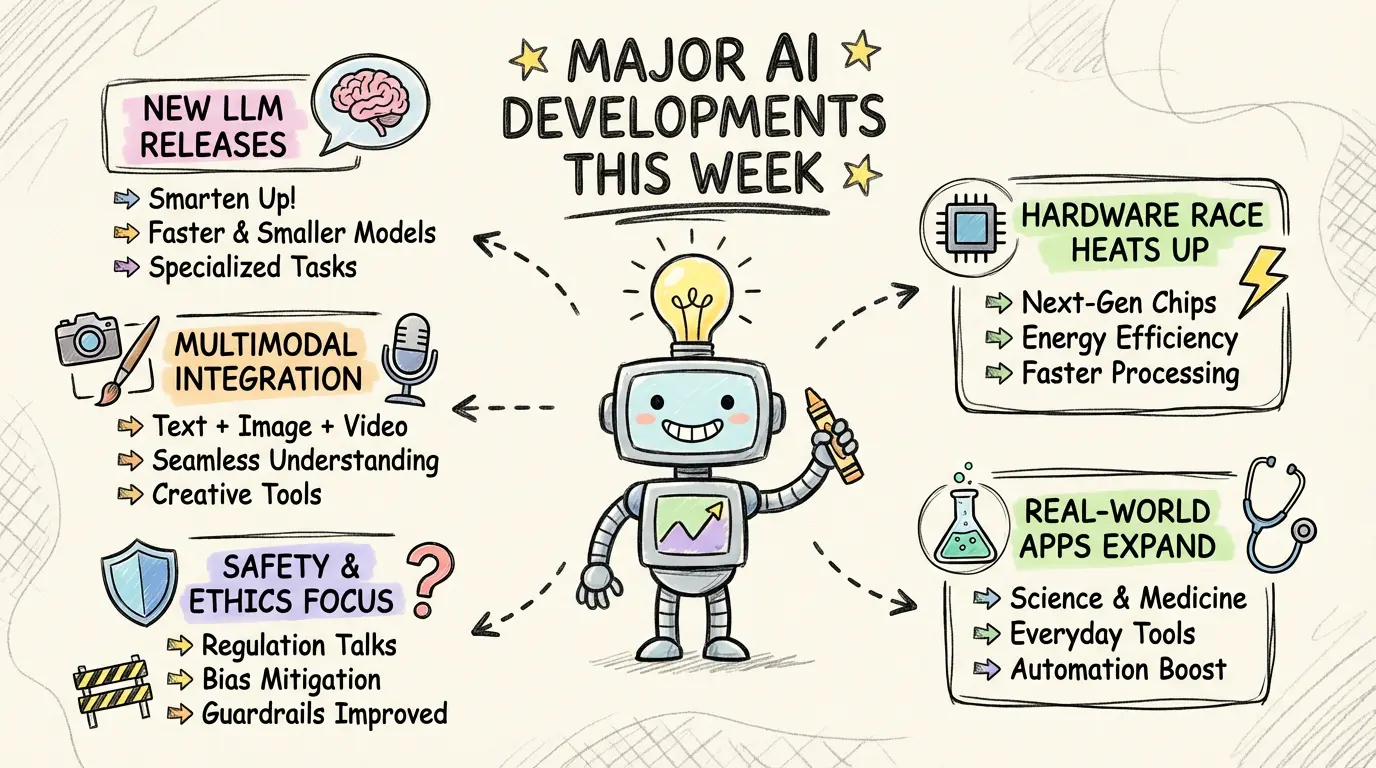
In mid-March 2026, the global AI industry continued to move at an extraordinary pace. From intensifying competition around AI infrastructure to traditional software companies restructuring around AI, and from large model development challenges to AI entering the physical world through robotics, several developments stood out across infrastructure, model development, enterprise software, and AI deployment.
Why infrastructure shifts matter for AI visibility
Model delays and infrastructure bottlenecks affect which AI products ship, how often answers refresh, and when brands need to update evidence across the web. Teams tracking AI visibility should watch adoption signals, source freshness, and answer-engine behavior, not only traditional search rankings.
For brands, the practical question is whether AI systems have current evidence to cite when market narratives change. Use AI visibility monitoring and the public AI leaderboard to compare how answer engines surface categories, products, and competitors over time.
Below are four of the most notable AI industry developments from March 2026, along with the broader trends they reveal.
1. The AI Infrastructure Race Intensifies Ahead of NVIDIA’s GTC Conference
The annual NVIDIA GTC conference has long been considered one of the most influential events in the AI ecosystem. This year’s conference is attracting even more attention, as it is expected to showcase the next stage of the global AI infrastructure race.
With the rapid adoption of generative AI, AI agents, and automated development tools, the demand for computing power is increasing at an unprecedented pace. More companies are shifting their operations toward AI-driven workflows, and behind this transformation lies a fundamental requirement: massive computational resources supported by GPUs and data centers.
NVIDIA said GTC 2026 would highlight new developments across GPU architectures, data center systems, and enterprise AI platforms.
Over the past two years, competition in the AI sector has largely centered on model capabilities. Today, however, the battleground is gradually shifting toward deeper layers of the technology stack—computing infrastructure, data centers, and integrated AI platforms. NVIDIA appears determined to position itself not merely as a GPU manufacturer, but as a foundational infrastructure provider for the entire AI industry.
2. Meta Delays the Launch of Its Next-Generation AI Model
Meanwhile, another major technology company, Meta, has reportedly postponed the release of its next-generation AI model, known internally as Avocado. Reuters reported that the launch could be delayed until May or later this year.
The delay highlights the growing complexity of developing cutting-edge AI models. Despite Meta’s massive investments in AI research, internal evaluations suggest the model has not yet reached the level of performance the company expects.
People walk behind a logo of Meta Platforms company, during a conference in Mumbai, India, September 20, 2023. REUTERS/Francis Mascarenhas Purchase Licensing Rights
Early tests indicate that the model performs somewhere between the capabilities of current top-tier systems, but it may not yet provide a sufficiently clear competitive advantage.
To continue advancing its AI strategy, Meta is also expanding its investments in infrastructure, including the development of proprietary AI chips and additional data centers. Analysts believe the competition among large AI models has entered an era of extremely high costs, where even major technology companies must carefully balance model quality, infrastructure spending, and product timelines.
3. Atlassian Cuts Jobs as Traditional SaaS Companies Pivot to AI
Enterprise software company Atlassian recently announced a significant restructuring plan that includes laying off approximately 1,600 employees—about 10% of its workforce.
The move was presented by the company as part of a broader shift toward AI investment and enterprise sales. Company leadership stated that more resources will now be directed toward integrating AI capabilities into Atlassian’s software ecosystem.
Atlassian CEO and co-founder Mike Cannon-Brookes announced the layoffs to employees on Wednesday. Photograph: Bloomberg/Getty Images
As AI technology becomes increasingly embedded in areas such as software development, project management, and team collaboration, traditional SaaS tools face mounting pressure to evolve. Companies that fail to adapt quickly risk being overtaken by a new generation of AI-native platforms.
Over the past year, many software companies have begun redesigning their products around AI capabilities—embedding AI assistants into workflows, enabling natural-language interactions with complex systems, and even allowing AI to generate documentation or code automatically. This signals a broader transformation across the enterprise software landscape.
4. Amazon Outage Renews Questions About AI-Assisted Code
AI coding tools are rapidly making their way into real production environments, but recent events have highlighted the risks associated with relying too heavily on automated code generation.
Reports about a recent Amazon service disruption renewed questions about the risks of using AI-assisted tools in production environments, although Amazon later said the issue was not caused by AI-written code and involved user error.
The incident has sparked renewed discussions within the software engineering community about the governance and reliability of AI-assisted development. While AI coding assistants can dramatically improve developer productivity, fully trusting AI-generated code without rigorous oversight can introduce serious vulnerabilities.
Going forward, many experts believe companies will need to establish new engineering frameworks for AI-assisted development, including stricter code review processes, automated testing pipelines, and specialized deployment safeguards.
Four AI Developments to Watch in March 2026
Looking at these developments together, three major trends are becoming increasingly clear.
First, competition in AI is moving beyond model performance and into infrastructure. Computing power, data centers, and platform ecosystems are becoming central to the next phase of industry competition.
Second, the enterprise software sector is undergoing a major transformation as companies adopt AI-first strategies. Traditional SaaS products are being redesigned around intelligent automation and AI-assisted workflows.
Third, AI is gradually expanding beyond the digital realm into real-world applications. Robotics, automation systems, and AI-powered hardware are likely to play a growing role in the next stage of technological development.
Taken together, these signals suggest that AI is no longer just about breakthroughs in machine learning models. Instead, it is becoming a foundational force reshaping the broader technology landscape.