
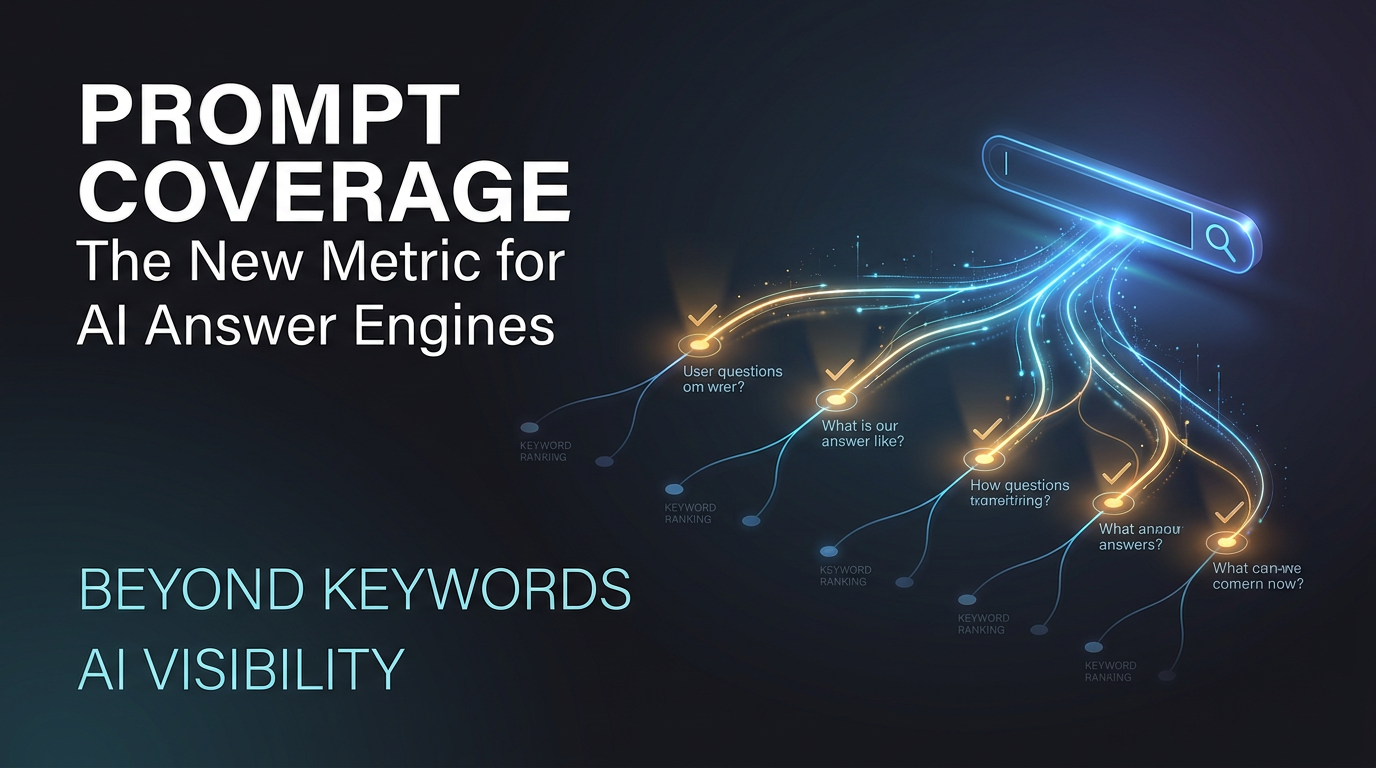
Prompt Coverage: The New Keyword Coverage for Answer Engines
SEO teams used to ask a familiar question:
How many keywords do we rank for?
That question still matters. But it is no longer enough.
AI search changes the unit of discovery. A user does not always type a short keyword, scan ten blue links, and choose a page. In ChatGPT, Perplexity, Gemini, Google AI Overviews, AI Mode, Copilot, and other answer engines, the user can ask a full question, add constraints, compare options, clarify intent, and keep exploring in the same thread.
That means brands need a new visibility metric:
Prompt coverage.
Prompt coverage measures how much of the real user question space a brand covers in AI-generated answers. It asks whether a brand appears, is recommended, is cited, and is compared when users ask the kinds of prompts that shape discovery, evaluation, and buying decisions.
Keyword coverage is about ranking for search terms.
Prompt coverage is about showing up for the questions people actually ask answer engines.
Why keyword coverage is not enough
Keyword coverage worked because traditional search was organized around queries and ranked documents. If a brand ranked for enough category keywords, comparison keywords, and long-tail keywords, it could capture search demand.
AI search is different in three ways.
First, prompts are more expressive than keywords.
A keyword might be:
- "project management software"
- "asana alternative"
- "best crm for startups"
An AI search prompt might be:
- "What project management tool should a 12-person marketing team use if we need approvals, calendar views, and client collaboration?"
- "Compare Asana, ClickUp, and Monday for a small agency that cares more about reporting than task automation."
- "What CRM is best for a seed-stage startup that sells to mid-market SaaS companies and cannot afford Salesforce yet?"
These prompts contain audience, use case, constraints, comparison logic, and decision criteria. They are not just longer keywords. They are compressed briefs.
Second, AI answers synthesize instead of listing.
Google says AI Mode is useful for nuanced questions, reasoning, and complex comparisons, and that AI Overviews and AI Mode may use query fan-out by issuing multiple related searches across subtopics and data sources before generating a response with supporting links (Google Search Central).
That matters because a brand may not win visibility by ranking for one exact phrase. It may appear because its content, documentation, reviews, third-party mentions, and category associations help the answer engine build a useful response.
Third, the user may never click.
If the AI answer already compares options, summarizes tradeoffs, and recommends a short list, the user can form an opinion without visiting each site. Keyword rankings and traffic still matter, but they miss the answer layer where consideration is being shaped.
This is why prompt coverage is not a replacement for keyword coverage. It is the next layer above it.
Keyword coverage asks:
- Do we rank for the words people search?
Prompt coverage asks:
- Do we appear for the questions people ask?
- Do we appear for the right reasons?
- Do we appear when competitors appear?
- Are we cited, recommended, or only mentioned?
- Which unanswered prompts should guide the GEO roadmap?
What is prompt coverage?
Prompt coverage is the percentage of relevant AI search prompts where a brand appears in the generated answer.
A simple formula is:
Prompt coverage = prompts where the brand appears / total relevant prompts tested
If a team tests 200 AI search prompts across category, use case, comparison, and problem-aware questions, and the brand appears in 62 answers, the brand has 31% prompt coverage for that prompt set.
But a useful prompt coverage report should not stop at present or absent. It should also track:
- whether the brand was recommended or only mentioned;
- whether the brand was cited or uncited;
- whether the brand appeared above or below competitors;
- whether the answer used owned sources, third-party sources, reviews, documentation, or community discussions;
- whether the answer framed the brand accurately;
- whether the brand appeared consistently across repeated runs.
This makes prompt coverage a practical bridge between AI visibility, content strategy, product positioning, digital PR, and technical SEO.
It turns "AI search feels hard to measure" into a working question:
Which prompts do we cover, which prompts do competitors cover, and which prompts should we build for next?
Prompt coverage vs keyword coverage
Prompt coverage is not keyword coverage with longer phrases.
| Dimension | Keyword coverage | Prompt coverage |
|---|---|---|
| Unit of measurement | Search keyword | User question or prompt |
| Main output | Ranked pages | Generated answers |
| Visibility signal | Rank position and click potential | Mention, recommendation, citation, answer position, competitor presence |
| User behavior | Query, scan, click | Ask, refine, compare, continue |
| Content implication | Create pages for terms | Build evidence for real decision contexts |
| Reporting question | How many keywords do we rank for? | How many important prompts include us? |
The difference sounds subtle until you look at a real buyer journey.
A keyword strategy might target:
- "AI visibility tool"
- "AI search visibility"
- "GEO audit"
- "answer engine optimization"
A prompt coverage strategy would ask:
- "Which AI visibility tools can show whether my brand appears in ChatGPT answers?"
- "How do I know if competitors are being recommended more often than us in AI search?"
- "What is the fastest way to audit whether a website is ready for answer engines?"
- "Which metrics should a marketing team track for AI search visibility?"
The second set is closer to how users ask questions in AI systems. It is also closer to how answer engines decide whether a brand belongs in a response.
How to define a prompt set
Prompt coverage is only useful if the prompt set is well defined.
The mistake is to collect a random list of clever prompts and call it a benchmark. A prompt set should represent the real questions that matter to a category, product, or audience.
A good prompt set usually includes four groups.
Category prompts
Category prompts define the market.
They are broad questions users ask when they are trying to understand what options exist.
Examples:
- "What are the best tools for tracking brand visibility in AI search?"
- "What platforms help marketers monitor mentions in ChatGPT and Perplexity?"
- "Which software can show whether a company is cited in AI answers?"
Category prompts are important because they shape discovery. If a brand is missing from these answers, it may never enter the user's consideration set.
For a GEO or AI visibility product, category prompts are where terms like "AI prompt tracking," "AI search prompts," "AI visibility tools," and "answer engine visibility" start to matter.
Use case prompts
Use case prompts connect the category to a specific job.
Examples:
- "How can a SaaS marketing team track whether its brand appears in AI answers?"
- "What should an agency use to monitor AI search visibility for clients?"
- "How can a content team find prompts where competitors are recommended instead of us?"
- "What tool helps a startup run a quick GEO audit before investing in a full platform?"
Use case prompts are valuable because AI answers often recommend different solutions for different contexts. A tool that is best for an enterprise brand team may not be best for a small content team. A product that wins agency-reporting prompts may not win technical SEO prompts.
Prompt coverage should capture those differences instead of averaging them away.
Comparison prompts
Comparison prompts show where users are close to a decision.
Examples:
- "Compare brand visibility tracking tools for AI search."
- "What is the difference between AI prompt tracking and traditional rank tracking?"
- "Which is better for AI visibility monitoring: a free GEO audit or a full enterprise platform?"
- "What are the tradeoffs between AI visibility tools that track citations and tools that track mentions?"
Comparison prompts are often more commercially valuable than broad category prompts. They reveal whether the brand is being placed in the right competitive set, whether its positioning is understood, and whether AI answers describe its strengths accurately.
Problem-aware prompts
Problem-aware prompts start with pain rather than category language.
Examples:
- "Why is my brand not showing up in ChatGPT recommendations?"
- "How do I find prompts where competitors appear but my company does not?"
- "Why did traffic drop even though brand awareness seems to be increasing?"
- "How do I make my content easier for AI search engines to cite?"
These prompts are easy to miss if the team only builds a keyword list. But they often reveal the user's real need.
Problem-aware prompt coverage is especially useful for content planning because it shows which questions the brand can answer before the user has chosen a tool category.
Coverage signals: what to track for each prompt
Prompt coverage should not be a single checkbox. Each prompt should produce a small set of signals.
Appears or does not appear
The first signal is simple:
Does the brand appear in the answer?
This is the baseline prompt coverage metric. If the brand does not appear at all for an important prompt, the team has a visibility gap.
But presence alone is not enough. A brand can appear in a weak position, appear as a negative example, or appear only because a source title mentioned it.
Recommended or only mentioned
The second signal is recommendation strength.
Useful labels include:
- recommended;
- listed as an option;
- compared neutrally;
- mentioned in passing;
- mentioned negatively;
- not mentioned.
This matters because AI answers often compress evaluation into a short list. Being recommended as a strong fit is different from being mentioned as one of many options.
For example, "Tool A is best for enterprise teams" is stronger than "Other tools include Tool A." Both count as appearances, but they should not carry the same weight.
Cited or uncited
The third signal is citation.
Is the answer citing the brand's own site, a third-party article, a review platform, a documentation page, a community thread, or no source at all?
This is where prompt coverage connects to source strategy.
A 2026 measurement paper on GEO separates citation selection from citation absorption. It argues that a page can be selected as a source, while the final answer may absorb different amounts of language, evidence, structure, or factual support from that page (arXiv).
That distinction matters for prompt coverage. A brand can appear without being cited. A page can be cited without the brand being recommended. A source can influence the answer even if the visible mention is small.
For each prompt, track:
- brand appears or not;
- brand recommended or only mentioned;
- owned site cited or not;
- third-party source cited or not;
- competitor cited or not;
- answer accurate or inaccurate;
- snapshot URL or saved evidence.
This creates a prompt-level evidence layer that is more useful than a raw visibility score.
How to calculate prompt coverage
Start with a defined prompt set.
Then calculate prompt coverage at several levels.
Overall prompt coverage
Overall prompt coverage gives the broad baseline.
Overall prompt coverage = prompts where brand appears / total prompts tested
This number is useful for a high-level health check, but it should not be the only number in the report.
Prompt coverage by type
Break coverage into prompt groups:
- category prompt coverage;
- use case prompt coverage;
- comparison prompt coverage;
- problem-aware prompt coverage;
- pricing prompt coverage;
- alternative prompt coverage;
- local or regional prompt coverage;
- integration prompt coverage;
- trust and risk prompt coverage.
This shows where the brand is visible in the buyer journey.
A brand may have strong category coverage but weak comparison coverage. That means users may discover the brand, but AI answers may not defend it when users compare options. Another brand may have weak discovery coverage but strong problem-aware coverage, which means it is visible when users ask a specific pain-driven question.
Prompt coverage by engine
Calculate coverage separately for each answer engine.
For example:
- ChatGPT prompt coverage;
- Perplexity prompt coverage;
- Gemini prompt coverage;
- Google AI Overviews prompt coverage;
- Google AI Mode prompt coverage;
- Copilot prompt coverage.
Google notes that AI Mode and AI Overviews may use different models and techniques, and that the responses and links they show can vary (Google Search Central).
That is why one combined score can be misleading. Prompt coverage should show where the brand appears and where it disappears.
Recommended prompt coverage
Recommended prompt coverage is stricter than appearance coverage.
Recommended prompt coverage = prompts where brand is recommended / total prompts tested
This metric is useful for growth and brand teams because it focuses on answers that can shape preference, not just awareness.
Cited prompt coverage
Cited prompt coverage measures whether the brand appears with source support.
Cited prompt coverage = prompts where brand appears and a relevant source is cited / total prompts tested
This helps content and SEO teams understand whether the brand's own content and earned sources are discoverable and usable by answer engines.
How to do competitor prompt gap analysis
Competitor prompt gap analysis is the most useful application of prompt coverage.
It answers:
Where do competitors appear in AI answers but we do not?
The process is straightforward.
1. Define the competitor set
Choose competitors based on the actual answer landscape, not only the sales team's usual list.
Include:
- direct product competitors;
- enterprise incumbents;
- niche specialists;
- marketplaces or review sites;
- open-source or free alternatives;
- category publishers that are frequently cited.
AI answers may introduce competitors that do not appear in traditional SEO rank tracking. If they show up in the answer, they are part of the user's consideration set.
2. Run the same prompt set for every brand
Use the same prompts across all tracked brands.
For each prompt, record:
- your brand appears or not;
- each competitor appears or not;
- who is recommended first;
- who is cited;
- what source supports the answer;
- whether the framing is positive, neutral, or negative.
This creates a clean matrix:
| Prompt | Your brand | Competitor A | Competitor B | Competitor C | Best visible source | Gap type |
|---|---|---|---|---|---|---|
| Best tools for AI search visibility | Missing | Recommended | Mentioned | Recommended | Third-party list | Category gap |
| How to audit GEO readiness | Recommended | Missing | Missing | Mentioned | Owned guide | Use case win |
| Compare AI prompt tracking tools | Mentioned | Recommended | Recommended | Missing | Review article | Comparison gap |
3. Classify the gap
Not every gap needs the same response.
Useful gap types include:
- missing brand gap: competitors appear, you do not;
- weak recommendation gap: you appear but competitors are recommended more strongly;
- citation gap: competitors are cited, you are uncited;
- source gap: AI answers rely on third-party sources that do not include you;
- accuracy gap: the answer mentions you but describes you incorrectly;
- content gap: no owned page clearly answers the prompt;
- authority gap: the page exists, but stronger external evidence supports competitors.
This turns prompt coverage into action.
4. Prioritize by business value
Do not chase every missing prompt.
Prioritize prompts that are:
- commercially meaningful;
- close to buying intent;
- repeated across engines;
- dominated by direct competitors;
- supported by sources you can influence;
- aligned with product strengths;
- likely to become reusable content assets.
The best prompt gaps are not just empty spaces. They are opportunities where a better page, clearer positioning, stronger documentation, or better third-party evidence can change how answer engines represent the brand.
How prompt coverage connects AI visibility and the GEO roadmap
Prompt coverage becomes useful when it turns measurement into a roadmap.
The AIvsRank features page frames the kind of monitoring layer teams need: brand mentions, citations, answer positions, competitor visibility, and saved snapshots across AI-generated answers. Prompt coverage gives that monitoring a planning structure.
Each prompt gap should point to an action.
| Prompt coverage finding | GEO roadmap action |
|---|---|
| Brand missing from category prompts | Build stronger category pages and comparison-ready content |
| Brand mentioned but not recommended | Clarify positioning, proof points, audience fit, and differentiators |
| Brand recommended but uncited | Strengthen owned pages, documentation, and source-ready evidence |
| Competitor cited from third-party lists | Improve PR, partner pages, review profiles, and list inclusion |
| Prompt answer uses outdated information | Update canonical pages and make current facts easier to extract |
| Prompt appears only in one engine | Investigate source differences and engine-specific evidence |
| High-value prompt has no owned answer | Create a page, guide, FAQ, or documentation asset for that use case |
This is where prompt coverage becomes more than reporting.
It helps teams decide what to write, what to update, what to structure, what to pitch, and what to monitor after changes are made.
The original GEO research introduced generative engine optimization as a way for content creators to improve visibility in generated responses and tested visibility across a benchmark of diverse user queries (arXiv). Later research has argued that content structure can influence citation behavior across generative engines, including macro-structure, information chunking, and visible evidence (arXiv).
That gives prompt coverage a practical role:
- measure where the brand is missing;
- identify which prompts matter;
- improve pages and sources around those prompts;
- retest the same prompt set;
- track whether visibility, recommendations, and citations improve.
For teams starting from zero, a free GEO audit is a useful first step because it checks whether key pages are crawlable, understandable, citable, and ready to be monitored before the team builds a full prompt tracking program.
A practical prompt coverage workflow
A simple workflow can work in six steps.
Step 1: Build the initial prompt set
Start with 50 to 200 prompts.
Include category, use case, comparison, and problem-aware prompts. Pull from sales calls, customer support tickets, Google Search Console queries, paid search terms, review-site questions, community discussions, and actual AI search sessions.
Do not make every prompt sound like a keyword. Write prompts the way a real user would ask.
Step 2: Group prompts by intent
Each prompt should have a label.
Useful labels include:
- category;
- use case;
- comparison;
- alternative;
- problem-aware;
- pricing;
- integration;
- industry;
- persona;
- trust or risk.
Without labels, the report becomes a long spreadsheet. With labels, it becomes a map of the buyer journey.
Step 3: Test across engines
Run prompts across the engines that matter to the audience.
For many teams, that means ChatGPT, Perplexity, Gemini, Google AI Overviews, Google AI Mode, and Copilot. For some technical or enterprise markets, Claude may also matter. The exact list should follow user behavior, not tool fashion.
Step 4: Record prompt-level signals
For each answer, record the signals:
- appears or not appears;
- recommended or only mentioned;
- cited or uncited;
- source URL;
- competitor appearances;
- sentiment or framing;
- answer position;
- snapshot date.
This is the data layer behind prompt coverage.
Step 5: Find prompt gaps
Look for gaps by prompt group, engine, and competitor.
Ask:
- Where are we absent?
- Where are competitors recommended first?
- Where are we mentioned but uncited?
- Which sources are shaping competitor visibility?
- Which prompts reveal positioning confusion?
- Which pages should be created or updated first?
Step 6: Turn gaps into GEO actions
Every high-value gap should map to a next step.
That step might be:
- a new comparison page;
- a more specific use case guide;
- stronger documentation;
- clearer feature pages;
- a better FAQ;
- third-party list outreach;
- review profile improvement;
- structured product facts;
- internal linking updates;
- refreshed pricing or integration information.
Then retest the same prompt set.
Prompt coverage only becomes powerful when it is measured repeatedly.
Common mistakes in prompt coverage
The first mistake is testing prompts that are too generic.
"Best software" is rarely useful. "Best software for a remote accounting team that needs approval workflows and QuickBooks integration" is better because it contains intent, audience, and constraints.
The second mistake is using only bottom-of-funnel prompts.
Comparison and buying prompts matter, but problem-aware and use case prompts often shape the user's first understanding of the category.
The third mistake is counting every appearance as a win.
A brand that is "also mentioned" has weaker coverage than a brand recommended as the best fit. A brand that is cited by an outdated third-party page may need source cleanup even if it appears.
The fourth mistake is ignoring source quality.
AI prompt tracking should capture where the answer comes from. If answers rely on old review pages, thin listicles, or competitor-owned content, the roadmap should include source strategy, not just page rewrites.
The fifth mistake is treating the prompt set as fixed forever.
Real users change how they ask questions. Products change. Competitors reposition. New AI search interfaces encourage new behaviors. Prompt coverage should be reviewed and refreshed regularly.
Final takeaway
Keyword coverage tells you whether your website ranks for search terms.
Prompt coverage tells you whether your brand appears in the questions that shape AI-generated answers.
That difference matters because answer engines do not simply return links. They interpret intent, synthesize sources, compare options, and often give users enough context to make a decision before a click happens.
The best prompt coverage program does not try to track every possible question. It tracks the prompts that matter:
- category prompts that shape discovery;
- use case prompts that reveal fit;
- comparison prompts that influence evaluation;
- problem-aware prompts that capture early demand;
- competitor gaps that show where the market is being framed without you.
Prompt coverage is the new keyword coverage for answer engines because it moves SEO reporting closer to how people actually ask, compare, and decide in AI search.
FAQ: Prompt Coverage in AI Search
What is prompt coverage?
Prompt coverage is the percentage of relevant AI search prompts where a brand appears in the generated answer. It helps teams measure whether they are visible for real user questions, not just traditional keywords.
How is prompt coverage different from keyword coverage?
Keyword coverage measures how many search terms a site ranks for. Prompt coverage measures whether a brand appears in AI-generated answers for category, use case, comparison, and problem-aware prompts.
What is AI prompt tracking?
AI prompt tracking is the process of repeatedly testing important prompts across answer engines and recording whether a brand appears, is recommended, is cited, and is compared against competitors.
What are AI search prompts?
AI search prompts are natural-language questions or instructions users enter into AI search engines and answer engines. They often include audience, use case, constraints, comparison criteria, and follow-up context.
What signals should prompt coverage track?
At minimum, prompt coverage should track appears or not appears, recommended or only mentioned, cited or uncited, competitor presence, source URL, sentiment, answer position, and date of the snapshot.
How many prompts should a team track?
A practical starting set is often 50 to 200 prompts grouped by category, use case, comparison, and problem-aware intent. Larger teams can expand by geography, language, product line, persona, and funnel stage.
How does prompt coverage support GEO?
Prompt coverage shows which user questions the brand already covers and which ones are gaps. Those gaps can become a GEO roadmap for new pages, better documentation, clearer positioning, stronger citations, and competitor-focused content updates.