
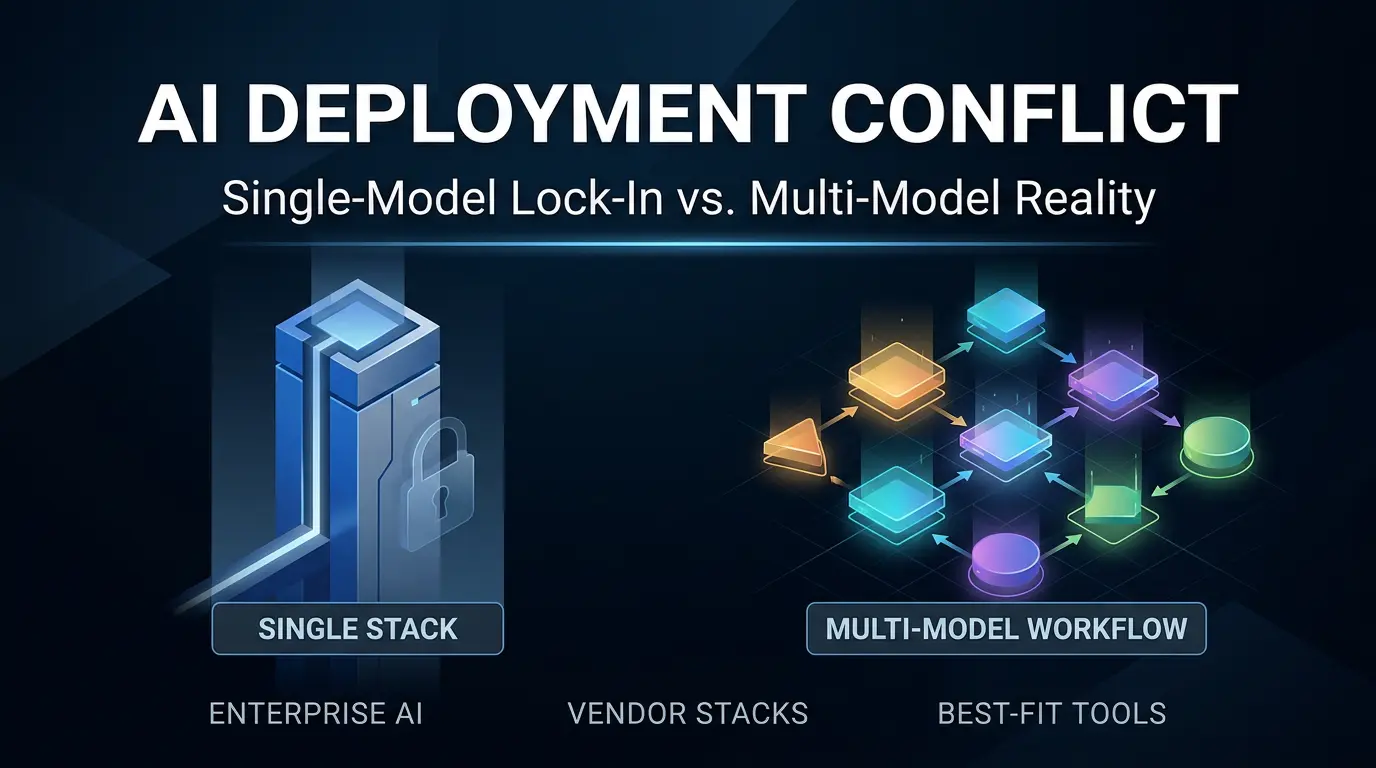
Here is a useful question for enterprise AI deployment:
If an OpenAI-led deployment team enters a software organization, and the engineering team already prefers Claude Code for some coding workflows, what happens?
This is not an official policy claim about OpenAI.
It is a deployment question.
Most major AI companies have an incentive to make their own stack the default. That is normal. A single stack can simplify integration, security, accountability, billing, support, and product feedback.
But enterprise work rarely fits neatly into one model vendor's preferred architecture.
Coding, research, enterprise search, customer support, financial analysis, document workflows, internal agents, and industry-specific tasks may all have different best-fit tools. Some teams may prefer Codex for one engineering workflow, Claude Code for another, Perplexity for research, Gemini for Google Workspace-connected work, an internal model for sensitive data, and a vertical model for industry-specific reasoning.
That is the multi-model AI stack reality.
The conflict is simple:
AI companies want deployment to standardize around their stack.
Enterprises want deployment to maximize workflow outcomes.
Those goals can overlap, but they are not always the same.
Why single-model deployment is attractive
Single-model deployment has real advantages.
It is not just vendor convenience.
For enterprise teams, one AI stack can make several things easier:
- integration architecture
- security review
- access control
- procurement
- observability
- billing
- vendor accountability
- governance policy
- support escalation
- employee training
If one provider owns the model, interface, agent framework, deployment team, and support relationship, the enterprise has fewer moving parts to manage.
OpenAI's Deployment Company points in this direction. OpenAI says its Forward Deployed Engineers will work inside organizations to design, build, test, and deploy production systems, connecting OpenAI models to customer data, tools, controls, and business processes. That is a powerful deployment model because it reduces the distance between model capability and business workflow.
Anthropic's enterprise AI services company also reflects the same enterprise need from another angle. Anthropic says the new company will work with mid-sized companies to bring Claude into core operations, with Anthropic Applied AI staff working alongside the company's engineering team to build systems tailored to each organization.
Both examples show why enterprises need help beyond API access.
But they also raise a harder question:
When an AI company becomes the deployment partner, how neutral can the deployment architecture remain?
The risk of AI model lock-in
AI model lock-in is not only a pricing issue.
It can show up in several forms:
| Lock-in type | What it means |
|---|---|
| Model lock-in | Workflows become deeply tied to one provider's models |
| Tooling lock-in | Agents, prompts, evaluations, and integrations depend on one platform |
| Data-path lock-in | Customer data pipelines are designed around one vendor's retrieval and context system |
| Workflow lock-in | Business processes are redesigned around one stack's assumptions |
| Governance lock-in | Approval, audit, and policy layers become hard to transfer |
| Cost lock-in | Token use, seat pricing, and deployment support become difficult to renegotiate |
Some lock-in is expected in enterprise software.
The problem starts when lock-in prevents a team from using the best tool for the task.
A model stack may be excellent for document workflows but weaker for large-repo code refactoring. Another may be strong for code but less suitable for enterprise knowledge retrieval. A third may integrate best with a company's existing cloud and productivity suite. An internal model may be required for sensitive or regulated data.
In those cases, "one stack for everything" may be easier to manage, but not always better for the business.
Why the multi-model AI stack is hard to avoid
The multi-model AI stack is not a theoretical preference.
It emerges from how real teams work.
Different tasks reward different strengths:
| Task | Why one model may not be enough |
|---|---|
| Coding | Teams may compare Codex, Claude Code, Gemini-based coding tools, and internal code assistants across repo size, language, review quality, latency, and developer workflow fit |
| Research | Teams may prefer answer engines or search-connected tools when citation, freshness, and source discovery matter |
| Documentation | Teams may choose tools based on style control, workspace integration, document structure, and collaboration features |
| Enterprise search | Internal knowledge retrieval may depend on connectors, permissioning, metadata, and source-level trust |
| Financial services | Domain workflows may require audit trails, filings, spreadsheets, market data, and approval chains |
| Customer operations | The best system may depend on CRM integration, policy grounding, escalation paths, and reliability |
| Regulated workflows | Some data or decisions may require private models, cloud-specific controls, or industry-tuned systems |
As teams become more AI-literate, many begin comparing and switching tools at the task level.
They do not ask, "Which vendor do we support?"
They ask:
- Which tool gets this job done best?
- Which one is safer for this data?
- Which one fits this workflow?
- Which one produces outputs the team can trust?
- Which one is easiest to monitor and improve?
That is why enterprise AI deployment should not be evaluated only by model benchmarks.
It will increasingly be evaluated by task fit.
A practical enterprise workflow may already be multi-model
Imagine a large enterprise deploying AI across several teams.
The software team may test Codex and Claude Code for different development workflows. Codex is positioned by OpenAI as a coding agent that can read, modify, and run code. Claude Code is positioned by Anthropic as an agentic coding tool that lives in the terminal and supports enterprise deployment options.
The strategy team may use Perplexity or another answer engine for external research, source discovery, and competitive scanning.
The operations team may use ChatGPT or Claude for document drafting and process analysis.
The knowledge team may use Gemini Enterprise or a cloud platform because the organization's data, productivity suite, and security controls already live there.
The compliance team may require an internal model or private deployment for sensitive workflows.
None of these choices are irrational.
They reflect different task requirements.
The enterprise question is not "Can we force one model to do all of this?"
The better question is:
Which workflows should be standardized, and which workflows should remain multi-model?
The commercial tension for AI deployment companies
This is where the deployment layer becomes strategically complicated.
An AI deployment company is judged by customer outcomes.
But a model company is also judged by platform adoption, token usage, seat expansion, and ecosystem control.
Those incentives can pull in different directions.
If the best workflow outcome requires mixing models, tools, and retrieval systems, will the deployment partner recommend that architecture? Or will it try to keep the customer inside its own stack?
The answer will likely vary by provider, contract, customer maturity, and workflow.
But the tension itself is real.
Enterprises should not treat it as a philosophical debate. They should turn it into procurement and architecture questions:
- Can this deployment partner support third-party tools where they are clearly better?
- Can the evaluation compare multiple models under the same task conditions?
- Can the customer keep logs, prompts, evaluations, and workflow definitions portable?
- Can the governance layer handle more than one model provider?
- Can cost, safety, and performance be compared at the task level?
- Can teams replace one model without rebuilding the whole workflow?
These questions matter because AI model lock-in becomes much more serious once AI is embedded into business processes.
Replacing a chatbot is one thing.
Replacing an AI-assisted operating workflow is much harder.
The enterprise buyer's framework
Enterprise buyers should not only ask:
Which model should we use?
They should ask:
Which tasks require a standard model stack, and which tasks need a multi-model AI stack?
A practical framework looks like this:
| Decision area | Useful question |
|---|---|
| Standardize | Which workflows benefit from one approved model and one governance path? |
| Diversify | Which workflows need best-fit tools across coding, research, search, analysis, or vertical domains? |
| Govern | Can access, audit, data handling, and approval rules work across multiple providers? |
| Evaluate | Are models compared on real tasks, not only general benchmarks? |
| Portability | Can prompts, agents, retrieval configs, and evaluation sets move if the model changes? |
| Cost | Is pricing evaluated by workflow outcome, not only token price? |
| Risk | What happens if the preferred model fails, changes behavior, raises price, or loses availability? |
This is a more useful conversation than "one vendor or many vendors."
Most enterprises will need both.
They will standardize where standardization reduces risk, cost, and complexity.
They will diversify where task performance, data constraints, or workflow fit matter more.
Why category-level evaluation matters
AIvsRank's view is that enterprise AI decisions should be evaluated at the category and task level, not only at the vendor level.
A vendor-level story asks:
Which AI company is winning?
A task-level story asks:
Which product or model combination is most visible, credible, and useful for this specific category of work?
Those are different questions.
This is why AIvsRank separates product, model, category, and question context.
For example:
| Category | What should be evaluated |
|---|---|
| AI Coding Agents | repository understanding, code modification quality, review burden, test execution, developer workflow fit |
| Enterprise Search Agents | source grounding, permissioning, citations, freshness, internal knowledge coverage |
| Financial Services AI Agents | filings, spreadsheets, audit chains, compliance workflows, human review points |
| Enterprise AI Deployment Companies | deployment depth, data connection, workflow redesign, governance, partner network, repeatable delivery |
| AI Visibility Checkers | mention rate, average answer rank, product-layer recognition, competitor context, source visibility |
A single overall AI leaderboard cannot answer all of these questions.
A model may be strong in one category and less suitable in another. A product may wrap the same model in a better workflow. A deployment partner may be more useful than a raw model provider for some enterprise buyers. A vertical tool may outperform a general assistant in a narrow regulated task.
This is why category-level ranking is closer to enterprise reality.
It does not ask customers to pick a vendor tribe.
It asks what job the user is trying to get done.
What AIvsRank would measure in a multi-model reality
In a multi-model AI stack, visibility and ranking become more complex.
AIvsRank would not only ask whether a brand appears in AI answers.
It would ask whether the brand appears in the right category, for the right task, against the right comparison set.
Useful checks include:
- Does the product appear when buyers ask about this task category?
- Is it compared with the right alternatives?
- Is the answer comparing products, models, platforms, or deployment services?
- Is the product layer described correctly?
- Does the AI answer recognize when a category is multi-model by nature?
- Does the brand remain visible across multiple AI search engines?
- Do competitors appear more often, rank higher, or get clearer descriptions?
- Are official pages, docs, partner pages, or third-party sources supporting the answer?
The result is not a claim that one vendor is universally better.
It is a map of how AI search engines understand the product in a specific task context.
For enterprise buyers, that is more useful than a generic model ranking.
For vendors, it shows where the market may misunderstand them:
- missing from the category
- placed in the wrong product layer
- compared with the wrong competitors
- described too narrowly
- described too generically
- visible in one task, absent in another
That is the real value of category-level AI visibility.
A small but important caveat
Multi-model does not mean every enterprise should use every model.
More tools can create more complexity, more security review, more governance burden, and more vendor management work.
The point is not "use everything."
The point is "do not pretend one model is automatically best for every task."
A mature enterprise AI deployment strategy should decide where to standardize and where to preserve optionality.
That balance will vary by company, industry, risk level, and workflow.
The bottom line
AI companies have strong incentives to make their own stacks the center of enterprise AI deployment.
Enterprises are likely to keep discovering that real work is messier than one stack.
The future will probably not be pure single-vendor deployment or uncontrolled model sprawl.
It will be governed multi-model deployment:
- standardized where possible
- diversified where necessary
- evaluated by task
- governed across providers
- measured by workflow outcome
Enterprises are unlikely to accept one model for every problem unless that model proves it is good enough across every critical category.
Until then, the more realistic question is not:
Which model wins?
It is:
Which model, product, and deployment pattern wins for this task?
That is the question AIvsRank is built to make visible.
References:
- OpenAI: OpenAI launches the OpenAI Deployment Company
- OpenAI: Forward deployed engineering at OpenAI
- OpenAI: Codex
- Anthropic: Building a new enterprise AI services company with Blackstone, Hellman & Friedman, and Goldman Sachs
- Anthropic: Claude Code
- Google Cloud: Gemini Enterprise
- Google Cloud: Introducing Gemini Enterprise
- Perplexity: Enterprise Pro