
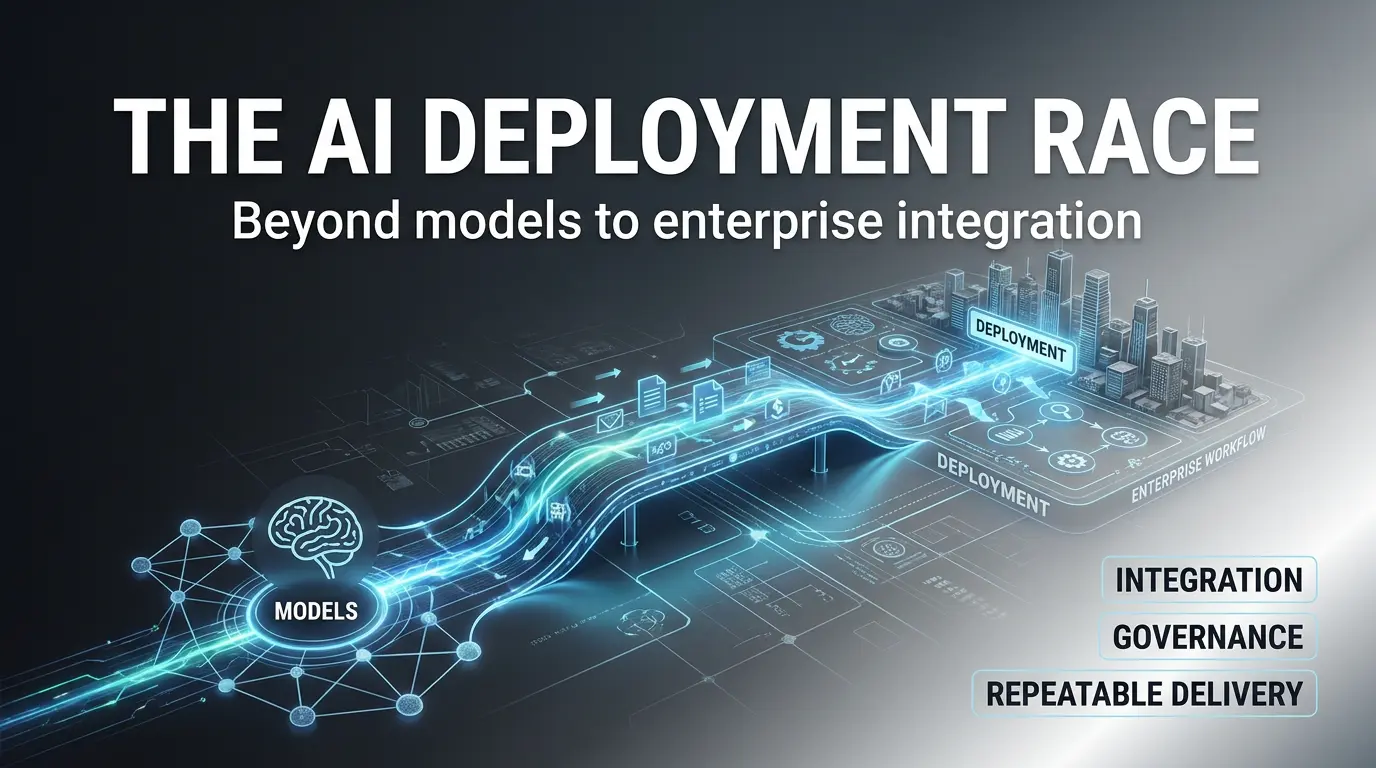
Model capability still matters.
But in enterprise AI, the harder question is no longer only "which model is strongest?"
It is:
Which company can turn that model into a working system inside a real organization?
That is the signal behind two recent moves. On May 11, 2026, OpenAI launched the OpenAI Deployment Company, a new company focused on helping organizations build and deploy AI systems across important work. On May 4, 2026, Anthropic announced a new enterprise AI services company with Blackstone, Hellman & Friedman, and Goldman Sachs, focused on helping mid-sized companies bring Claude into core operations.
These are not just product announcements.
They point to a broader shift in enterprise AI deployment. The competition is moving from model access alone toward the ability to connect models with data, tools, permissions, workflows, governance, and business change.
A better way to say it is:
Models are the source of capability. Deployment is how that capability becomes enterprise value.
Why model strength is not enough for enterprise AI
A strong model can summarize, reason, code, retrieve, plan, and assist.
But an enterprise does not run on prompts alone.
It runs on:
- internal data
- legacy systems
- permissions
- security reviews
- compliance requirements
- operational workflows
- business owners
- frontline teams
- measurement and audit processes
This is why enterprise AI adoption often slows down after the first pilot.
The model may be capable, but the organization still has to answer practical questions:
- Which workflow should AI touch first?
- Which systems need to be connected?
- Who approves the output?
- How is sensitive data handled?
- What happens when the model changes?
- How does the team know the system is reliable enough for production?
- Who owns the process after launch?
This is where "enterprise AI deployment" becomes its own category.
It is not just selling API access or SaaS seats. It is helping a company redesign how work actually happens.
What OpenAI Deployment Company signals
OpenAI describes the OpenAI Deployment Company as a company designed to help organizations build and deploy AI systems they can rely on every day across important work.
The public details matter.
OpenAI says the Deployment Company will embed Forward Deployed Engineers, or FDEs, into organizations working on complex problems. These teams are meant to work with business leaders, operators, and frontline teams to identify high-impact opportunities, redesign infrastructure and workflows, and turn those gains into durable systems.
OpenAI also announced an agreement to acquire Tomoro, an applied AI consulting and engineering firm. According to OpenAI, the acquisition will bring approximately 150 Forward Deployed Engineers and Deployment Specialists into the OpenAI Deployment Company from day one.
The structure is also notable.
OpenAI says the OpenAI Deployment Company is a committed partnership between OpenAI and 19 global investment firms, consultancies, and system integrators. The company will launch with more than $4 billion of initial investment. Its investment and consulting partners sponsor more than 2,000 businesses around the world, while its consulting and integrator partners work with many thousands more.
This is not a normal SaaS motion.
It looks more like a deployment operating model:
- embedded technical teams
- workflow diagnostics
- production system design
- data and tool connection
- controls and business process integration
- partner-led distribution
- repeatable transformation patterns
In other words, OpenAI is not only asking enterprises to buy access to frontier models. It is building a path for those models to enter real operating environments.
What Anthropic's enterprise AI services company signals
Anthropic's move points in the same direction, but with a different market shape.
On May 4, 2026, Anthropic, Blackstone, Hellman & Friedman, and Goldman Sachs announced the formation of a new AI services company. Anthropic says the organization will work with mid-sized companies across sectors to bring Claude into their most important operations.
The key phrase is not "sell Claude."
The key phrase is "core operations."
Anthropic says Applied AI engineers from Anthropic will work alongside the new firm's engineering team to identify where Claude can have the most impact, build custom solutions, and support customers over the long term.
Anthropic also explains why this delivery layer matters. Putting Claude to work in core operations requires hands-on engineering and deep familiarity with how each business runs. The announcement specifically points to companies such as community banks, mid-sized manufacturers, and regional health systems that may lack the in-house resources to build and run frontier AI deployments.
This is a clear enterprise AI services pattern:
- identify high-impact workflows
- work with domain teams
- build Claude-powered systems around existing operations
- support customers beyond the first deployment
- extend delivery capacity beyond traditional systems integrators
Again, the point is not that the model stops mattering.
The point is that the model has to be carried into the operating layer of the business.
Why private equity and consulting partners matter
The partner lists in these announcements are not incidental.
Private equity firms, consultancies, and systems integrators bring assets that model companies usually do not have on their own:
- enterprise access
- portfolio distribution
- transformation experience
- industry relationships
- operating playbooks
- change management capacity
- implementation teams
- executive trust
For enterprise AI deployment, this matters because the buying decision is rarely just technical.
A CIO may care about architecture and security. A business leader may care about cycle time and productivity. A compliance team may care about auditability. A frontline team may care about whether the tool fits into the work they already do.
A model provider can offer capability.
A deployment partner has to turn that capability into a working organizational change.
This is why AI transformation partners may become more important in AI search and buyer discovery. When a buyer asks an AI search engine "who can help deploy AI into enterprise workflows?", the useful answer should not only compare model benchmarks. It should compare who can actually help a company deploy, govern, and scale AI in production.
Enterprise deployment is a different capability layer
If we separate model access from deployment capability, the enterprise AI market becomes easier to read.
| Layer | What it answers |
|---|---|
| Model capability | What can the underlying model do? |
| Product interface | How does the user access the model? |
| Data connection | Can the system work with the customer's internal data and tools? |
| Workflow integration | Can AI fit into real business processes? |
| Governance | Can access, audit, permissions, and compliance be managed? |
| Delivery model | Can the provider help the customer move from pilot to production? |
| Repeatability | Can the provider reuse deployment patterns across customers or portfolios? |
Many AI rankings still focus mostly on the first two layers.
That is useful, but incomplete for enterprise buying.
A company choosing an enterprise AI deployment partner needs to know something more specific:
- Can this provider identify the right workflows?
- Can it connect to enterprise data safely?
- Can it work across business, IT, compliance, and operations teams?
- Can it build systems that survive beyond a demo?
- Can it repeat the same deployment pattern across departments or portfolio companies?
These are not just feature questions.
They are deployment questions.
Why this changes AI ranking and AI visibility
AIvsRank's view is that AI rankings cannot only measure generic model strength.
For enterprise buyers, the more useful question is often category-level:
Which companies are the strongest enterprise AI deployment partners for this kind of workflow?
That suggests a new category:
Enterprise AI Deployment Companies.
This category should not rank every AI model, every consulting firm, and every workflow platform in one undifferentiated list. It should evaluate the specific capability that matters when enterprises move from AI experimentation to production.
A public-safe evaluation framework could include:
| Dimension | What it checks |
|---|---|
| Deployment depth | Whether the provider supports real production deployment, not only advisory or model access |
| Data connection | Whether the provider can connect AI to customer data, tools, and systems |
| Workflow redesign | Whether the provider can help reshape business processes around AI |
| Governance and audit | Whether permissions, controls, compliance, and auditability are part of the deployment story |
| Partner network | Whether the provider has credible distribution, implementation, or transformation partners |
| Repeatable templates | Whether deployment patterns can be reused across teams, industries, or portfolios |
| Production reliability | Whether the provider emphasizes reliability, monitoring, and day-to-day operational use |
This is not a hidden scoring formula.
It is a category definition.
Without category definition, AI search engines may mix very different suppliers together: frontier model labs, consulting firms, systems integrators, workflow platforms, governance tools, and vertical AI vendors.
That can confuse buyers.
A buyer asking for "AI transformation partners" may need one answer. A buyer asking for an "AI deployment company" may need another. A buyer asking for "enterprise AI deployment for regulated workflows" may need a narrower set again.
What AIvsRank would look for in this category
For an AIvsRank Leaderboard or GEO analysis, the question is not only "which brand is famous?"
It is whether AI search engines understand the role each brand plays in the enterprise AI deployment ecosystem.
Useful checks include:
- whether the brand appears when buyers ask about enterprise AI deployment
- whether it is described as a model provider, deployment company, consulting partner, systems integrator, platform, or governance layer
- whether it is compared with the right alternatives
- whether it appears in the right category rather than a generic AI tools list
- whether official pages, partner pages, and third-party sources support the description
- whether visibility changes over time as new deployment partnerships are announced
The customer-facing result is not just a ranking.
It is a readout of how AI search engines position the brand:
- Is the brand included in enterprise AI deployment answers?
- Where does it appear?
- Which competitors appear with it?
- Is the product layer correct?
- Are sources strong enough to support the positioning?
- Is the brand becoming more visible in deployment-related prompts over time?
This matters because enterprise AI buyers may increasingly use AI answers to build early shortlists.
If a brand is absent, misclassified, or placed beside the wrong competitors, the buyer's first impression may already be moving in the wrong direction.
A practical buyer scenario
Imagine a mid-sized financial services company asking:
"Which AI transformation partners can help us deploy AI into compliance, customer support, and internal operations?"
A good answer should not only list the most capable foundation models.
It should separate different roles:
- model providers
- AI deployment companies
- consulting and systems integration partners
- workflow platforms
- governance and audit tools
- vertical solution providers
It should also explain why each company belongs in the list.
Does the provider embed engineers? Does it connect to enterprise data? Does it support governance? Does it have partner capacity? Does it have experience with regulated workflows? Does it offer repeatable deployment patterns?
That is the level at which enterprise AI discovery is starting to move.
The bottom line
The AI race is not moving away from models because models are unimportant.
It is moving upward because strong models are becoming the starting point, not the whole answer.
OpenAI's Deployment Company and Anthropic's enterprise AI services company both point to the same enterprise reality: the next bottleneck is not just access to intelligence. It is the ability to deploy that intelligence inside real organizations.
For AIvsRank, that means future AI rankings need to measure more than model performance.
They need to measure whether AI search engines recognize deployment capability, category fit, partner networks, governance readiness, and production relevance.
Models create the potential.
Deployment decides whether that potential becomes operating value.
References: