
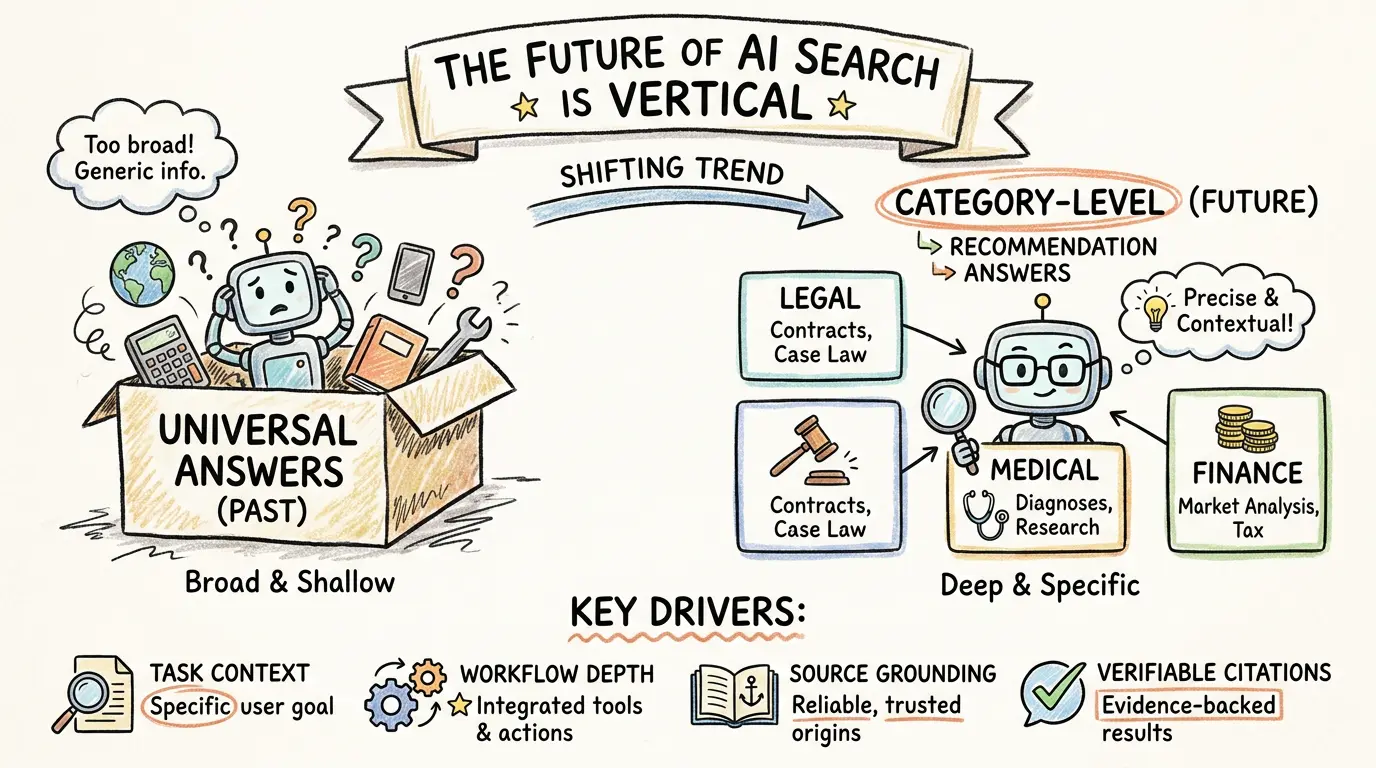
The next stage of AI search will not be defined only by better answers. It will be defined by whether an AI system can recommend the right product, agent, or workflow for a specific task.
Search engines used to return web pages. AI search engines now return answers. The next step is more specific: returning solutions that fit a real job to be done.
Users will not stop at broad queries like:
"best AI tool"
They will ask:
- best AI tool for clinical documentation
- best AI agent for KYC screening
- best AI search tool for supply chain planning
- best AI coding agent for large repo refactoring
When the question becomes vertical, the recommendation layer has to become vertical too.
A single universal AI leaderboard can show which brands are known, which tools are frequently mentioned, and which models look strong in broad comparison. But it struggles to answer the question that matters most in adoption and procurement: for this task, in this category, which product is most suitable to recommend?
That is the core shift:
The future of AI search is not one universal ranking. It is category-level recommendation.
AI Search Is Moving From General Answers To Category-Level Recommendation
"AI search is vertical" points to four related changes.
First, search objects are becoming vertical.
AI search no longer searches only web pages. It can search medical literature, financial data, enterprise documents, supply chain constraints, code repositories, product documentation, and internal knowledge bases. Each source type has different trust standards, update cycles, and citation requirements.
Second, tasks are becoming vertical.
Users are not just asking for summaries. They are doing documentation, KYC screening, pitchbook generation, inventory planning, clinical research, and large-repo refactoring.
Third, evaluation needs to become vertical.
Healthcare evaluation depends on safety, citations, and clinical boundaries. Finance depends on data connectivity, compliance, audit trails, and human approval. Supply chain work depends on constraint modeling, solver quality, and executable plans. A single generic prompt set can easily distort the evaluation of very different AI products.
Fourth, recommendation needs to become vertical.
AI search engines should not rank every AI tool on one universal leaderboard. They need category-aware recommendation. An industry leaderboard can show brand recognition. A category leaderboard is better suited to evaluating task-level capability.
This is why AIvsRank separates Leaderboard into industry and category views. An industry view answers, "Who is more often recognized by AI in this industry?" A category view answers, "For this specific task, which product is more suitable to recommend?"
OpenAI's ChatGPT for Clinicians Is Not An Isolated Healthcare Example
On April 22, 2026, OpenAI released ChatGPT for Clinicians.
On the surface, this looks like ChatGPT entering healthcare. The stronger signal is that OpenAI positioned ChatGPT as a vertical product experience for clinical work, rather than only presenting it as a stronger general model.
OpenAI describes ChatGPT for Clinicians as a product for verified U.S. physicians, NPs, PAs, and pharmacists. It supports clinical tasks such as documentation, medical research, and care consults. It also includes trusted clinical search, medical-journal deep research, repeatable clinical workflow skills, and clinically oriented evaluations such as HealthBench Professional.
That matters because AI search in healthcare cannot rely only on expert-sounding answers.
It needs trusted source boundaries, verifiable citations, professional context, and a clear boundary around clinician judgment.
For AIvsRank, this is a useful example of category logic.
Categories such as AI Tools for Clinical Documentation, AI Medical Research Assistants, and Clinical Evidence Review Tools should not be compared on the same universal leaderboard as coding agents, finance agents, and supply chain agents.
They serve different tasks, so they need different question pools, citation standards, and comparison sets.
Anthropic's Finance Agents Show Vertical AI Moving Into High-Value Workflows
On May 5, 2026, Anthropic released Agents for financial services and insurance, with 10 ready-to-run agent templates.
These templates do not frame Claude as a generic productivity layer for finance. They break financial work into specific tasks: pitch builder, meeting preparer, earnings reviewer, model builder, market researcher, valuation reviewer, general ledger reconciler, month-end closer, statement auditor, and KYC screener.
This is not just "Claude can chat."
It is Claude being mapped into specific job capabilities inside financial services.
Anthropic also emphasizes financial workflow connections: Excel, PowerPoint, Word, Outlook, and ecosystems such as FactSet, S&P Capital IQ, MSCI, PitchBook, Morningstar, LSEG, and Moody's.
The impact on AI search is direct.
When a user asks "best AI agent for KYC screening" or "best AI for pitchbook generation," a good AI search engine cannot look only at model names or brand visibility.
It needs to understand whether a product actually covers financial data, compliance workflows, audit trails, Excel and PowerPoint workflows, human approval points, and traceable records.
Those questions fit better inside a category such as Financial Services AI Agents.
In that category, useful evaluation criteria may include:
- whether the data connections are specialized enough
- whether the product supports compliance and audit workflows
- whether it can enter real Excel and PowerPoint workflows
- whether it includes human review and approval mechanisms
- whether outputs can be explained, traced, and reused by teams
A universal AI tools leaderboard is too blunt for that kind of comparison.
NVIDIA cuOpt Agent Skills Show That Vertical AI Also Needs Specialized Tools
On May 4, 2026, NVIDIA released cuOpt Agent Skills, showing how an LLM can turn natural-language supply chain questions into mathematical optimization models and pass them to a GPU-accelerated solver.
Supply chain problems are not solved by more fluent answers.
They involve demand fluctuations, cost changes, capacity limits, inventory constraints, transportation costs, service levels, and route optimization. NVIDIA cuOpt supports optimization problems such as linear programming, mixed-integer programming, and routing. The role of agent skills is to let LLMs call those specialized solving capabilities.
This shows that vertical AI is not only about better search.
It also needs to connect language understanding to specialized tools, specialized data, and specialized solvers.
When users ask AI search engines "how to optimize multi-period supply chain planning," a useful answer should not only explain what supply chain optimization means. It should identify which products or agents can connect to data, model constraints, call solvers, and produce executable plans.
That makes Supply Chain Optimization Agents a more useful category than a generic AI tools list.
Its evaluation questions should not stop at "introduce supply chain management." A more useful question is:
When demand fluctuation, capacity limits, changing inventory costs, and transportation constraints all exist at the same time, which agent is more likely to produce an executable plan?
Google Gemini File Search Shows That The Search Layer Is Also Becoming Vertical
On May 5, 2026, Google updated Gemini API File Search with multimodal support, custom metadata filtering, and page-level citations.
This looks like a RAG infrastructure update, but it also matters for vertical AI search.
Vertical search needs a constrained source scope.
Healthcare needs medical literature. Finance needs filings, market data, and research material. Supply chain work needs inventory, route, capacity, and cost files. Engineering scenarios need code repositories, architecture diagrams, and issue records.
If the source scope is unclear, AI search can mix together materials that should be evaluated separately.
Google's emphasis on custom metadata and page-level citations helps developers narrow search scope in a specific context and gives users a way to verify where an answer came from.
That connects directly to AIvsRank's GEO logic.
GEO is not only about whether a brand is mentioned by AI. It also asks whether AI search engines correctly understand a brand's industry, product layer, core functions, and competitor relationships; whether they can place the brand into the correct category; and whether they can find clear, credible, and classifiable content when citations are needed.
Why Universal AI Leaderboards Break Down
A model leaderboard can answer questions about the upper bound of model capability. It is much less useful for answering which product is more reliable for a specific task.
There are four reasons.
First, the same model behaves differently across different products.
ChatGPT for Clinicians, Claude Cowork, Claude Code, Perplexity, and Gemini File Search are not bare models. They combine models, tools, data sources, permissions, workflows, and interfaces.
Second, different industries carry different risks.
Healthcare depends on safety, citations, and clinical boundaries. Finance depends on compliance, auditability, and data permissions. Supply chain work depends on constraint solving and plan executability. A single universal ranking loses key information when it compares all of them at once.
Third, the data sources are different.
Medical literature, financial data, enterprise documents, code repositories, and supply chain spreadsheets cannot be evaluated through one shared retrieval logic.
Fourth, user intent is different.
"Help me write a summary" and "help me screen KYC risk documents" are not the same task. "Find a coding agent" and "find a coding agent that can handle large-repo refactoring" are not the same question either.
This is why AIvsRank's Leaderboard needs category definition, inclusion rules, exclusion rules, canonical examples, and a question pool.
Define the category first, and then you can decide who should be compared.
Define the question pool first, and then you can decide who is more suitable to recommend.
Why AIvsRank Needs Category-Level Product Understanding
AIvsRank is not building another AI tools directory.
More precisely, it is building category-level product understanding for the AI search era.
In this framework, different modules play different roles.
Leaderboard category creates comparable boundaries for vertical AI products. For example, finance agents, clinical AI assistants, supply chain agents, and AI coding agents should not be mixed into one universal leaderboard.
Question pool turns real user search intent into evaluable questions instead of asking one generic prompt such as "best AI tool."
LLM evaluation observes how products perform in recommendation contexts for specific tasks, rather than looking only at brand visibility.
GEO checks whether AI search engines correctly understand a brand's industry, product layer, core functions, and competitor relationships.
Mentions and average rank help customers see whether a brand is mentioned in relevant AI searches, where it usually ranks, and whether it is described correctly.
For customers, these results are not ultimately about making a polished leaderboard. They are about answering practical questions:
- Which category does my product actually belong to?
- In this category, does AI mention me consistently?
- Am I being placed into the right comparison set?
- Which competitors are more likely to be recommended for specific tasks?
- Should I strengthen brand messaging, content structure, or product category definition?
Seven Questions For Judging Whether An AI Product Fits Vertical AI Search
A team can start with seven questions when judging whether its product fits vertical AI search.
First, category fit.
Which vertical category does the product actually belong to? Are the boundaries clear? Is it a clinical documentation tool or a general healthcare AI assistant?
Second, source grounding.
Can it connect to trusted data sources and provide citations? This is especially important in healthcare, finance, legal, and enterprise knowledge scenarios.
Third, workflow depth.
Can it complete real tasks, or can it only summarize? A pitchbook agent, KYC screener, or supply chain optimizer must enter the specific workflow.
Fourth, tool integration.
Does it connect to specialized tools such as Excel, EHR, market data, solvers, code repositories, or enterprise document systems?
Fifth, governance.
Does it support permissions, auditability, human approval, compliance controls, and traceable records?
Sixth, evaluation.
Does it have scenario-level benchmarks, rather than relying only on generic model scores?
Seventh, brand clarity.
Can AI search engines consistently recognize what problem it solves, which product layer it belongs to, and who it competes with?
These questions all point to the same conclusion:
Vertical AI search does not start by asking "who is the strongest?" It starts by asking, "What task is the user trying to complete?"
Conclusion: One AI Leaderboard Is Not Enough
The future of AI search is not only about searching more information. It is about recommending more suitable vertical capabilities.
The competition will not only be about who can answer in the most human-like way. It will be about who can provide credible, executable, and verifiable recommendations in a specific industry.
OpenAI building ChatGPT for Clinicians, Anthropic building financial-services agents, NVIDIA building supply chain optimization agent skills, and Google building verifiable RAG all point to the same shift:
AI is moving from general capability into specific professional scenarios, industry data, and task workflows.
If AI search engines are going to recommend AI products, they need categories.
AIvsRank's value is to define those categories clearly and continuously evaluate how products perform on real questions.
The future of AI search is not one universal ranking.
It is category-level recommendation.
Sources: