
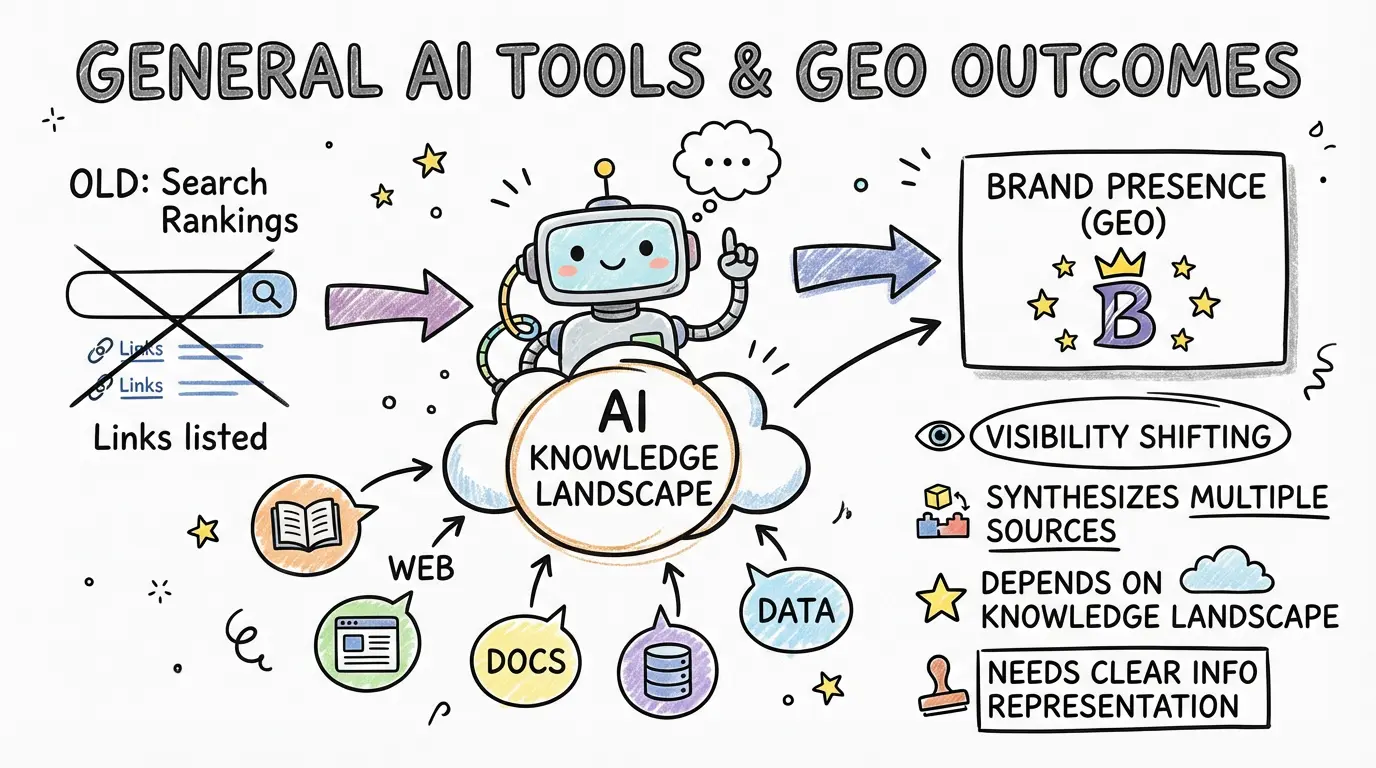
How to Use General AI Tools for GEO Without Guessing
Quick answer: General AI tools can help with GEO by showing how language models describe your brand, where your public content is unclear, and which explanations need stronger definitions, evidence, or structure. They cannot reveal a model's ranking algorithm. Treat them as diagnostic tools, then verify findings with source review, search data, and repeatable AI visibility tracking. |
Generative Engine Optimization, or GEO, is the work of making brand and product information easier for AI answer systems to find, interpret, cite, and explain accurately.
That does not mean asking ChatGPT to "optimize my website for AI" and publishing whatever comes back. That is how teams end up with generic pages, soft claims, and a pile of content that sounds polished but says very little.
General AI tools are useful in a narrower way. They can act like a mirror. Ask the right questions and they will show you how your brand is likely to be described, which terms are confusing, which pages contradict each other, and where a human reader would need to guess.
Used carefully, that is valuable. Used lazily, it becomes another content factory.
What Can General AI Tools Actually Do For GEO?
General AI tools can help you audit how your information is interpreted, but they should not be treated as direct access to AI search rankings. They are good at language analysis, comparison, summarization, and inconsistency detection. They are weaker at proving visibility, attribution, or model behavior across the wider AI search ecosystem.
For GEO work, use general AI tools to answer practical questions:
• Can a model explain what our company does in one sentence?
• Does it use the same product category we use?
• Does it confuse us with competitors?
• Does our website explain the problem, product, audience, and differentiator clearly?
• Are our definitions consistent across homepage, docs, blog, pricing, and help pages?
• Can individual paragraphs stand on their own if an AI system retrieves only a small passage?
Those questions matter because AI systems often work from fragments. A clean homepage tagline helps, but it is not enough if your docs, blog posts, product pages, and third-party mentions describe the company in different ways.
Step 1: Ask AI Tools To Describe Your Brand From Public Information
Start GEO analysis by asking several AI tools to describe your brand without giving them your preferred wording. The goal is to observe what the systems already infer from public information.
Use prompts like:
Describe [brand] in one paragraph based only on publicly available information. |
Do not treat the answers as truth. Treat them as symptoms.
If the AI tool gives a vague description, the public content may not define the brand clearly enough. If it picks the wrong category, your entity signals may be weak or inconsistent. If it names strange competitors, the comparison frame around the product may be muddy.
The useful output is not the generated prose. The useful output is the gap between how you want the brand understood and how the AI system currently explains it.
Step 2: Compare AI Descriptions Against Your Source Pages
After collecting AI-generated brand descriptions, compare each claim against your own source pages. This keeps the analysis grounded and avoids treating hallucinated summaries as insight.
Create a simple review table:
AI-generated claim | Supported by source page? | Source URL | Action |
Brand does X | Yes / No / Partly | URL | Keep, clarify, or correct |
Product is for Y audience | Yes / No / Partly | URL | Add audience page or rewrite section |
Competitor is Z | Yes / No / Partly | URL | Build comparison page or clarify category |
This step is important for Google compliance as well. Google's guidance on AI-assisted content is not "never use AI." The issue is whether the final content is useful, accurate, original, and reviewed. If an AI tool surfaces a weak claim, do not paste it into a page. Trace it back to source material and decide whether the source needs improvement.
Step 3: Find Missing Definitions And Entity Gaps
Many GEO problems are definition problems. If your site does not clearly define the brand, product category, use case, audience, and core terms, AI systems have to infer too much.
Ask an AI tool to audit a page with prompts like:
Read this page and list every entity, product category, feature, and concept that is mentioned but not clearly defined. |
Then fix the content with short, explicit definitions. Do not bury the answer in a long introduction.
Weak:
Our platform helps modern teams unlock AI-driven visibility across the digital ecosystem.
Better:
AIvsRank tracks how brands appear in AI search answers across engines such as ChatGPT, Claude, Gemini, Perplexity, and Google AI Overviews.
The second version is easier for users, search engines, and AI systems because it names the action, object, context, and examples.
Step 4: Check Semantic Consistency Across Pages
Semantic consistency means your site uses stable terms for the same ideas across important pages. Inconsistent wording can make a brand harder to classify.
For example, a company might describe itself as:
• an AI visibility tracker on the homepage;
• a GEO platform on a feature page;
• an AI rank tracker in a blog post;
• an answer engine optimization tool in a comparison page.
Those phrases can all be valid, but the relationship should be clear. If they are used casually, AI systems may treat them as separate categories instead of related ways to describe the same product.
Use AI tools to compare pages:
Compare the following pages and identify inconsistent terms for the product, audience, category, and main value proposition. |
The output should become a content vocabulary map. For AIvsRank, that might look like:
Concept | Primary term | Secondary terms |
Product category | AI search visibility tracker | AI rank tracker, GEO tracker |
Practice area | Generative Engine Optimization | GEO, AI search optimization |
Public data asset | AI leaderboard | public AI rankings, industry leaderboard |
Measurement event | AI citation | source attribution, cited URL |
This does not mean every page must sound identical. It means the important terms should not fight each other.
Step 5: Test Whether Important Passages Work Alone
AI systems often retrieve passages, not full pages, so important sections should make sense without distant context. A paragraph that starts with "this approach" or "these outcomes" may be clear to a human reading the full article, but unclear when extracted alone.
Ask an AI tool to review passages this way:
Review each paragraph below as if it were retrieved without the rest of the page. |
Then rewrite high-value passages so each one names its subject.
Weak:
This helps improve outcomes by making the information easier to interpret.
Better:
Clear product definitions improve GEO outcomes because AI systems can connect the brand, category, use case, and supporting evidence without guessing from scattered context.
That kind of rewrite improves more than tone. It improves extractability.
Step 6: Model Real User Questions Before Writing New Content
General AI tools are useful for finding natural-language questions that your content should answer. AI search queries are often longer and more conversational than classic keyword searches.
Instead of asking an AI tool to write a blog post, ask it to model the questions users would ask:
List 30 natural-language questions a marketing team might ask before choosing an AI search visibility tracker. |
This is a safer workflow than mass-producing articles. It starts with user intent, then maps content to real questions.
Google's spam policies warn against scaled content created mainly to manipulate search rankings. The practical takeaway is simple: do not create a page for every tiny phrase variation. Create pages when the question deserves a complete answer, original evidence, or a useful decision framework.
Step 7: Monitor AI Descriptions Over Time
GEO analysis should be repeated because AI-generated brand descriptions change as models, retrieval systems, and public sources change. A one-time test can show obvious problems, but it cannot show trends.
Build a small prompt set and run it on a schedule:
• What does [brand] do?
• What is [brand] best known for?
• Which companies compete with [brand]?
• Is [brand] mentioned when users ask for [category] tools?
• Which sources are cited when [brand] appears?
• Does the answer describe [brand] accurately?
Track the results in a table:
Date | Tool / engine | Prompt | Brand mentioned? | Brand cited? | Description accurate? | Notes |
This is where general AI tools start to hit their limit. Manual checks are fine for early diagnosis, but serious GEO work needs repeatable tracking across prompts, engines, sources, and competitors.
When Should You Use A Specialized GEO Tool Instead?
Use general AI tools for diagnosis and content review; use specialized GEO tools when you need repeatable measurement. A chat interface is not built to track visibility over time.
General AI tools are enough when you need to:
• inspect unclear copy;
• compare definitions;
• generate user-question maps;
• review whether a paragraph can stand alone;
• find contradictions across a small set of pages.
Specialized GEO tools are more appropriate when you need to:
• run the same prompt set repeatedly;
• compare multiple AI engines;
• monitor competitors;
• track citations and source URLs;
• measure changes after content updates;
• separate brand mentions, recommendations, rankings, and citations.
The line is not complicated. If the task is language analysis, a general AI tool may be enough. If the task is measurement, you need a system of record.
What Are The Limits Of AI-Assisted GEO Analysis?
AI-assisted GEO analysis is useful, but it is not proof of ranking, citation eligibility, or search performance. It has several limits.
First, one model does not represent all models. ChatGPT, Claude, Gemini, Perplexity, Grok, and Google AI features may retrieve different sources and generate different answers.
Second, AI tools do not expose their full retrieval or ranking logic. If a tool says your page is unclear, that is a useful editorial signal. It is not a confirmed ranking factor.
Third, AI-generated suggestions often smooth out nuance. A model may rewrite technical content into something simpler but less accurate. Human review is still required, especially for product claims, legal topics, medical topics, finance, pricing, and anything that affects customer decisions.
Fourth, AI tools can reinforce generic content patterns. If every brand asks the same model to rewrite pages for "GEO clarity," the web fills up with similar definitions and similar checklists. That is not a durable advantage.
The best use of AI is to find weak spots faster. The judgment still has to come from people who know the product, market, and customer.
A Practical GEO Workflow Using General AI Tools
Here is a simple workflow teams can run before investing in deeper tracking:
1. Ask three AI tools to describe the brand, category, audience, and competitors.
2. Save the answers with date, tool name, and prompt.
3. Mark every claim as accurate, inaccurate, incomplete, or unsupported.
4. Trace each weak claim back to source pages.
5. Rewrite source pages with clearer definitions and stronger evidence.
6. Check terminology consistency across homepage, product pages, docs, blog, and FAQ.
7. Rewrite important passages so they make sense when extracted alone.
8. Add internal links between related definitions, tools, and case studies.
9. Repeat the same prompts after the content update.
10. Move recurring monitoring into a dedicated AI visibility tracking workflow.
This workflow keeps AI in the right role. It helps with diagnosis, not blind publishing.
FAQ
Can general AI tools improve GEO?
Yes. General AI tools can improve GEO by helping teams find unclear definitions, inconsistent terminology, missing context, and weak passages. They are most useful as diagnostic and editorial tools, not as automatic optimization systems.
Can ChatGPT tell me how my brand ranks in AI search?
ChatGPT can give a snapshot of how it answers a specific prompt in a specific session, but that is not the same as rank tracking. AI search visibility should be measured across repeatable prompts, engines, source URLs, and dates.
What is the best first GEO audit prompt?
A useful first prompt is: "Describe this brand based only on publicly available information, then list any unclear claims, missing definitions, and possible competitor confusions." The answer should be reviewed against source pages before any content changes are made.
Should I publish AI-generated GEO content?
AI-assisted content can be acceptable when it is accurate, useful, original, and reviewed by people. It becomes risky when it is mass-produced, generic, unsupported, or created mainly to capture search traffic without helping users.
How often should I test AI-generated brand descriptions?
Early-stage teams can test monthly. Teams in competitive categories should test weekly or after major website, product, pricing, or positioning changes. The prompt set should stay consistent so changes are easier to interpret.
Conclusion
General AI tools can make GEO work less mysterious. They help teams see how a brand is described, where content is vague, and which explanations need more structure or evidence.
But they are not magic instruments. They do not reveal hidden ranking systems, and they do not replace Search Console, source review, structured content work, or proper AI visibility tracking.
The best GEO teams will use general AI tools the way a good editor uses a checklist: to find weak spots before users, search engines, and AI answer systems find them first.