
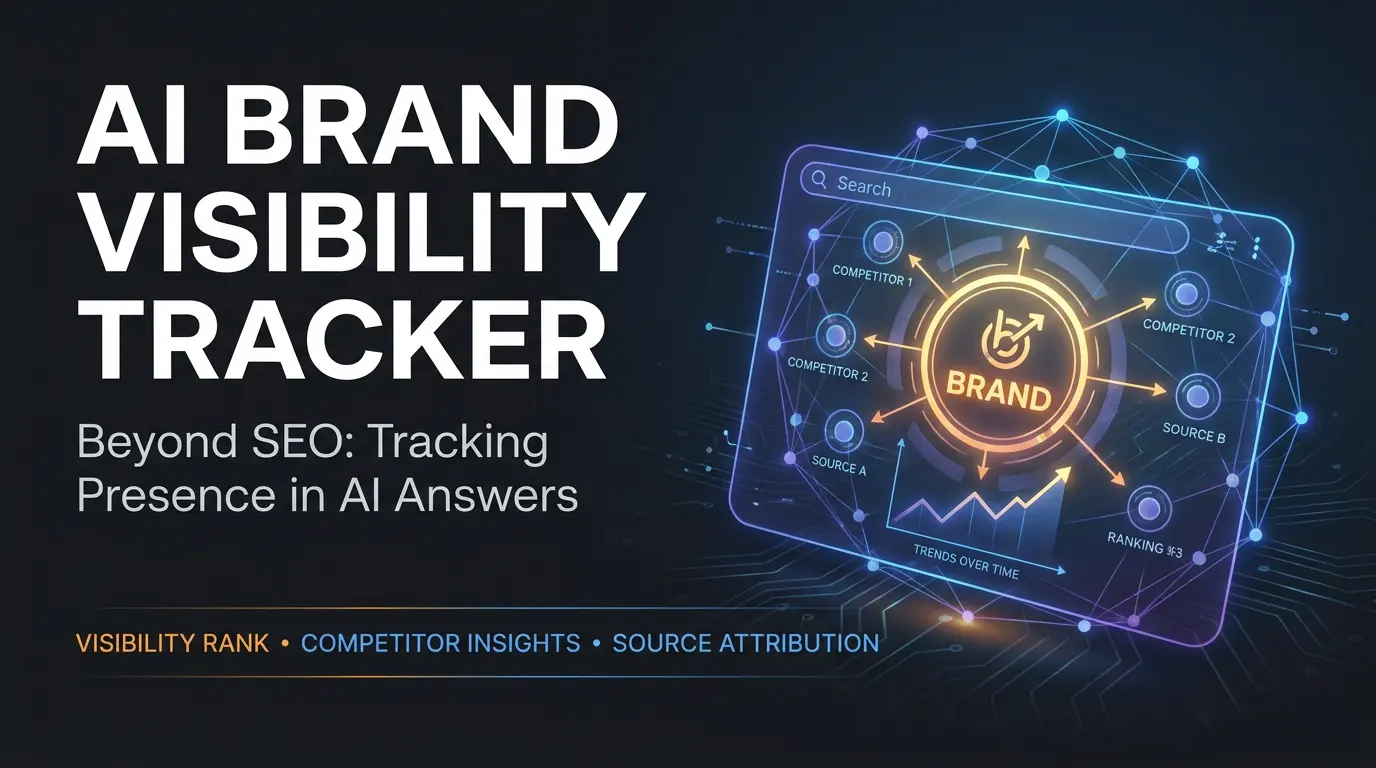
An AI brand visibility tracker monitors whether a brand appears in AI answers, how it is described, where it ranks, which competitors appear, which sources are cited, and how those signals change over time.
Use this article as a support path for recurring monitoring: start with the free AI search visibility checker for a quick signal, compare public category patterns in AIvsRank Leaderboard, then use AIvsRank features when brand, competitor, citation, and snapshot tracking need to repeat over time.
Traditional brand visibility signals still matter: search rankings, branded search volume, traffic, backlinks, media mentions, and share of voice.
But AI answers add a new layer. A buyer can ask ChatGPT, Claude, Perplexity, Gemini, or Google AI Overviews for product recommendations, vendor comparisons, category explanations, or buying criteria. The answer may mention your brand, rank it behind competitors, describe it incorrectly, or leave it out completely.
What is AI brand visibility?
AI brand visibility measures how a brand appears inside AI-generated answers.
It focuses on questions such as:
- Is the brand mentioned?
- Where does it appear in the answer?
- Is the brand described correctly?
- Is it placed in the right product category?
- Which competitors appear with it?
- Which sources support the answer?
- Does visibility change over time?
This is different from traditional brand visibility.
Traditional brand visibility often measures whether audiences can find, recognize, or remember a brand.
AI brand visibility measures whether AI systems include and represent the brand correctly when users ask relevant questions.
Why traditional SEO visibility is not enough
Traditional SEO visibility starts with webpages.
AI brand visibility starts with answers.
A brand may rank well in Google but still be missing from AI-generated recommendations.
A brand may have strong content but still be placed in the wrong category by an AI answer.
A brand may appear in an answer but lose attention because competitors are listed first or described more clearly.
This is why SEO visibility and AI brand visibility should be measured separately.
| Traditional SEO visibility | AI brand visibility |
|---|---|
| Website rankings | Answer inclusion |
| Clicks and impressions | Mentions and answer position |
| Keyword performance | Prompt-level visibility |
| Backlinks | Citations and source presence |
| SERP competitors | Competitors inside AI answers |
| Page history | Saved answer snapshots |
SEO tells you how visible your pages are.
AI brand visibility tells you how AI answers present your brand.
What should an AI brand visibility tracker monitor?
A useful AI brand visibility tracker should monitor answer evidence, not just brand mentions.
The core signals include:
| Signal | What it tells you |
|---|---|
| Mention rate | How often the brand appears across relevant prompts |
| Average answer rank | Where the brand appears when mentioned |
| Description accuracy | Whether AI explains the brand correctly |
| Category fit | Whether AI places the brand in the right product or market category |
| Competitor context | Which competitors appear in the same answer |
| Citation presence | Whether official or third-party sources support the answer |
| Snapshot history | What the answer looked like at a specific point in time |
| Trend change | Whether visibility is improving, declining, or shifting |
These signals help teams move beyond a simple question:
"Did AI mention us?"
The better question is:
"Did AI mention us in the right context, with the right description, beside the right competitors, and with enough source support?"
Signal 1: brand mentions
Mentions are the starting point.
If the brand does not appear in relevant AI answers, the team may have a category association problem.
But mentions should be interpreted carefully.
A brand might appear only when the prompt includes the brand name. That is different from appearing naturally in unbranded category prompts.
A brand might appear in broad educational answers but not in high-intent buyer prompts.
A brand might appear in one AI engine and disappear in another.
This is why mention rate should be tracked across a defined prompt set, not judged from one answer.
Signal 2: answer position
In AI answers, position affects perception.
If an answer lists five recommended tools, the first tool and the fifth tool do not usually receive the same attention.
If the brand appears only in an "also consider" paragraph, that is different from being framed as a primary recommendation.
An AI brand visibility tracker should therefore track average answer rank when the brand appears.
It should also keep absence separate from low rank.
This prevents teams from mixing two different problems: not appearing at all and appearing too low.
Signal 3: description accuracy
Visibility is not valuable if the description is wrong.
AI answers may describe a brand too broadly, too narrowly, or at the wrong product layer.
For example:
- an AI visibility platform may be described as a generic SEO tool
- an enterprise deployment partner may be described as a chatbot vendor
- a category-specific product may be placed in a broad software list
- a B2B tool may be framed as a consumer app
These are not small wording issues.
They affect whether a buyer understands why the brand belongs in the shortlist.
Signal 4: category fit
Category fit measures whether AI places the brand in the right product category.
This is especially important in new markets where terms are still forming.
In AI visibility, for example, AI answers may mix:
- SEO tools
- AI rank trackers
- brand monitoring platforms
- citation tracking tools
- AI search monitoring products
- GEO tools
- content optimization tools
Some overlap is normal.
But if the AI answer consistently puts the brand in the wrong category, the brand may be competing in the wrong mental set.
Signal 5: competitor visibility
AI brand visibility is relative.
Your brand may appear, but competitors may appear more often, rank higher, receive stronger descriptions, or be cited by better sources.
A tracker should show:
- which competitors appear with your brand
- which competitors appear when your brand is absent
- whether competitors rank higher
- whether competitors receive clearer recommendation reasons
- whether the comparison set is accurate
This helps teams understand whether the issue is brand absence, weak positioning, or competitor pressure.
Signal 6: citation and source presence
Many AI search and answer experiences can show sources, links, or citations.
That creates a new kind of brand evidence.
A tracker should record whether AI answers rely on:
- official product pages
- documentation
- comparison pages
- partner pages
- third-party reviews
- news articles
- public discussions
If AI answers cite competitor pages but not yours, that may point to a source visibility issue.
If AI answers cite your pages but still describe you incorrectly, the page content may need clearer definitions or more structured facts.
Why saved snapshots matter
AI answers are not fixed.
They can change by engine, prompt wording, search mode, account state, region, language, source freshness, or product rollout.
That is why saved snapshots matter.
A saved snapshot lets teams see exactly what the answer looked like when it was checked.
Over time, snapshots help answer:
- Did visibility improve after content updates?
- Did competitors start appearing more often?
- Did AI answers change how they describe the brand?
- Did source visibility improve or decline?
- Did one category improve while another stayed weak?
Without snapshots, teams cannot reliably compare change.
They only have scattered observations.
How AIvsRank connects brand visibility with AI rank tracking
AIvsRank treats AI brand visibility as part of a broader AI rank tracking workflow.
A team may start with a free AI search visibility checker to test whether the brand appears in a few relevant prompts.
It can then use AIvsRank Leaderboard to understand public category visibility and market context.
For ongoing monitoring, AIvsRank features help teams track recurring prompt sets, mentions, answer position, citations, competitors, saved snapshots, and visibility trends. When you are evaluating recurring monitoring, review AIvsRank pricing for plan and usage options.
The goal is not only to collect more data.
The goal is to help teams decide what to do next:
- clarify product positioning
- improve category pages
- add sourceable facts
- build comparison content
- strengthen third-party references
- monitor competitor pressure
- check whether updates change AI answers
The bottom line
An AI brand visibility tracker helps teams understand how AI answers present their brand.
It should track more than whether the brand appears.
It should show whether the brand appears in the right prompts, in the right position, with the right description, beside the right competitors, and with the right sources.
Traditional SEO visibility still matters.
But for teams that rely on AI-assisted discovery, AI answer visibility is now its own measurement layer.
If buyers are forming opinions inside AI answers, brands need evidence of how those answers represent them.
References: