
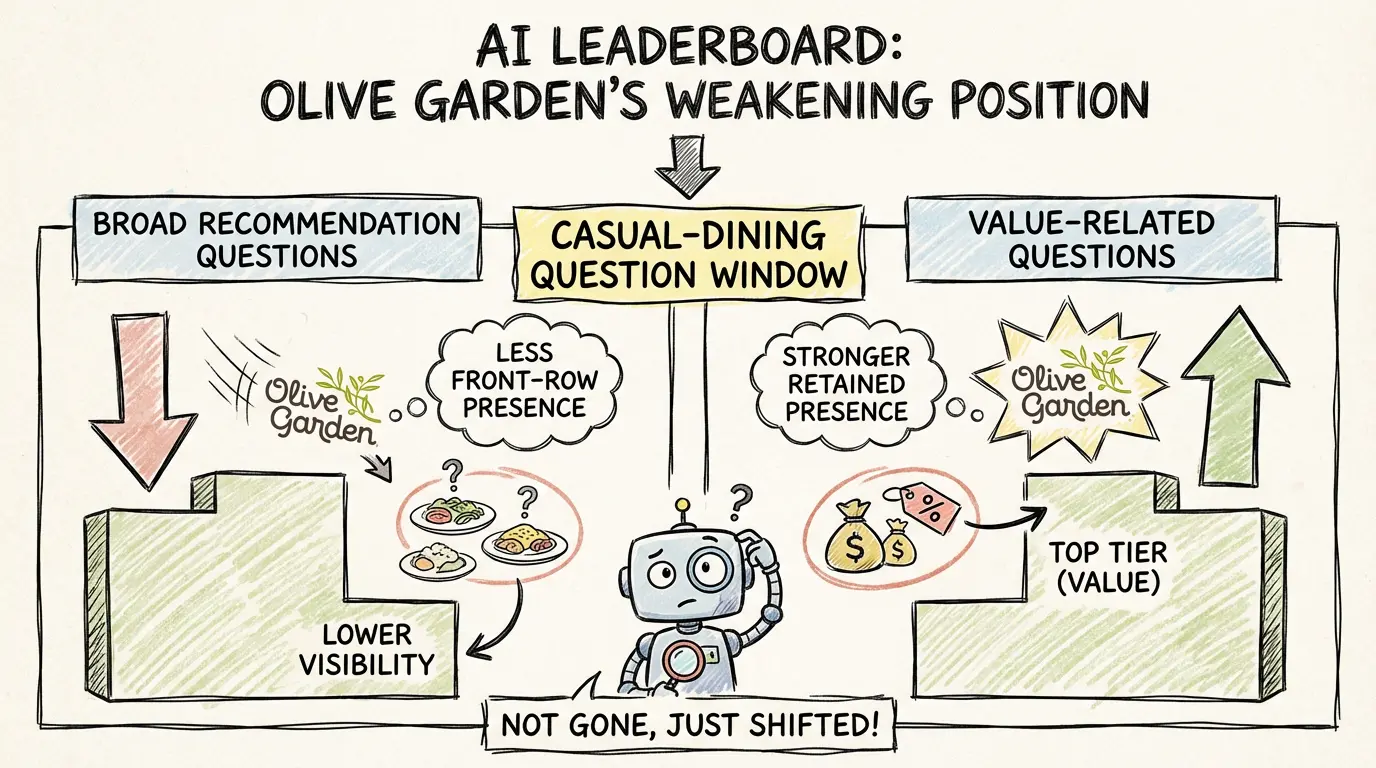
When Olive Garden's AI position started to weaken, the most useful signal was not a single missed recommendation. It was the pattern that appeared after the brand was placed back into an industry Leaderboard view.
This article is not trying to explain one isolated answer. It is trying to explain what a Leaderboard can surface when a brand is still active, still running visible promotions, but its position inside AI recommendation structure is beginning to move.
The Observation Basis: A Question Window, Not a Single Prompt
To avoid mistaking a one-off answer for a trend, this analysis is not built on one question or one answer. It is built on a question window that is closer to real advisory language in casual dining.
In AIvsRank's Leaderboard observation logic, that kind of window usually includes:
best casual diningbest family restaurant chainbest chain restaurant for value- adjacent recommendation, comparison, and value-related advisory questions
The window discussed here runs from 2026-04-09 to 2026-04-17. The phrase "after the drop" is used relative to an earlier period when front-row presence was more stable. Because of public-boundary constraints, this article does not disclose a full time-series score curve. It focuses only on the repeatable result pattern visible inside this window.
More specifically, that "after the drop" framing carries two claims:
- Olive Garden's front-row presence in broad recommendation questions is weaker in this window than in an earlier, more stable period
- the weakening does not appear in only one question; it repeats across adjacent question scenarios
So this article is not announcing a complete long-run sequence. It is describing a weakening pattern in industry position that can be observed inside this window and that repeats across multiple question scenarios.
What the Leaderboard Saw First Was Not the Promotion, but the Position Shift
Looking only at public materials, Olive Garden was not inactive. But when the brand is put back into a Leaderboard view, the first thing that shows up is not whether the brand was running offers. It is the position shift:
- In broad recommendation questions such as
best casual diningandbest family restaurant chain, Olive Garden still appears, but its front-row presence is weaker than Chili's and Texas Roadhouse - In value-related questions such as
best chain restaurant for value, Olive Garden's retained presence is stronger than in broad recommendation questions - The replacement pressure on Olive Garden's front-row position is not coming from random brands. It is concentrated in Chili's and Texas Roadhouse
- The difference is not a one-point anomaly. It repeats across adjacent question scenarios inside the window
That is the important shift. The issue is not who won a single prompt. It is which kinds of question scenarios show the position change more clearly, which competitor is replacing Olive Garden more consistently, and whether the change is a one-off fluctuation or a structural pattern that keeps appearing inside the window.
That is why the Leaderboard is more explanatory than a single recommendation result.
Why Single Recommendations Can Mislead Teams
If a team looks only at one answer, it can easily misread Olive Garden's problem in two ways.
The first misreading is: "It was not recommended this time only because the model happened to prefer another brand." The second is: "It still showed up, so the broader problem cannot be that serious."
The Leaderboard view makes the structure more visible:
- Olive Garden is not completely absent
- but its front-row presence in broad recommendation questions is weaker than Chili's and Texas Roadhouse
- its retained presence in value-related questions is stronger than its front-row presence in broad recommendation questions
- Chili's and Texas Roadhouse are more consistently taking over its front-row position in broad recommendation questions
At that point, the article is no longer explaining one answer. It is explaining a shift in industry position over a window.
Why That Position Shift Happened
Position shifts do not appear out of nowhere. The reasons become easier to understand when public signals are read together with the Leaderboard observations.
Start with Olive Garden's own public signals.
In early April 2026, Olive Garden's official News & Media page showed: There are no updates at this time. That means the public news entry point was not reinforcing a fresh, brand-level reason for why Olive Garden was especially worth recommending at that moment.
At the same time, Olive Garden's visible site actions were concentrated more heavily in promotional and value-oriented information, including:
- Buy One, Take One
$6 Take Home Entr?esLunch-Sized Favorites
Those items clearly matter for conversion, but they act more like transaction-layer signals. They do not automatically become the strongest signals for AI systems answering a question such as "Which casual-dining brand is more worth recommending?"
Then look at the competitor side.
One of the most visible public signals in April 2026 came from Nation's Restaurant News: Chili's had surpassed Olive Garden to become the second-largest casual-dining chain in the United States, behind Texas Roadhouse.
Chili's also had public signals that were easier to turn into a "why it is worth recommending right now" narrative. In Brinker?? April 2025 earnings report, Chili's posted 31.6% comparable sales growth with 21% traffic growth, and that growth narrative stayed tightly tied to industry-leading value messaging. By April 2026, Chili's was still reinforcing that value narrative through 3 For Me $10.99, a message that is easier for both media and users to repeat.
Texas Roadhouse represented a different kind of strong signal: sustained category strength. According to its official fourth-quarter 2025 results, the Texas Roadhouse brand delivered 4.4% comparable sales growth in Q4 2025. That kind of continued brand performance keeps reinforcing an image of being worth visiting, stable, and at the top of the category.
In short, Olive Garden was not inactive. The problem was that the stronger public narrative around "who should be recommended right now" had shifted more clearly toward Chili's and Texas Roadhouse.
Why Frequent Promotions Did Not Automatically Turn Into Stronger Recommendation Position
The deeper lesson here is not merely that promotions do not always increase recommendation likelihood. It is that promotions solve a transaction problem, not necessarily a recommendation problem.
AI systems more often favor signals that are easier for public materials to restate and verify, such as:
- whether there is fresh industry endorsement
- whether there is a stronger growth narrative
- whether the brand appears more often in third-party contexts framed as worth recommending
- which competitor currently has the stronger outside signal set
So when a brand's visible moves are concentrated at the transaction layer while stronger recommendation signals are being occupied by competitors, the brand's industry position inside AI can shift first.
That is why this kind of problem makes more sense inside a Leaderboard view than inside a one-off recommendation-rate reading.
What a Client Can Actually See in the Leaderboard
For clients, the value of this case is not only understanding why Olive Garden weakened. It is understanding what that kind of change looks like inside the product.
In a Leaderboard view, the client sees more than "it was not recommended once." The client sees:
- whether Olive Garden's overall rank in casual dining is moving down
- whether mention rate is weakening across multiple adjacent question scenarios
- whether the AI Visibility Index is weakening at the same time
- whether Chili's and Texas Roadhouse are entering the front-row recommendation set more consistently
- whether the pattern is a short fluctuation or something that has started to persist in historical trend data
More important than those field names, though, is the result slice already visible in this article itself: weaker front-row presence in broad recommendation questions, stronger retained presence in value-related questions, and more concentrated replacement pressure from competitors, all inside the same observation window.
That is what turns "a case" into "a signal of industry-position change."
The Product Value This Article Is Really Pointing To
The most important thing about the Olive Garden case is not whether it was running promotions. It is that brand activity and the recommendation signals a model prefers are not always aligned one-to-one.
If a team looks only at single recommendations, it is easy to read this movement as ordinary fluctuation. But when the brand is placed back into a Leaderboard view, the team can see earlier whether this is one isolated miss or a weakening in industry position, whether the brand itself is weakening or competitors are strengthening, and whether the pattern is accidental or a repeated structural shift inside the window.
That is where the real value of the Leaderboard shows up. It does not only tell teams who was recommended once. It helps them see the brand's relative position shift inside the industry's AI recommendation structure and turn that shift into something more diagnosable, trackable, and useful for the next action.