Why Brands Need AI Visibility in the Age of AI
As more users ask AI directly, brands are no longer dealing only with discoverability. They are dealing with three more practical AI visibility risks: absence, misunderstanding, and misplacement. AIvsRank AI visibility helps teams identify those risks earlier and focus limited optimization effort where it can actually change AI answer outcomes.
 EmmaWu 5 views 4 min read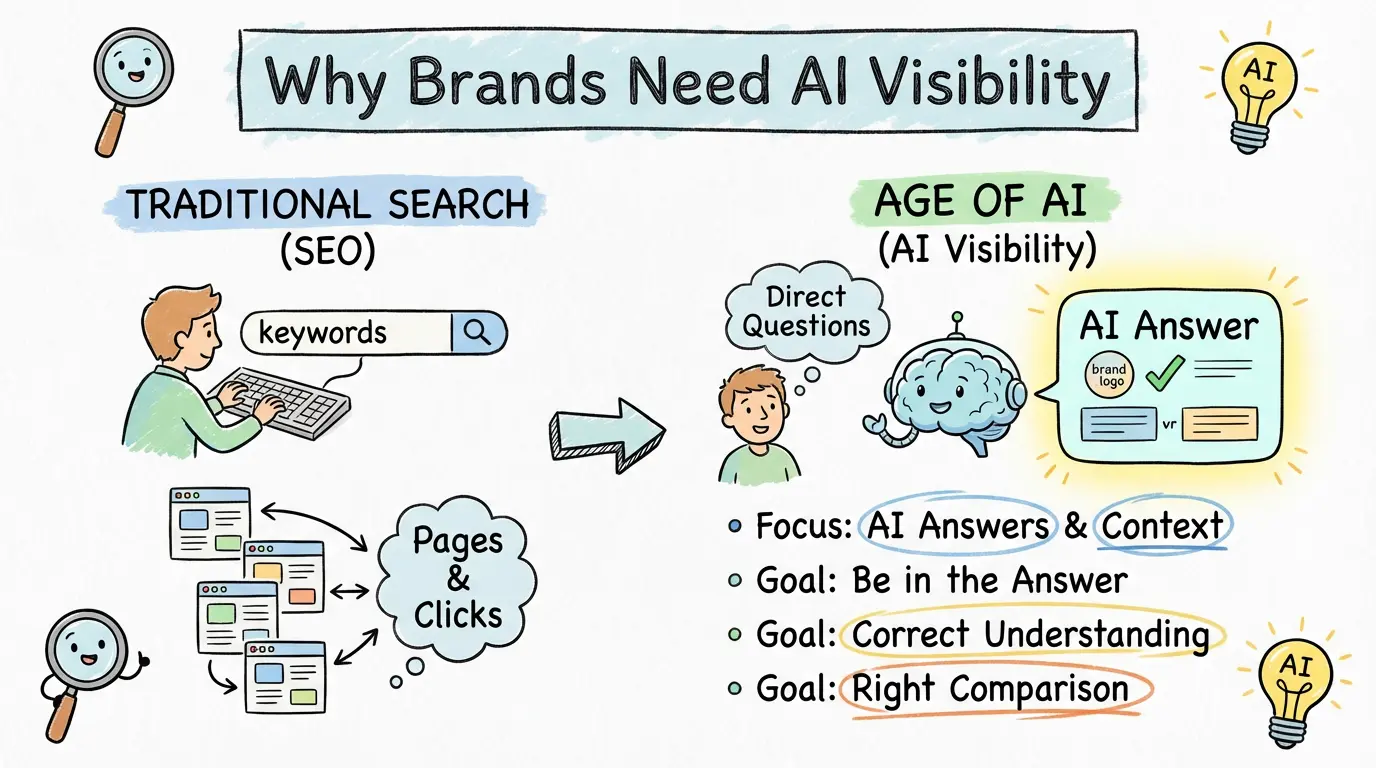
In the traditional search era, brand optimization largely revolved around SEO. As long as users were typing keywords into search engines, scanning results, and clicking through to pages, SEO remained a core driver of visibility and traffic.
That has not disappeared, but the search experience has changed. More users are now going directly to AI with questions: which brands are worth paying attention to in this category, what solution fits someone like me, or how one option compares with the alternatives.
In those moments, the first thing a user sees is no longer a webpage. It is an AI-generated answer. That changes the brand problem. It is no longer only about whether pages can be found. It is also about whether the brand can enter AI answers, whether AI understands it correctly, and whether it shows up in the right comparative context.
That is why AI visibility matters.
AI visibility is more than being mentioned
Many people first understand AI visibility as a simple question: did AI mention the brand or not? That is a reasonable starting point, but it is far too narrow.
A brand can appear in an answer and still have weak AI visibility. It might show up late in the response. It might be described vaguely. Or it might be grouped into the wrong category or competitive frame.
Real AI visibility includes at least three layers:
- whether the brand is surfaced by AI
- whether the brand is understood correctly by AI
- whether the brand occupies the right place inside a competitive answer context
So the real question is not only whether the brand appears. It is how it appears, why it appears, and who appears alongside it.
The problem customers face is not abstract "low visibility"
In practice, customers usually face three more concrete business problems:
- brand absence: the brand does not enter the answer at all when users ask relevant questions
- brand misunderstanding: the brand appears, but its core capabilities are described incorrectly, too shallowly, or too vaguely
- brand misplacement: the brand is placed into the wrong comparison context and grouped with the wrong set of alternatives
Each of these problems creates a different type of business risk:
- losing the chance to enter the candidate set
- losing the chance to be understood correctly
- being weakened too early in the comparison stage
From a business perspective, this is not simply a visibility issue. It is an issue of whether the brand is being placed correctly before the user has even reached the website.
Why AI visibility matters after SEO
SEO is still important, but it solves a page discovery problem. AI visibility solves a recognition problem inside AI-generated answers.
A brand can perform well in traditional search and still fail to appear naturally in AI answers. Or it may appear only in weak positions, or inside the wrong comparison set. That shows that entering search systems and entering AI answer logic are not the same thing.
In that sense, the competition is shifting. SEO is still about discoverability. AI visibility is about whether the brand can earn a place in AI-mediated recognition.
This is also why first impressions are moving upstream. In the past, users often built their opinions after clicking through pages and comparing brands manually. Now, many of those initial judgments are being formed one step earlier, directly inside the AI answer.
A minimal scenario: the brand is not absent, but misplaced
Imagine a SaaS company that consistently describes itself on its website as an AI workflow platform. But in AI answers, it is repeatedly categorized as an automation tool. The result is that the brand does appear, but it appears inside the wrong comparison set and gets judged against the wrong kind of competitors.
In that situation, the problem is not "no exposure." The problem is that AI visibility has been distorted. If the team only tracks mention counts, it may think the brand is doing fine. In reality, it is already being weakened at the comparison stage.
That is why brands need AI visibility, not just mention monitoring.
What AI visibility actually gives customers
For customers, the value of AI visibility is not simply receiving another layer of analysis. It is being able to spot earlier which problems are already affecting acquisition and comparison at the AI layer.
In many cases, the real loss is not a single missed mention. It is the earlier loss of entry opportunity, recognition opportunity, and comparison opportunity. For example:
- the brand has no place in question scenarios where it should have entered the candidate set
- the brand appears, but is already misunderstood in the first layer of AI description
- the brand enters an unfavorable comparison set, which compresses later comparison and conversion space
Seeing those issues clearly means the team does not have to spread effort evenly across every page, every message, and every expression. It can judge earlier which problem spaces deserve priority, which parts of the brand narrative need alignment first, and which comparison contexts need correction first.
AI visibility is becoming a new brand capability
AI visibility will not replace SEO, but it is becoming an additional layer of brand capability in the AI era. The real question for brands is no longer only "Do we rank?" It is increasingly "When users ask AI directly, do we have a place in the answer?"
That is the reason AIvsRank built AI visibility as a product capability: to help brands identify absence, misunderstanding, and misplacement earlier, reduce blind changes across content, positioning, and competitor judgment, and focus limited optimization resources on the areas most likely to influence AI-generated answers.
EmmaWu
Product Manager