
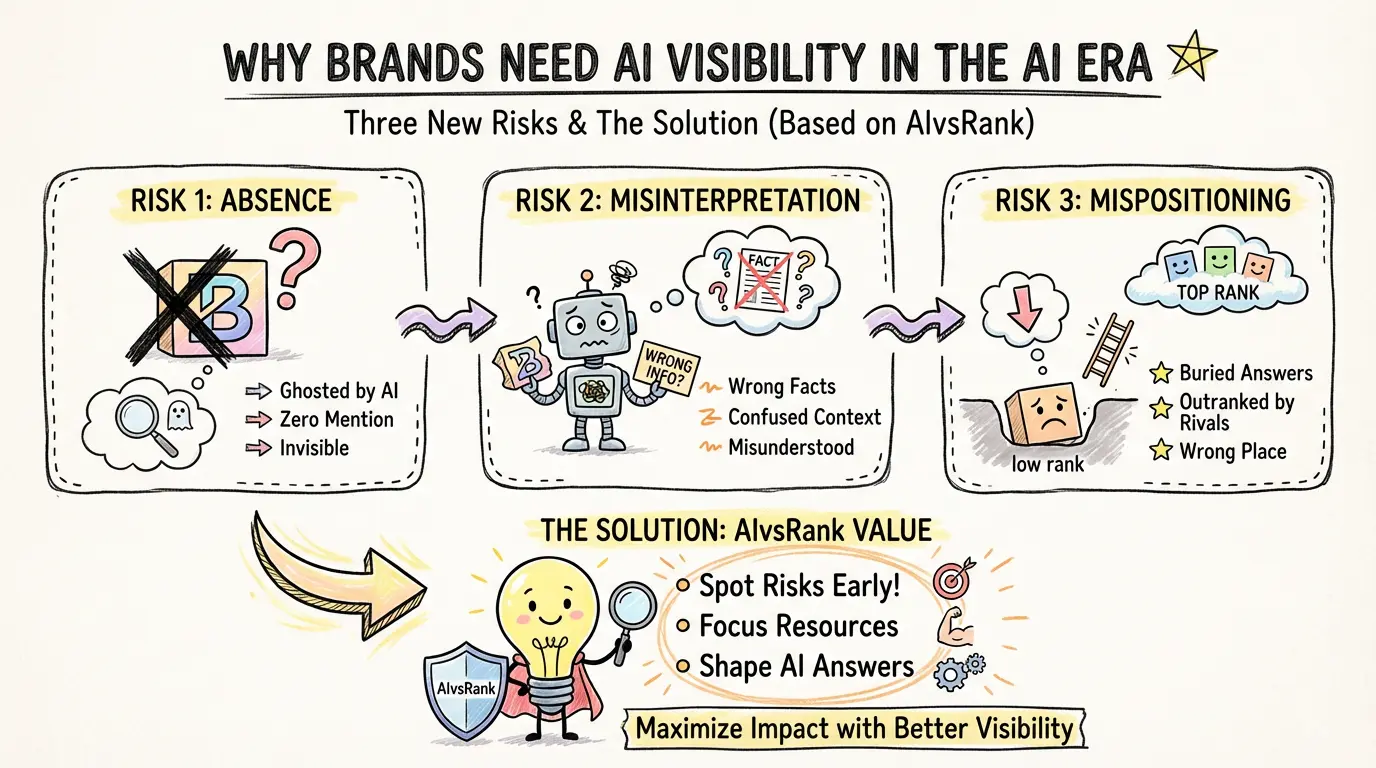
Brands need AI visibility because user discovery is expanding beyond the traditional search results page and into AI-generated answers. SEO still matters, but it no longer explains whether a brand enters the answer, is understood correctly, or appears in the right comparison context.
In the era of traditional search, most brand optimization efforts revolved around SEO. As long as users were still entering keywords into a search box, comparing results, and clicking through to pages, SEO remained critical infrastructure for earning visibility and traffic.
That entry point is now changing. More and more users are no longer opening ten blue links first. Instead, they are asking AI directly: Which brands in this category are worth paying attention to? If I belong to a certain type of user, what solution should I consider first? How does one brand differ from the alternatives?
This is not just a subjective impression. When OpenAI introduced Introducing ChatGPT search in October 2024, it explicitly positioned "timely answers with links, without having to use a separate search engine" as a user-facing product capability. In 2025, Bain cited Sensor Tower sample data in How Customers Are Using AI Search and noted that ChatGPT prompt volume grew by nearly 70% in the first half of 2025, while shopping-related prompts doubled over the same period. Adobe also reported in Adobe Analytics: Traffic to U.S. Retail Websites from Generative AI Sources Jumps 1,200 Percent that traffic to U.S. retail sites from generative AI sources was up 1,200% in February 2025 compared with July 2024. At a minimum, these public signals point to one thing: the path users take to discover brands and products is extending beyond the traditional search results page and into the AI answer layer.
As more users ask AI directly, the question for brands is no longer just whether their pages can be found. It is whether the brand can enter the AI answer, whether it will be understood correctly, and whether it will be placed in the right comparison context.
That is why AI visibility matters.
AI Visibility Is Not Just About Being Mentioned by AI
When people first encounter AI visibility, the most intuitive interpretation is simple: is the brand mentioned by AI or not? That is not wrong, but it is too shallow.
A brand can appear in an AI response and still lack real AI visibility. It may be mentioned, but only near the bottom. It may be mentioned, but described vaguely. Or it may appear, only to be placed in the wrong product category or competitive set.
In AIvsRank's working framework, we usually evaluate AI visibility across three layers:
- whether the brand is seen by AI
- whether the brand is understood correctly by AI
- whether the brand occupies the right position in a competitive context
In other words, what matters is not just whether a brand appears, but how it appears, why it appears, and which other options it appears alongside.
What Clients Usually Face Is Not an Abstract Visibility Problem
For clients, AI visibility issues are usually not abstract. In our work, they tend to show up as three more concrete business problems. This is AIvsRank's own working categorization based on how brands perform in real AI query scenarios, not a universal industry taxonomy.
We typically review those scenarios across three layers: whether the brand is present in high-value prompts, whether the brand is described accurately in the answer, and whether it is grouped against the right comparison set. In practice, that is where the pattern usually appears.
- brand absence: the brand does not enter the answer at all when users ask about a relevant need
- brand misinterpretation: the brand is mentioned, but its core capability is described incorrectly, too shallowly, or too vaguely
- brand mispositioning: the brand is placed in the wrong comparison context, alongside options that are not truly in the same tier
Those three problems map to three different risks:
- losing the chance to enter the consideration set
- losing the chance to be understood correctly
- being weakened too early in the comparison stage
From that perspective, brands are no longer dealing only with an exposure problem. They are dealing with whether they have already been placed correctly at the AI layer before a user even reaches the decision stage.
Why SEO Is No Longer Enough
SEO still matters, but it solves a page discovery problem. AI visibility addresses a brand perception problem inside AI-generated answers.
A brand can perform well in traditional search and still appear only rarely in AI answers. It may show up occasionally, but only as a secondary mention, or it may repeatedly be compared with options that do not belong in the same tier.
That difference matters. Entering a search system and entering an AI generation layer are not the same thing. The former is closer to page competition. The latter is closer to competition over how the brand is framed and understood.
That is also why the brand's first impression is moving earlier. More precisely, based on these public signals and our own observations, more users are forming their first round of judgment inside AI answers before they ever visit the website.
A Minimum Scenario: The Brand Shows Up, but in the Wrong Place
Consider a SaaS brand that consistently describes itself on its website as an AI workflow platform, but is repeatedly classified in AI answers as an automation tool. The brand does enter the answer, but it enters the wrong comparison set and starts being evaluated alongside options that are not truly on the same level.
For that brand, the problem is not a total lack of visibility. The problem is that AI visibility is mispositioned. If the team tracks mentions alone, it may conclude that the brand is performing normally. From a business perspective, though, the brand has already been weakened at the comparison stage.
That is why brands need AI visibility, not just mention counts.
What AI Visibility Actually Delivers for Clients
For clients, the value of AI visibility is not just another analysis report. It is an earlier way to see which problems are already affecting acquisition and comparison at the AI layer.
In many cases, what a brand loses is not a single impression. It loses earlier opportunities to be considered, understood, and compared in the right way. For example:
- in scenarios where the brand should have entered the consideration set, it has no place in the AI answer
- the brand appears, but the first AI description already frames it incorrectly
- the brand enters an unfavorable comparison set, compressing later comparison and conversion room
Seeing those problems clearly means teams no longer need to spread effort evenly across every page, every piece of content, and every message. They can decide earlier which problem spaces deserve priority, which brand language must be aligned first, and which competitive contexts need correction first.
In AIvsRank AI visibility results, clients can directly see at least three types of findings: which high-value query scenarios exclude the brand, which answers misinterpret or misclassify it, and which comparison contexts make competitors easier to surface first. Those more specific observations are what allow teams to move from simply seeing the problem to deciding what to fix first.
AI Visibility Will Become a New Foundational Brand Capability
AI visibility will not replace SEO. But based on these public signals and our project observations, it is becoming a new layer of capability that brands need to add in the AI era. The question is no longer just, "Do I rank?" It is also, "When users ask AI directly, do I have a position at all?"
That is the core reason AIvsRank launched AI visibility: to help brands find absence, misinterpretation, and mispositioning earlier, reduce blind revisions across content, positioning, and competitive judgment, and direct limited optimization resources toward the places most likely to change the answer AI gives.