
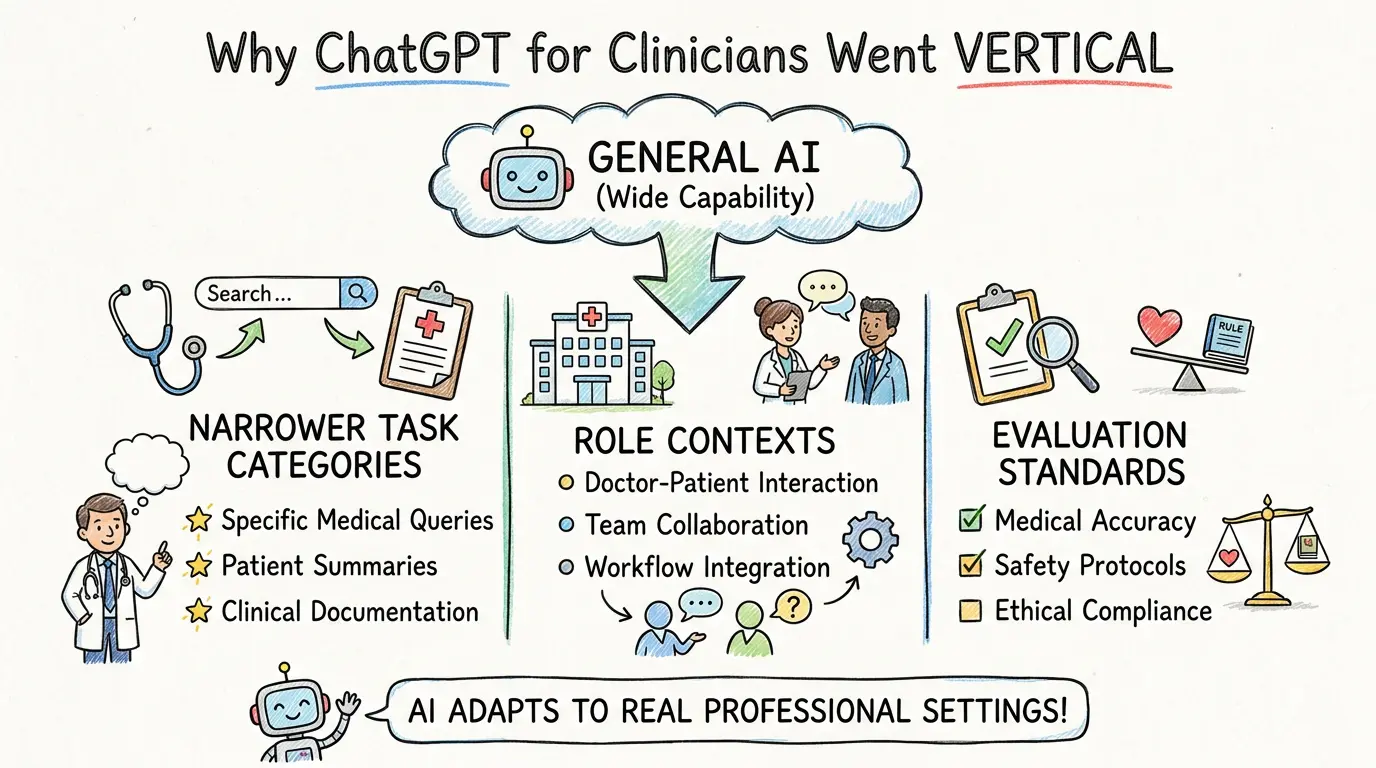
ChatGPT for Clinicians had to go vertical not because healthcare is simply a larger market, but because real professional settings cannot be served well by broad, generic AI messaging alone.
On April 22, 2026, OpenAI launched ChatGPT for Clinicians. That news can easily be read as "ChatGPT has another new version." But the more important signal is that general-purpose AI is moving deliberately into narrower professional contexts.
ChatGPT for Clinicians is designed for verified U.S. clinicians, including physicians, nurse practitioners, physician assistants, and pharmacists. OpenAI says it is built to support evidence review, documentation work, and medical research, while also offering trusted clinical search, citations, prebuilt skills, clinical starter prompts, deep research, and CME support for eligible clinical questions.
This is not just another layer of industry packaging.
It points to a broader reality: once AI enters real industries, products cannot stay at the level of "we are powerful and we can do everything." What industry users care about is not whether a model feels strong in the abstract, but whether it is reliable, well-matched, and worth recommending for a specific professional task.
Why Real Industries Push AI Products Toward Verticalization
The advantage of general AI is breadth.
But breadth creates four common problems once products enter real industries.
First, role understanding gets blurry.
Even within "healthcare AI," patients, physicians, hospital administrators, and pharmaceutical researchers are solving completely different tasks. A consumer health Q&A tool is not the same kind of product as one meant to support clinical documentation, evidence review, or referral-letter drafting.
For example, a patient may ask, "What does this lab marker mean?" A physician is more likely to need, "Draft a discharge summary from this chart." Both questions sit inside a healthcare context, but the user role, risk level, and output standard are completely different.
If AI cannot identify the user role, it tends to produce answers that look related but do not actually fit the scene.
Second, product boundaries get fuzzy.
Many AI products say they can "improve efficiency," "support decision-making," or "assist research." Those claims sound reasonable at a broad industry level, but they become vague once the task gets specific.
For clinicians, the real question is not, "Can this AI help doctors?" It is whether the product can help with clinical documentation, evidence review, medical literature work, or reducing low-value repetitive labor without replacing professional judgment.
"Supporting healthcare work" is too broad. "Helping draft discharge instructions, organize progress notes, or review evidence around a treatment category" gives a task boundary that can actually be judged.
Third, the comparison set becomes distorted.
If you stay only at the large-industry level, products from completely different layers get thrown into the same comparison set.
A general chat assistant, a clinical documentation tool, a medical literature search product, and a hospital-scale AI platform may all be grouped under "healthcare AI." But real users do not compare them that way. A physician looking for documentation support does not start by ranking every healthcare AI company on one giant list.
Fourth, the evaluation standard drifts.
The broader the industry, the easier evaluation becomes a generalized comparison.
But vertical tasks need standards that match the actual usage context. In clinical settings, users do not care only about whether the answer sounds fluent. They also care about whether citations are verifiable, whether the professional context is accurate, whether evidence review is supported, and whether professional-judgment boundaries are clearly preserved.
That is why OpenAI repeatedly frames ChatGPT for Clinicians as supporting clinical work rather than replacing professional judgment. The product is not dropping general AI into healthcare unchanged. It is repositioning capability inside clinicians' tasks, contexts, and responsibility boundaries.
Why Healthcare Is a Good Industry for Seeing the Value of Verticalization
Healthcare is especially useful for observing AI verticalization because the user need is not abstract.
Physicians are not usually asking, "Which AI is strongest?" They are more likely to care about:
- whether it can help them review evidence quickly
- whether it can generate verifiable citations
- whether it can support a first draft of clinical documentation
- whether it can fit professional context
- whether it can reduce low-value repetitive work
- whether it clearly keeps final judgment in the hands of the clinician
AMA reporting on its 2026 physician AI usage survey gives a more concrete picture: 39% of physicians reported using AI to summarize medical research and standards of care, 30% used it to generate discharge instructions, care plans, or progress notes, and 28% used it for billing-code, chart, or visit-note documentation.
That suggests AI adoption in real professional settings does not begin with the idea of an all-purpose assistant. It begins with a set of concrete tasks.
In other words, the value of verticalization is not just that a product knows more industry terminology. Its deeper value is that it allows an AI product to be understood, compared, evaluated, and recommended inside a more accurate task category.
What This Means for the AIvsRank Leaderboard
This is also why AIvsRank places so much emphasis on category inside the Leaderboard.
A broad industry leaderboard still has value.
It can answer questions like:
- which brands are more likely to be mentioned in a given industry
- which brands have stronger overall presence in AI recommendation environments
- which brands sit higher in the industry's overall ranking
But an industry is often too broad. It can answer only who tends to be mentioned often inside that industry.
Once user questions become more specific, the big industry view stops being enough.
Real users rarely ask:
"Who is the strongest AI company?"
They are more likely to ask:
- which AI tool is better for clinical documentation
- which AI product is better for medical evidence review
- which tool is better for a prior authorization letter
- which product is better for a physician's literature research
- which solution is better suited for hospital-scale deployment
Those are no longer questions that a broad industry leaderboard can answer well on its own.
They need a narrower category.
In AIvsRank's product logic, that is exactly what category is for: it compresses "industry recommendation" into "specific task-category recommendation."
The broad industry view answers overall visibility. The more specific category view answers task fit.
The first tells a client whether the brand is being seen in the industry. The second tells a client whether the brand is more likely to be recommended as a fit inside a specific usage scenario.
Why the Leaderboard Has to Evolve from Big Industry Lists into Category
If the Leaderboard stops at the broad industry level, it runs into a natural limit: it can see a brand's industry position, but it struggles to explain why that brand's position changes across tasks.
A brand may be highly visible at the industry level, yet still not be the most suitable object of recommendation for a particular task.
The reverse can also happen: a brand may not be the loudest name in the larger industry, but it may hold a stronger AI recommendation position in a specific category.
That is the point of category.
It allows the Leaderboard to answer more than "who gets mentioned most in the industry." It can move on to questions such as:
- who is more likely to enter the AI consideration set for this task category
- who is more likely to be placed near the front
- who is more likely to appear alongside the correct comparison set
- whose product capability is closer to the user's real question
That matters because brand teams do not only need to know whether they have industry visibility. They need to know whether they have position inside the categories that matter most.
If a medical AI product wants physicians to recommend it in clinical documentation questions, it needs to be understood by AI as a suitable tool for the documentation context, not just broadly classified as healthcare AI.
If an enterprise AI product wants to appear in workflow agent questions, it needs to be understood as a product for workflow execution and organizational collaboration, not just generically grouped as an AI assistant.
If a brand has visibility only at the large-industry level but is absent from a key category, it is very likely to be replaced in real user questions by a competitor that is more vertical and more tightly aligned to the task.
Verticalization Does Not Shrink the Market. It Improves Recommendation Accuracy
Many product teams worry that verticalization means narrowing the market.
But from the perspective of AI recommendation, verticalization is not about making the market smaller. It is about placing the product into a more accurate question space.
Once a product is placed in the right category, AI can more easily understand:
- what tasks it is suitable for
- what tasks it is not suitable for
- who it should be compared with
- why it deserves to be recommended
That is the value of the ChatGPT for Clinicians news hook.
It shows that once general AI enters real professional settings, it naturally moves toward clearer roles, more specific tasks, sharper boundaries, and evaluation that is closer to actual usage contexts.
For AIvsRank, the move from industry to category inside the Leaderboard is the same directional shift.
Industry-level lists show brands where they stand in the broad AI recommendation environment. Category-level views show whether a brand is correctly understood, whether it enters the consideration set, and whether it is more suitable than competitors inside the concrete tasks real users are actually asking about.
Future competition among AI products will not play out only at the level of broad industry visibility. The more important competition will happen inside specific categories.
The products that AI can understand in the right task category are the ones that are more likely to be recommended in real user questions.