
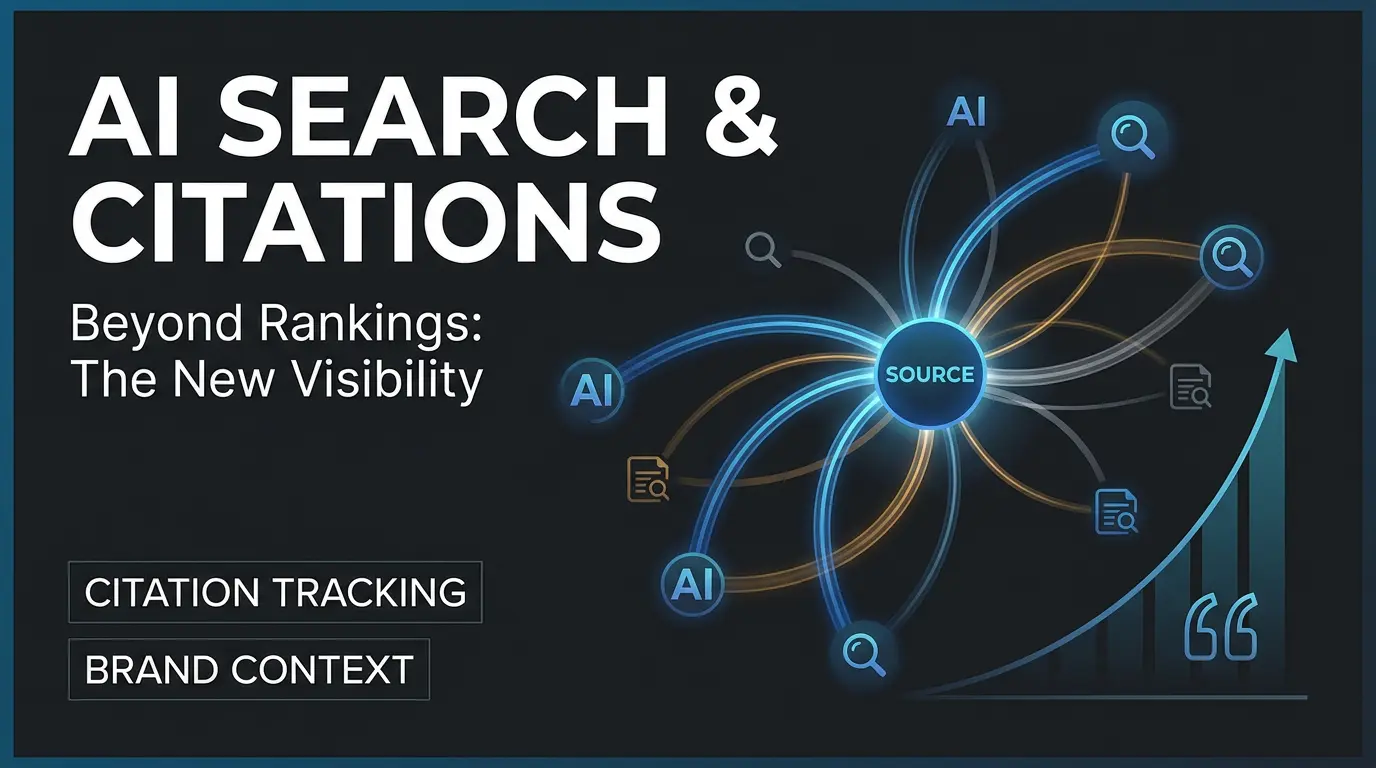
Traditional SEO taught teams to ask one dominant question:
Where do we rank?
AI search forces a different question:
Are we used as a source, and what does the AI say because of us?
That makes citation tracking a product workflow, not only an editorial checklist: use AIvsRank features to monitor source visibility over time, and use AIvsRank docs when methodology, coverage, or API details matter.
That is not a small shift. Ranking is a position in a list. Citation is evidence that an AI system selected a source, interpreted it, and attached it to an answer.
In classic search, the user saw ten blue links and decided what to open. In AI search, the answer often appears before the user makes that decision. The AI system may summarize multiple pages, choose supporting sources, cite some of them, ignore others, and frame the final answer in its own language.
That means visibility is no longer just about occupying a search result.
It is about becoming part of the answer.
Rankings measure position. Citations measure selection.
A ranking tells you where a page appears in a list of results.
A citation tells you that an AI answer used, surfaced, or attached your source to a claim.
Those are different forms of visibility.
In traditional SEO, a page could rank third, fifth, or tenth and still have a clear relationship to the user's next action. The user scanned results, judged snippets, clicked links, and built an answer by reading.
AI search compresses that journey. The system may read across sources and present a synthesized answer with only a small number of supporting links.
So a page can rank well in classic search and still disappear from the AI answer.
The reverse can also happen. A brand may not own the top organic ranking for a broad query, but it may appear inside the AI answer because its page provides a clear fact, comparison, statistic, definition, or source passage that the system can use.
This is why citation tracking matters.
It measures whether your content is actually being selected when AI systems build answers.
The AI answer is not a search results page.
AI search engines do not simply display a shorter version of the SERP.
They transform retrieval into synthesis.
The user asks a question. The system may run multiple searches, retrieve pages, extract passages, compare claims, resolve ambiguity, and produce a single response. Google says AI Overviews and AI Mode can use a query fan-out technique that issues multiple related searches across subtopics and data sources to develop a response, then display supporting links associated with that response (Google Search Central).
That matters because the citation is not just a link.
It is a signal that the source survived several layers of selection:
- the page was crawlable and indexable;
- the page matched some part of the user's intent;
- the content was understandable enough to extract;
- the claim fit the answer the AI system was building;
- the system chose to attach that source rather than another source.
In other words, a citation is closer to "source acceptance" than "page position."
That is why AI visibility cannot be reduced to rank tracking.
A citation has context, not just presence.
In classic SEO, a ranking was mostly directional. Higher usually meant better.
In AI search, a citation can be helpful, neutral, or damaging depending on context.
Consider three possible AI answers for the same brand.
The first says the brand is a leading option for enterprise teams and cites the brand's documentation.
The second says the brand is one of several options but cites an outdated comparison page.
The third says users complain about pricing or reliability and cites a third-party discussion.
All three are forms of visibility.
Only one is clearly positive.
This is why citation tracking has to ask more than "Did we appear?"
It should also ask:
- Which page was cited?
- Which claim was the citation attached to?
- Was the brand mentioned by name?
- Was the context positive, neutral, or negative?
- Did the AI summarize the source accurately?
- Did it cite the original source or a secondary source?
- Did the cited page support the claim being made?
- Was the answer current, complete, and fair?
The citation is not the finish line.
The surrounding sentence is part of the result.
Click data makes citations more important.
If AI search answers reduced no clicks, citations would still matter.
But the click environment is changing.
Pew Research Center found that Google users clicked traditional search results in 8% of visits when an AI summary appeared, compared with 15% of visits when no AI summary appeared. Pew also found that links inside the AI summary were clicked in only 1% of visits to pages with such a summary (Pew Research Center).
Ahrefs found a similar pressure in its AI Overviews study. In an analysis of 300,000 keywords, Ahrefs reported that the presence of an AI Overview correlated with a 34.5% lower average click-through rate for the top-ranking page compared with similar informational keywords without an AI Overview (Ahrefs).
These studies do not mean clicks disappear.
They mean rankings and clicks are becoming less tightly connected.
A page can rank, appear near an AI answer, or even support an AI answer without receiving the traffic that would have followed a traditional ranking.
When clicks become scarcer, citations become more valuable as a separate measurement layer.
They show whether the brand is still present in the answer environment even when the user does not visit the site.
Search Console does not fully solve citation visibility.
Google's documentation says that sites appearing in AI features such as AI Overviews and AI Mode are included in overall Search traffic in Search Console's Performance report under the Web search type (Google Search Central).
That is useful.
But it also creates a blind spot.
If AI feature impressions and clicks are blended into broader Search reporting, a website owner may struggle to answer practical questions:
- Did this query trigger an AI answer?
- Was our page cited in that answer?
- Was the citation above or below competitors?
- Did the AI answer use our content without sending a click?
- Did the citation context help the brand?
- Did the answer mention us but cite someone else?
Traditional rank trackers were built for result positions.
AI search requires answer inspection.
That is why AI visibility and citation tracking are becoming their own disciplines.
ChatGPT search makes crawler access part of citation strategy.
Citation visibility also depends on whether AI systems can access and use the site.
OpenAI's crawler documentation separates OAI-SearchBot from GPTBot. OpenAI says OAI-SearchBot is used to surface websites in ChatGPT search features, and sites that opt out of OAI-SearchBot will not be shown in ChatGPT search answers, though they may still appear as navigational links (OpenAI).
That does not mean every site should allow every crawler.
It does mean crawler policy is now connected to citation strategy.
If a website blocks the search crawler that an AI system uses for answer visibility, it may protect some content uses but reduce the chance of being cited in that system's answers.
The practical question is no longer only:
Can Google index this page?
It is also:
Can AI systems retrieve, understand, and cite this page when the user asks the question we care about?
AIvsRank's AI crawler access checker is useful for the access side of that question. The AI search visibility checker is useful for the answer-side question: whether the brand appears, where it appears, and how the citation context looks.
What makes a page citation-worthy?
AI systems cite pages for different reasons than users click pages.
A user may click because a title is appealing, a brand is familiar, or the snippet promises an answer.
An AI system needs extractable support.
Citation-worthy pages usually have several traits.
They answer a specific question clearly.
AI systems need passages that map cleanly to user intent.
A page that buries the answer under vague introductions, jargon, or broad positioning is harder to use. A page that states the answer, defines the concept, and supports the claim is easier to cite.
They include original evidence.
Original data, screenshots, benchmarks, product details, examples, and expert commentary give AI systems a reason to choose the page over generic summaries.
If ten pages repeat the same basic advice, the AI system can cite any of them.
If one page has the current dataset, the original table, or the clearest comparison, it has a stronger citation claim.
They make entities unambiguous.
AI systems need to understand what the page is about and which entities are connected to it.
Names, product categories, feature labels, dates, authors, sources, locations, and use cases should be explicit.
Ambiguous content is easier to ignore or misattribute.
They are structurally easy to extract.
Clear headings, short factual passages, descriptive tables, internal links, schema that matches visible content, and accessible text all help.
Google's AI features documentation says existing SEO fundamentals still matter, including crawlability, internal links, page experience, textual content, high-quality supporting media, and structured data that matches visible text (Google Search Central).
The point is not to create magic markup for AI.
The point is to make the page easy to retrieve, parse, and trust.
Citation tracking changes the SEO dashboard.
Classic SEO dashboards usually track rankings, impressions, clicks, CTR, backlinks, and conversions.
AI search adds another layer.
A serious AI visibility dashboard should track:
- whether the brand is mentioned for target prompts;
- whether the brand is cited or only named;
- which URLs are cited;
- which competitors are cited nearby;
- whether the citation context is positive, neutral, or negative;
- whether the answer is accurate;
- whether the answer is current;
- whether AI systems cite first-party pages or third-party pages about the brand;
- whether citation visibility changes after content updates;
- whether cited pages receive clicks, conversions, or branded search lift.
This is not vanity monitoring.
It is the new version of share of voice.
In classic search, share of voice meant ranking visibility across a keyword set.
In AI search, share of voice means participation in the generated answer across the prompts that matter.
AIvsRank's leaderboard helps frame this at the category level. The features and docs are useful when teams need to move from one-off checks into recurring prompt sets, tracked entities, citation reviews, and repeatable workflows. For more advanced workflows, geoskills can help define reusable AI search tasks around markets, categories, and entity visibility.
Rankings still matter. They just do not tell the whole story.
This article is not arguing that rankings are dead.
They are not.
Google says pages must be indexed and eligible to be shown with a snippet to be eligible as supporting links in AI Overviews or AI Mode. Existing SEO fundamentals still apply. Crawling, indexing, internal links, content quality, structured data, accessibility, and helpful content remain important.
The point is that rankings are now an input, not the full outcome.
The full outcome is:
- Can the page be discovered?
- Can the page be understood?
- Can the page be selected?
- Can the page be cited?
- Is the citation accurate?
- Is the citation context favorable?
- Does the citation lead to clicks, branded demand, trust, or conversion?
Classic SEO mostly measured the first two or three.
AI visibility has to measure all seven.
How to optimize for citations without becoming mechanical.
The worst way to chase AI citations is to stuff pages with artificial FAQ blocks, repetitive definitions, and awkward entity lists.
That may make a page look optimized, but it often makes the content worse.
A better approach is to write for human clarity and machine extractability at the same time.
Use direct explanations. Show your evidence. State what changed. Include dates where freshness matters. Link to supporting pages. Make product facts and category claims precise. Keep comparison criteria visible. Give the AI system something accurate to cite, and give the human reader a reason to continue.
AIvsRank's guide on how to optimize for AI search engines explains this broader shift: content has to be retrievable, understandable, extractable, and credible. The Google-focused guide on AI optimization for website owners makes the same practical point: AI search optimization is mostly clearer technical SEO, better content, structured data discipline, and accessibility rather than a separate mystical playbook.
Citation optimization should feel like making the page more useful.
If it makes the page worse for readers, it is probably the wrong move.
The new question for SEO teams.
The old question was:
Do we rank?
The new question is broader:
When AI search answers our buyer's question, are we part of the answer?
And if we are, are we represented correctly?
This is why citations matter more than rankings in AI search engines.
Rankings show where a page sits.
Citations show whether the AI answer chose the page as evidence.
In a world where users may read the answer before they click, that distinction matters.
The future of SEO will not be only rank tracking.
It will be rank tracking plus citation tracking, answer monitoring, prompt coverage, context analysis, and source-quality work.
The websites that win will not only appear in search.
They will be trusted enough to be used.
FAQ: AI Search Citations and Rankings
Do rankings still matter in AI search?
Yes. Rankings still matter because crawlability, indexing, content quality, internal links, snippets, and technical SEO can influence whether a page is eligible to appear as a supporting source. But rankings no longer capture the full outcome. A page also needs to be selected, cited, and represented accurately inside AI-generated answers.
Why are citations more important than rankings in AI search engines?
Citations show whether an AI system actually used or surfaced a source inside an answer. Rankings show position in a search results list. In AI search, the user may read a synthesized answer before clicking any link, so being cited in the answer can matter more than simply ranking somewhere below or around it.
What is AI citation tracking?
AI citation tracking is the process of monitoring whether a brand, page, or source is cited in AI-generated answers across target prompts. Good citation tracking also reviews the cited URL, competitors cited nearby, answer accuracy, source context, sentiment, and whether the citation supports a useful business outcome.
Can a page rank well but not be cited by AI search?
Yes. A page can rank in classic search but be ignored by an AI answer if it is not useful for the generated response, is hard to extract, lacks clear evidence, or is less relevant to the specific subtopic the AI system is answering.
Can a brand be mentioned without being cited?
Yes. AI systems may mention a brand without linking to the brand's own website. They may also cite a third-party source when describing the brand. That is why teams should track brand mentions and citations separately.
What makes a page more likely to be cited?
Pages are more citation-worthy when they provide clear answers, original evidence, current facts, explicit entities, well-structured sections, accessible text, and claims that are easy to verify. The goal is not to over-optimize for machines, but to make the page easy to understand and trustworthy.
How should SEO teams measure AI visibility?
SEO teams should combine classic metrics such as rankings, impressions, clicks, and conversions with AI-specific metrics such as prompt coverage, brand mentions, cited URLs, citation context, answer accuracy, competitor citations, and changes after content updates.