
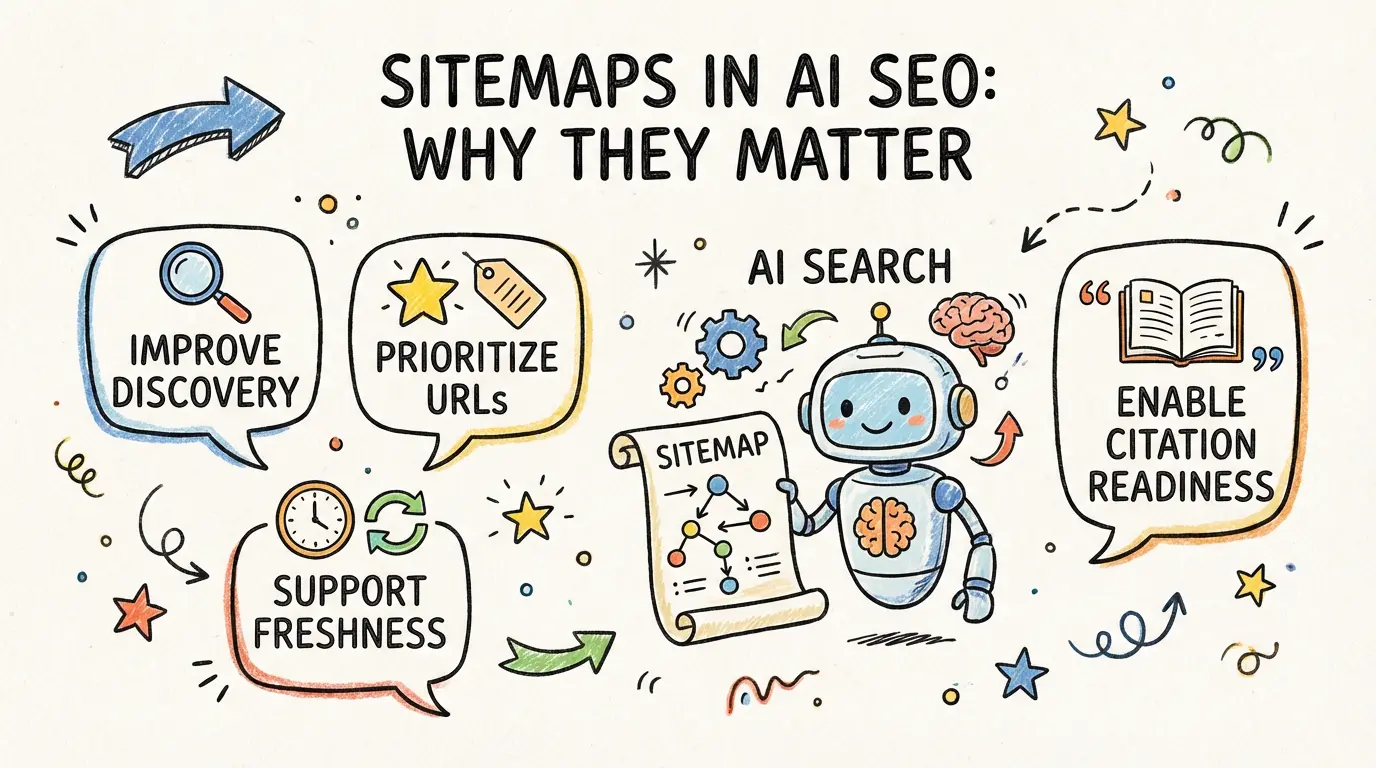
When people talk about AI SEO, they usually jump to more novel topics first: AI Overviews, answer engines, entity optimization, llms.txt, or whether a brand is getting cited in chatbot results. Sitemap files rarely get that kind of attention because they feel too basic.
That is a mistake.
A sitemap is not an AI SEO trick, and it is not a guarantee that your content will be indexed, summarized, or cited. But it is still one of the clearest ways to help search systems discover the URLs you care about, understand which pages matter, and notice when important content changes. In AI-driven search, that matters because discovery and freshness both happen before citation.
The short version is simple: sitemaps are not the thing that makes a page win in AI search, but they are part of the infrastructure that makes the page eligible to compete.
AI SEO Still Depends on Standard Search Foundations
This point is worth grounding early because a lot of teams overcomplicate it. Google says the same SEO best practices still apply to AI features such as AI Overviews and AI Mode, and that there are no extra technical requirements or special AI-only files needed just to appear in those experiences (Google Search Central).
That matters for how teams should prioritize work.
If your important pages are difficult to crawl, weakly linked, inconsistently updated, or slow to get discovered, adding more "AI SEO" language on top does not fix the real problem. AI-facing visibility still sits on top of ordinary search infrastructure: crawlability, indexability, page quality, internal linking, structured content, and clean discovery signals.
A sitemap belongs squarely in that foundation layer.
What a Sitemap Actually Does
Google defines a sitemap as a file that gives search engines information about the pages, videos, and other files on your site, along with relationships between them. It also says the file can include useful details such as when a page was last updated and language variants (Google Search Central).
That sounds straightforward, but the operational value is easy to underestimate.
In practice, a sitemap helps in four ways:
- it gives crawlers a clean list of URLs you consider important
- it reduces the chance that new or weakly linked pages stay invisible for too long
- it provides update signals, especially when
<lastmod>is accurate - it gives large or messy sites a better discovery layer than internal links alone
Google is also clear about the limits. A sitemap helps discovery, but it does not guarantee that every listed page will be crawled or indexed (Google Search Central). That distinction matters even more in AI SEO, where people often expect a technical file to act like a visibility switch.
It is not a switch. It is a signal.
Why That Signal Matters More in AI Search Than It First Appears
The reason sitemaps matter in AI SEO is not that answer engines directly "read your sitemap and cite you." The reason is more upstream than that.
Google explains that AI features can use query fan-out across related subtopics and supporting sources, then surface a wider set of helpful links than a classic search result might (Google Search Central). For a page to even have a chance in that broader retrieval environment, it still has to be discovered, crawled, indexed, and eligible to appear with a snippet.
In other words, AI citation opportunity starts before the AI layer.
If your best comparison page, documentation page, pricing page, or glossary page is slow to be found or refreshed, it may not enter the candidate set at the right time. And if it is missing from the candidate set, no amount of clever AI positioning language will make it quotable in practice.
This is why sitemap work often feels indirect but still matters. It affects the path by which pages become available to the systems that later summarize, support, and cite them.
Discovery Layer vs Control Layer
One useful way to frame this is to separate discovery signals from control signals.
Sitemaps are part of the discovery layer. They help search systems find and revisit important content.
robots.txt, by contrast, is mainly about access control. It helps determine what crawlers may fetch. As AIvsRank's article on LLMs.txt and Robots.txt: Technical Control Layers for SEO, AEO, and GEO explains, robots.txt and llms.txt are better understood as control mechanisms, not discovery mechanisms.
That distinction is easy to blur in AI SEO conversations. Teams sometimes ask whether they should spend more time on llms.txt, more time on robots.txt, or more time on sitemap cleanup, as though these are interchangeable. They are not.
They answer different questions:
- sitemap asks: what should be discovered and revisited?
robots.txtasks: what may be crawled?llms.txtasks: how should AI systems think about reuse or policy, if they support it at all?
If you neglect the sitemap layer, you are weakening the part of the stack that helps your most important URLs enter the crawl and refresh loop in the first place.
Sitemaps Help Freshness Travel Faster
This is where the AI SEO case gets stronger.
In classic SEO, sitemap quality mostly gets discussed as a crawl hygiene issue. In AI SEO, it also affects freshness readiness. That matters because AI answers are often more sensitive to stale facts than ordinary blue links. A page can still rank for a while with slightly old information. An AI answer that cites outdated pricing, outdated capabilities, or outdated comparisons feels broken immediately.
Google's crawl budget guidance says that keeping your sitemap up to date is adequate for many sites, and specifically recommends including the <lastmod> tag when content is updated (Google Developers). That does not mean Google will instantly recrawl every changed page. But it does mean your sitemap can help communicate that something worth revisiting has changed.
That fits well with AIvsRank's article on AI Answer Bias and Freshness: How Often Do Engines Update Sources?, which makes the broader point that freshness is a real operational variable in answer engines, not just a nice extra. If your content changes but your discovery and recrawl signals are sloppy, the engine may keep leaning on older material or on fresher third-party pages that are easier to find.
That is one of the most practical sitemap arguments in AI SEO:
accurate sitemap updates do not create authority, but they help current authority get seen as current.
Where Sitemaps Matter Most
Not every site gets the same lift from sitemap work. If your site is small, tightly linked, and updated infrequently, the gains may be modest. Google says small, comprehensively linked sites may not rely heavily on a sitemap for discovery (Google Search Central).
But the importance goes up quickly in cases like these:
- large sites with many landing pages, docs pages, or article archives
- new sites with limited external links
- sites that publish frequent updates to product, pricing, or comparison content
- multilingual sites with alternate language versions
- sites with important pages that are technically reachable but not strongly linked from main navigation
These are exactly the kinds of sites that often care about AI SEO, because they want a wider footprint across informational, commercial, and brand queries. On those sites, sitemap quality is less about checking a box and more about keeping the URL inventory legible.
What a Good AI-Ready Sitemap Strategy Looks Like
The right goal is not "submit one sitemap and forget it." The goal is to make sure the sitemap reflects the content you actually want crawlers to prioritize.
A practical standard looks like this:
- include only canonical, index-worthy URLs
- remove redirects, 404s, and thin utility pages that do not belong in search
- keep article, docs, product, and comparison URLs updated when their content materially changes
- use accurate
<lastmod>values instead of touching them automatically on every minor template edit - keep internal linking strong so the sitemap supports discovery instead of trying to replace site structure
For some teams, it is also worth splitting sitemaps by content type or site section, especially when different sections update at different speeds. That makes it easier to monitor whether your high-value areas are actually getting refreshed.
This is not glamorous work. It is infrastructure work.
But infrastructure is often what separates a site that is theoretically optimized for AI search from one that is actually ready to be discovered and cited consistently.
What Sitemaps Do Not Do
This is just as important as the upside.
A sitemap does not:
- guarantee crawling
- guarantee indexing
- guarantee citation in AI answers
- fix weak content
- replace internal links
- override poor canonicalization or crawl blocks
It also does not make special AI markup unnecessary because there largely is no special markup requirement to appear in Google's AI features in the first place (Google Search Central).
So the mistake is not "using a sitemap too much." The mistake is expecting a sitemap to carry strategic work it was never meant to do.
The page still needs to be useful. It still needs to be clear. It still needs to answer something worth quoting.
The Real Meaning of Sitemap Work in AI SEO
The most useful way to think about sitemaps in AI SEO is this:
they improve your odds of being discovered, revisited, and understood at the right moment.
That may sound less exciting than talking about answer engines and generative visibility, but it is exactly the kind of quiet leverage that matters. AI search surfaces can only reuse what their upstream systems can reliably find and refresh. Sitemap quality helps with that upstream reliability.
If you want a cleaner mental model, use this one:
- content quality creates citation potential
- internal links and site architecture distribute discoverability
- sitemaps reinforce URL discovery and update signals
- freshness work keeps important pages competitive over time
None of these alone is "AI SEO." Together, they are a large part of the technical base that AI SEO depends on.
Final Takeaway
Sitemaps still matter for AI SEO not because they are an AI-specific hack, but because AI visibility still depends on ordinary search discovery and refresh systems.
If a page cannot be found efficiently, revisited when it changes, or treated as an important part of your site, it is already at a disadvantage before any answer engine decides whether to cite it. That is why sitemap work deserves more respect in AI SEO than it usually gets.
It is not the final step. It is not the flashy step. But it is one of the steps that makes the rest of the stack possible.