
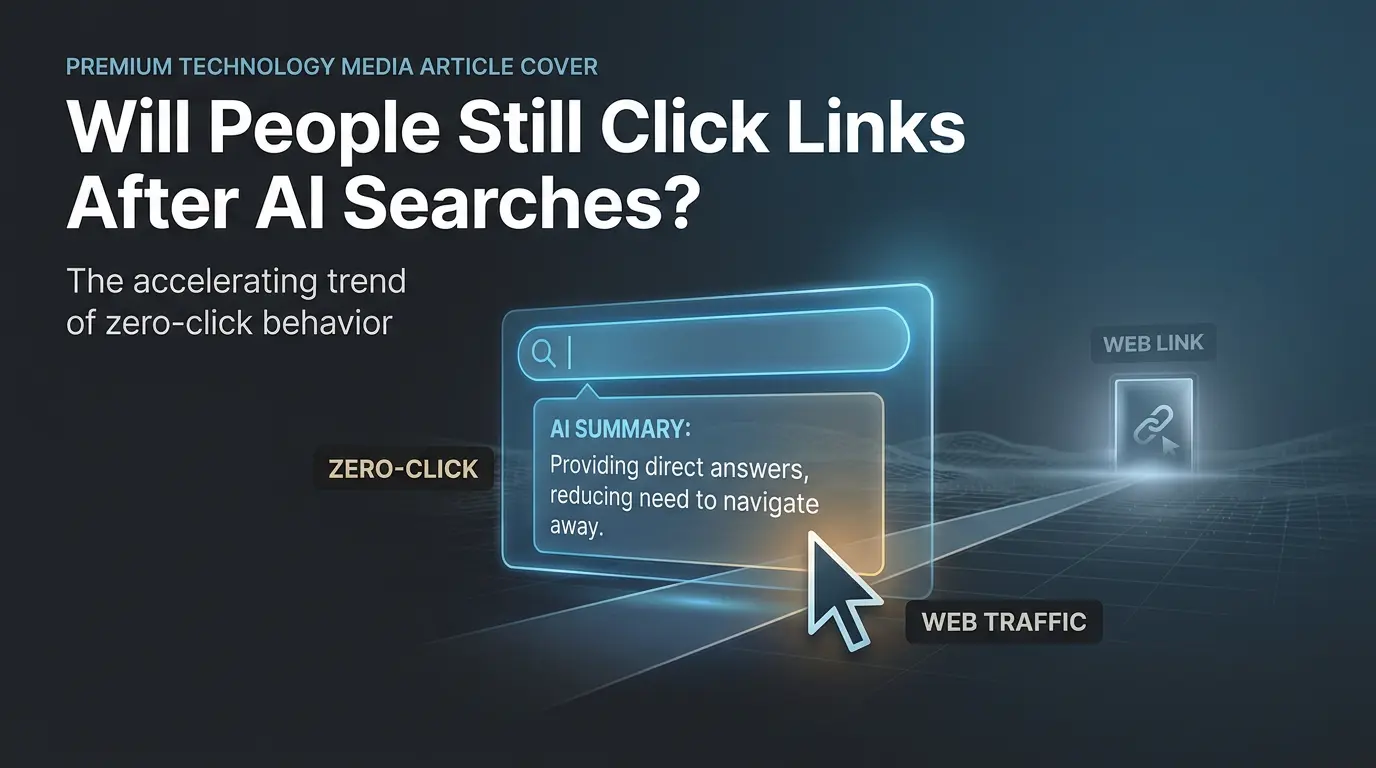
People will still click links after AI searches.
But they will click fewer of them.
That is the uncomfortable middle ground many website owners need to accept. AI search does not erase the click. It changes what the click is for.
In traditional search, the user often clicked because the search engine did not answer the question. It returned a ranked set of pages, and the user had to inspect those pages to build the answer.
In AI search, the first layer of interpretation happens before the click. The system reads across sources, compresses the answer, and gives the user a usable response on the results page or inside a conversational interface.
That means the link is no longer the default next step.
It has to earn its place.
Zero-click search is not new. AI makes it harder to ignore.
Zero-click search means the user performs a search but does not click through to an external web page.
This pattern existed long before generative AI. Weather boxes, sports scores, currency converters, calculators, featured snippets, local packs, knowledge panels, and dictionary answers all taught users that some searches could end on the results page.
The difference is scope.
Older zero-click features usually handled narrow facts. AI summaries can handle broader questions: comparisons, explanations, troubleshooting steps, product research, health-adjacent questions, travel planning, coding help, and multi-part informational queries.
That changes the economics of content.
SparkToro and Datos estimated in their 2024 zero-click search study that, for every 1,000 Google searches in the United States, only 360 clicks went to the open web. In the European Union, the number was 374 clicks per 1,000 searches (SparkToro).
That was already a click-scarce environment.
AI search adds a new layer: not just a direct answer, but a synthesized answer.
Pew's data shows the click gap clearly.
Pew Research Center analyzed online browsing activity from 900 U.S. adults during March 2025. Its dataset included 68,879 unique Google searches, and 12,593 of those searches produced an AI summary when Pew collected the search result pages in April 2025 (Pew Research Center).
The click difference was sharp.
When a Google results page included an AI summary, users clicked a traditional search result in 8% of visits. When there was no AI summary, they clicked a traditional result in 15% of visits.
That is not a small UX detail. It is close to a halving of traditional link-click behavior in that dataset.
Pew also found that links inside the AI summary itself were rarely clicked. Users clicked a link in the AI summary in only 1% of visits to pages with such a summary.
The session-ending behavior matters too. Pew found that users ended their browsing session after 26% of pages with an AI summary, compared with 16% of pages with only traditional results.
In plain language: when the answer appears before the link, more users stop.
Why AI summaries reduce clicks.
AI summaries reduce clicks because they remove uncertainty from the user's next step.
Before AI, a search result page often left the user with questions:
- Which result is reliable?
- Which page has the actual answer?
- Which source is up to date?
- Which result is trying to sell me something?
- Which result has the shortest path to the information?
AI search tries to answer those meta-questions on the user's behalf.
That creates five click-reducing effects.
First, the user may feel satisfied. If the summary answers the question well enough, the page visit becomes optional.
Second, the user may feel falsely satisfied. Even if the answer is incomplete, the confident format can reduce the urge to verify.
Third, the user may treat citations as decoration. A cited source can increase perceived credibility without producing a visit.
Fourth, the search task may continue inside the AI interface. Instead of opening a page, the user asks a follow-up.
Fifth, the AI answer changes the user's expectation. A page that merely repeats the same basic answer now feels redundant.
The link survives only when it offers something the summary cannot fully absorb.
Not every query loses clicks equally.
The future of clicking is uneven.
Some queries are naturally click-resistant. If a user asks for a definition, conversion, simple fact, quick how-to step, or short comparison, the AI answer may be enough.
Other queries still invite clicks because the user needs more than a compressed answer.
Clicks are more likely to survive when the user needs:
- a tool, calculator, template, checklist, or downloadable asset;
- original data or a chart that cannot be reduced to one sentence;
- a detailed tutorial with screenshots or implementation steps;
- a product page, price page, demo, trial, or comparison table;
- first-hand experience, reviews, community discussion, or expert nuance;
- legal, financial, medical, or technical context that requires verification;
- a source they trust enough to bookmark, cite, or share.
This is why zero-click search should not make every website panic in the same way.
A commodity definition page is more exposed than an interactive tool. A generic how-to article is more exposed than a diagnostic workflow. A thin comparison page is more exposed than a page with original testing, pricing evidence, screenshots, and current product details.
AI search compresses the easy answer.
It does not fully replace the high-value next step.
Ranking is no longer the same as receiving the click.
For years, SEO teams treated ranking as the main proxy for traffic.
If the page ranked, the clicks would usually follow.
AI search breaks that assumption.
A page can rank, be cited, or influence an answer while still receiving fewer visits. A brand can be visible inside an AI answer without getting the same traffic that a classic blue-link ranking once produced.
Ahrefs found a similar pressure in its AI Overviews analysis. In a study of 300,000 keywords, Ahrefs reported that the presence of an AI Overview correlated with a 34.5% lower average click-through rate for the top-ranking page compared with similar informational keywords without an AI Overview (Ahrefs).
That does not mean every site loses 34.5% of clicks. It means AI Overview visibility changes the click environment around ranking.
Google's own Search Central documentation frames AI Overviews and AI Mode as Search features that surface links and help users explore, while also saying that pages must be indexed and eligible for snippets to appear as supporting links in those features. Google also says AI features are reported inside the standard Search Console Performance report rather than broken out as a separate click channel (Google Search Central).
That creates a measurement problem.
If AI visibility, classic rankings, impressions, and clicks are blended together, the site owner may see impressions hold steady while clicks decline. The page still appears to be present in search, but the user journey has changed.
This is the new SEO tension:
Visibility can rise while visits fall.
The click is becoming a higher-intent signal.
The optimistic reading is that clicks will become fewer but more meaningful.
If an AI summary filters out casual informational needs, the users who do click may be more serious. They may want the original source, deeper detail, a product action, a downloadable asset, an expert explanation, or proof that the AI answer is correct.
Google has argued in its AI features documentation that clicks from search results pages with AI Overviews can be higher quality, meaning users are more likely to spend more time on the site.
That may be true for some categories.
But it does not remove the publisher's concern. A higher-quality click is only helpful if enough clicks remain, and if those clicks lead to business outcomes.
This is why website owners should stop measuring only raw organic sessions.
They also need to measure:
- AI citation visibility;
- branded search lift after AI exposure;
- click-through rate on queries that trigger AI summaries;
- conversion rate from AI-influenced traffic;
- whether cited pages are the right pages;
- whether the AI answer represents the brand accurately;
- whether traffic loss is concentrated in commodity informational pages.
AIvsRank's AI search visibility checker is useful when the question is not just "Do we rank?" but "Do AI systems mention us, cite us, or ignore us?" For Google-specific exposure, an AI Overview eligibility check can help separate technical eligibility from answer visibility.
The point is not to replace analytics. It is to add a visibility layer that classic click reports often miss.
How websites can still earn clicks.
The wrong response to zero-click AI search is to write longer versions of the same generic answer.
If the AI summary already gives the basic explanation, adding 2,000 more words of loosely related prose will not make the click more necessary.
The better response is to make the page useful after the summary.
That usually means one or more of these moves.
Give users something AI cannot complete on the results page.
Tools, calculators, templates, interactive checkers, original datasets, comparison matrices, demos, and configuration workflows are harder to replace with a paragraph.
This is why free tools often perform differently from ordinary informational pages. A summary can explain what a crawler access problem is. It cannot run the actual check for the user.
Add original evidence.
AI systems are good at summarizing common knowledge. They are less able to create legitimate first-party data, benchmarks, screenshots, expert interviews, field tests, customer examples, or current product observations.
Original evidence gives the user a reason to click and gives AI systems a reason to cite.
Make the next step obvious.
If a user arrives after reading an AI answer, they do not need another vague introduction.
They need a next action:
- compare options;
- verify a claim;
- download the template;
- run the audit;
- inspect the data;
- see the example;
- start the workflow;
- contact the source;
- buy, trial, subscribe, or save.
Every page should answer: after the AI summary, why should someone still open this?
Build pages for citation and continuation.
A good AI-era page should be easy to cite and worth continuing into.
That means clear headings, factual passages, dates, named entities, concise definitions, original examples, visible authorship, internal links, and structured supporting material.
AIvsRank's guide on how to optimize for AI search engines describes this broader shift: pages need to be retrievable, understandable, extractable, and credible enough to become source material. The newer Google-focused guide on AI search optimization makes a similar point: AI search optimization is still grounded in technical SEO, content quality, structured data, internal links, and accessibility.
The click is no longer guaranteed by ranking.
It is earned by usefulness after the answer.
What this means for publishers.
Publishers face the hardest version of the zero-click problem.
News, explainers, reviews, and service journalism often depend on pageviews, subscriptions, ads, affiliate links, and direct reader relationships. If AI systems summarize the work without sending readers back, the economics weaken.
The risk is not only traffic loss.
It is relationship loss.
When a user reads the summary but not the publication, the publisher may lose:
- the pageview;
- the ad impression;
- the newsletter signup;
- the subscription prompt;
- the related article click;
- the reader habit;
- the brand memory.
That is why the question "Will people still click links?" is also a question about whether the web can maintain a fair value exchange.
If AI systems depend on publisher content, but the click becomes rare, publishers will push for better attribution, licensing, traffic reporting, and content controls.
This is already visible in the broader conversation about AI crawlers, robots.txt, and content authorization. The strategic issue is not simply whether a crawler can access the page. It is whether access leads to visibility, credit, traffic, licensing value, or some other fair return.
What this means for brands and SEO teams.
For most brands, the practical answer is not "give up on clicks."
It is to separate three goals that used to be bundled together:
Ranking means appearing in classic search results.
Citation means being used as a source in AI-generated answers.
Clicking means the user chooses to leave the AI or search interface and visit the site.
These three outcomes now need separate tracking.
AIvsRank's leaderboard can help teams see category-level visibility patterns. The free tools hub is useful for one-off checks. For teams turning AI search into a repeatable process, AIvsRank features, AIvsRank Docs, and geoskills help connect prompts, entities, visibility checks, and recurring workflows.
The important shift is mental.
SEO used to ask: can we rank for this query?
AI search adds two harder questions:
Can we be selected as a source?
And if we are selected, is there still a reason for the user to click?
The future is not clickless. It is click-selective.
People will still click links after AI searches.
They will click when the answer is not enough.
They will click when trust matters.
They will click when they need a tool, transaction, original source, detailed proof, human judgment, or a next step.
But they will not click just because a link exists.
That is the real zero-click lesson.
AI search turns the link from a default path into an earned continuation.
The websites that adapt will not simply chase rankings. They will build pages that deserve to be cited and still give users a reason to arrive.
FAQ: AI Search and Zero-Click Search
Will people still click links after AI searches?
Yes, but they will likely click fewer links for simple informational queries. AI summaries can satisfy many quick questions on the results page. Links will still matter when users need deeper detail, original sources, tools, transactions, verification, or expert context.
What is zero-click search?
Zero-click search happens when a user performs a search but does not click through to an external website. The user may get the answer on the results page, run another search, click a Google-owned feature, or end the session.
How do AI summaries affect click-through rates?
Pew Research Center found that Google users clicked traditional search results in 8% of visits when an AI summary appeared, compared with 15% of visits without an AI summary. Pew also found that users clicked links inside AI summaries in only 1% of visits to pages with such a summary.
Does appearing in an AI Overview guarantee traffic?
No. Being cited or included as a supporting link can create visibility, but it does not guarantee a click. Some users may treat the AI answer as complete. Others may notice the source but continue searching or ask a follow-up instead of visiting the page.
What types of pages can still earn clicks from AI search?
Pages with original data, interactive tools, calculators, templates, product details, screenshots, expert analysis, community discussion, or transaction paths are more likely to earn clicks. A page that merely restates a common answer is easier for AI to summarize away.
Should SEO teams still care about ranking?
Yes. Ranking still matters because search visibility, indexing, and snippet eligibility can affect whether a page appears as a supporting link in AI search features. But ranking is no longer enough. Teams also need to track AI citations, answer accuracy, brand visibility, and post-answer click value.
How should websites measure zero-click AI search?
Websites should combine Search Console, analytics, AI visibility checks, prompt tracking, citation monitoring, branded search trends, and conversion data. The goal is to understand not only whether traffic changed, but whether the brand is appearing in AI answers and whether those appearances produce meaningful outcomes.