
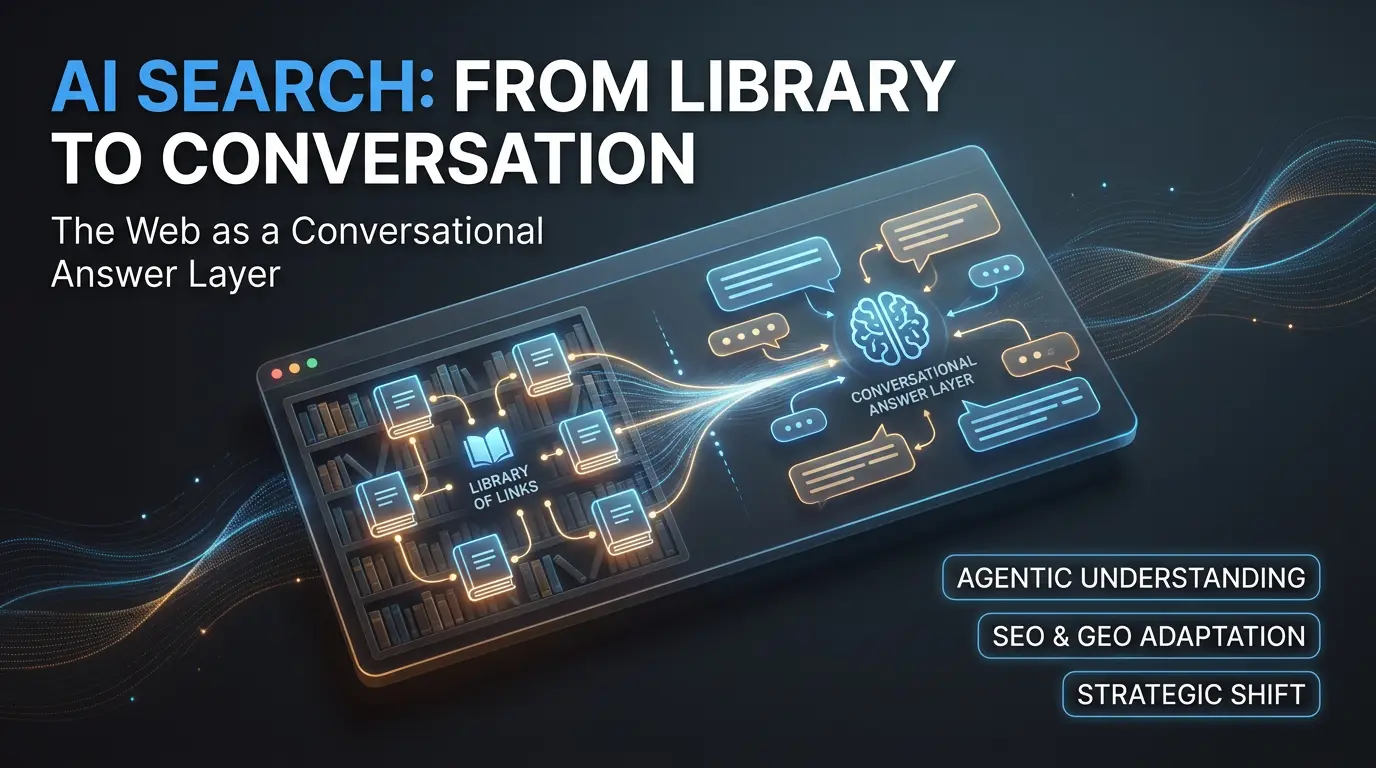
For most of the web's history, search worked like a library.
The user asked a question. The search engine pointed to an index. The index returned a list of pages. The user opened several sources, compared them, and built an answer through browsing.
The path looked like this:
User -> index -> website
AI search changes the path.
The user asks a question. The AI interprets intent, retrieves sources, compares claims, compresses context, and returns a synthesized answer. The website may still be used, but it is no longer always the place where the user does the thinking.
The new path looks more like this:
User -> AI -> synthesized answer
That small diagram explains a large shift. Search is moving from navigation to agentic understanding. The web is still there, but the user's first experience is increasingly a conversation with an AI system that has already read, filtered, and summarized parts of the web on their behalf.
This is why AI search is not just another search feature. It changes what visibility means.
If you need the broader mechanics first, AIvsRank's guide to AI search engines explains how retrieval, synthesis, source selection, and citations work together. This article focuses on the deeper strategic change: the web is becoming less like a public shelf of documents and more like source material for an AI middle layer.
The old web assumed users would browse
Traditional search was built around a simple bargain.
Search engines helped users find pages. Publishers created useful pages. Users clicked results. Websites earned attention, trust, subscribers, leads, or revenue.
That model had flaws, but the role of the website was clear. The page was the main destination. The search engine was the route.
Classic SEO grew inside that world. It optimized for crawling, indexing, ranking, snippets, backlinks, internal links, technical health, and click-through rate. Those things still matter. A page that cannot be crawled, indexed, understood, or trusted is unlikely to perform well in any search environment.
But traditional SEO assumes the user still needs to visit the page to complete the information task.
AI search weakens that assumption.
When an AI answer can define a concept, summarize options, compare tools, extract steps, explain trade-offs, and cite a few sources, many users will not open ten tabs. They may not open one. They may treat the answer as the first meaningful interface to the web.
This does not mean websites disappear. It means websites are being repositioned. They are no longer only destinations. They are also evidence, training context, retrieval candidates, citation candidates, and brand signals.
AIvsRank's article on why traditional SEO falls short in the AI answer era makes this distinction clearly: ranking pages and winning clicks are no longer the full visibility problem. Brands also need to be understood, selected, cited, and represented correctly inside AI-generated answers.
The AI layer is becoming the user's interpreter
In traditional search, the user performed much of the interpretation.
The search engine returned links. The user opened pages, judged credibility, compared claims, and decided which source to trust. The interface gave users many options, but it also pushed the work of synthesis onto them.
AI search moves much of that work into the system.
An AI search engine may:
- turn one query into several implied sub-questions;
- retrieve pages, documents, discussions, structured data, and known entities;
- compare overlapping claims;
- decide which sources are relevant enough to cite;
- rewrite the result into a conversational answer;
- let the user continue with follow-up questions.
OpenAI described ChatGPT search as a way to get timely answers with links to relevant web sources, blending a natural language interface with up-to-date web information (OpenAI). Google is moving in a similar direction inside Search. On May 6, 2026, Google announced updates to AI Mode and AI Overviews that add more inline links, deeper follow-up suggestions, public discussion previews, and hover previews for linked websites (Google).
Those updates are important because they do not simply restore the old web. They redesign links inside the answer.
The link is no longer the whole search result. It becomes one supporting object inside a larger AI response.
That is the new middle layer: an AI system sits between the user and the open web, turning pages into answer material.
Users are already clicking less when AI answers appear
The shift from browsing to answer consumption is visible in user behavior.
Pew Research Center analyzed U.S. Google browsing behavior from March 2025 and found that users who encountered an AI summary clicked a traditional search result in 8% of visits, compared with 15% of visits without an AI summary. Pew also found that users clicked links inside AI summaries in just 1% of visits to pages with such a summary (Pew Research Center).
Ahrefs reported a similar directional pattern. In a study of 300,000 keywords, the presence of an AI Overview correlated with a 34.5% lower average click-through rate for the top-ranking page compared with similar informational keywords without an AI Overview (Ahrefs).
The exact numbers will vary by query type, brand, industry, and interface design. But the direction matters: when AI provides a useful answer up front, many users have less reason to browse.
This is especially true for informational queries:
- "what is an AI search engine?"
- "best tools for AI search visibility"
- "how does llms.txt affect SEO?"
- "compare traditional SEO and GEO"
- "how do AI Overviews choose sources?"
These are the same queries many blogs, documentation sites, and comparison pages were built to capture.
The risk is not only that traffic declines. The deeper risk is that influence moves off-site. A user may learn your category, compare your competitors, and form a shortlist before visiting any official website.
AIvsRank calls this answer visibility without click visibility: a brand can be mentioned, cited, compared, or recommended inside an AI answer even when analytics show no matching website session.
The web is becoming a source layer, not only a destination layer
The open web used to be the user's reading environment.
In AI search, the web increasingly becomes the system's source environment.
That changes the role of content. A blog post is no longer only something a person might read from top to bottom. It is also a collection of passages that may be retrieved, segmented, compared, summarized, cited, or ignored.
This is why generic content is becoming less useful. If an article does not make a clear claim, name the entities involved, provide evidence, explain limits, and structure its argument cleanly, an AI system may have little reason to use it as source material.
The new question is not only:
Can this page rank?
It is also:
Can this page be understood, extracted, verified, selected, and attributed?
AIvsRank's article AI Search Is Entering Its PageRank Moment frames this as a second selection layer. Being retrieved is not the same as being cited. A page can enter the candidate pool and still lose the final competition for attribution.
That second selection layer is where many brands will win or disappear.
Citation is not the same as correctness
It is tempting to treat citations as the solution. If AI answers show sources, the web survives. If your page is cited, your brand is visible.
That is partly true, but incomplete.
Citations improve traceability. They do not guarantee that an AI system has understood the source correctly.
The Tow Center for Digital Journalism at Columbia Journalism Review tested ChatGPT Search by asking it to identify the source of 200 article quotes from 20 publishers. ChatGPT returned partially or entirely incorrect responses in 153 cases and rarely admitted uncertainty (Columbia Journalism Review).
That finding matters for content strategy. AI search does not only create a traffic problem. It creates a representation problem.
If your brand is absent, you lose visibility.
If your brand is present but misclassified, you lose positioning.
If your article is cited for a claim it does not support, you inherit trust risk.
If your competitor's rewritten summary becomes easier to cite than your original source, you lose attribution.
This is why AI search optimization should not be reduced to "get more AI citations." The better goal is accurate answer inclusion: being mentioned in the right context, cited for the right claims, and described in a way that matches your actual product, category, and evidence.
Internal links should read like a source map, not a sales path
Internal links are easy to misuse in articles about AI search. If every link points to a product page, the article starts to sound like a funnel. If the links are chosen well, they do something more useful: they show readers and machines how the site thinks about the topic.
A strong source map usually has three layers.
First, it gives readers a concept path. Someone who is still learning the category should be able to move from this article into broader explainers in the AIvsRank blog, such as the guide to AI search engines or the argument for why traditional SEO falls short in the AI answer era. These links belong near strategy claims, not in a generic "related resources" block.
Second, it gives readers a diagnostic path. When the article discusses whether AI systems can access a page, a link to an AI crawler access check is useful because it answers the next practical question. When the article discusses answer-surface eligibility, an AI Overview eligibility check fits naturally. The broader free tools hub only makes sense when the reader is choosing which problem to inspect first.
Third, it gives readers a measurement path. If the point is that visibility now happens inside answers, readers need examples of what can be measured. A public AI visibility leaderboard helps illustrate category-level comparison, while a concise overview of tracked AI visibility features is useful when the discussion shifts from one-off checks to recurring monitoring.
Finally, operational work needs documentation. When teams turn GEO from an idea into a repeatable process, AIvsRank Docs and the geoskills documentation are more natural follow-ups than another conceptual blog post.
That is the standard for internal links in an AI search article: the link should answer the reader's next question at that exact moment. If it does not, it is probably marketing noise.
What brands should do differently
The web is not dead. But the job of a website is changing.
In a library model, your page competes to be opened.
In a conversation model, your page competes to be used accurately inside an answer.
That requires a different operating rhythm.
First, keep the technical foundation clean. AI systems cannot use what they cannot access. Check robots rules, status codes, canonical tags, rendering, structured data, and important internal links before rewriting content. If the question is access, use a focused crawler check. If the question is whether a page is likely to work in an AI Overview-style result, use an eligibility check. The tool should match the diagnostic question, not interrupt the argument.
Second, write answer-ready sections. Each major section should answer one clear question, name the entities involved, and include enough context to stand alone. This does not mean writing robotic FAQ pages. It means making your claims easier to extract without losing nuance.
Third, publish durable evidence. AI systems need stable source material: definitions, comparisons, methodology pages, product documentation, original data, changelogs, and explainers. A blog feed alone is weaker than a connected knowledge base.
Fourth, measure answer visibility directly. Traffic analytics cannot tell you whether an AI answer recommended your competitor, cited your docs, or described your product incorrectly. Treat public benchmarks, prompt-level monitoring, citation checks, and answer-position tracking as different views of the same problem. For example, a public leaderboard can show how a category is represented, while recurring feature-level tracking is better suited to private brand monitoring.
Fifth, review representation, not just ranking. Ask how AI systems describe your brand. Do they understand the product layer? Do they name the right use cases? Do they cite official pages or third-party summaries? Do they compare you with the right competitors?
That is the practical meaning of GEO. It is not a replacement for SEO. It is the layer that asks whether your content survives the AI middle layer with its meaning intact.
The new search question
Traditional search asked:
Can users find our page?
AI search asks:
Can an AI system understand our page well enough to use it in an answer?
That is a more demanding question. It includes crawlability, structure, entity clarity, evidence, internal links, source authority, citation readiness, and measurement.
The web was once organized as a library of pages. Users walked the shelves through search results and built understanding by browsing.
AI search turns that library into a conversation. The user asks, the AI reads across sources, and the answer arrives already synthesized.
For users, that can be faster.
For publishers, it can be destabilizing.
For brands, it creates a new visibility layer: not just whether your website receives the click, but whether your knowledge becomes part of the answer.
The winners will not be the sites that publish the most pages. They will be the sites that become the clearest, most trustworthy, most extractable sources in their category.
In the old web, the goal was to be found.
In the AI search web, the goal is to be understood, selected, cited, and represented correctly.
FAQ: AI Search and the Conversational Web
What does it mean that AI search turns the web into a conversation?
It means the user no longer has to move through a list of links before getting an answer. In AI search, the system interprets the query, retrieves sources, synthesizes an answer, and often lets the user continue with follow-up questions. The web still matters, but it increasingly works as source material for the AI response.
Is AI search replacing traditional search?
No. Traditional search still matters for discovery, crawlability, links, authority, and direct navigation. The change is that AI search adds another layer on top of classic search: source selection, answer synthesis, citation, and brand representation inside the response itself.
Why do users click fewer links when AI summaries appear?
Users often click fewer links because the summary answers part of the question immediately. If the answer is simple, the user may stop there. If the answer is complex, the user may use the AI response to narrow the next step instead of browsing many pages manually.
How should websites optimize for AI search?
Start with access and clarity. Make important pages crawlable, internally linked, and easy to understand. Then structure content around clear answer blocks, named entities, evidence, caveats, and fresh source material. For a more tactical workflow, see AIvsRank's guide on how to optimize for AI search engines.
Do backlinks still matter in AI search?
Yes, but backlinks are no longer the whole story. Links still help with authority, discovery, and trust signals. AI search also cares about whether a source is understandable, extractable, current, and useful for a specific answer. A strong backlink profile helps, but weak source structure can still make a page hard for AI systems to use.
What is answer visibility without click visibility?
Answer visibility without click visibility happens when a brand, product, or source appears inside an AI answer even though the user does not click through to the website. This is why teams need to monitor mentions, citations, and answer position in addition to traffic and rankings.
How do you measure AI search visibility?
Measure whether the brand is mentioned, cited, recommended, compared accurately, or omitted across important prompts. Then separate the result by engine, query type, source cited, competitor presence, and answer position. A quick visibility check can show whether the brand appears at all; deeper monitoring is needed to understand whether that visibility is improving over time.