
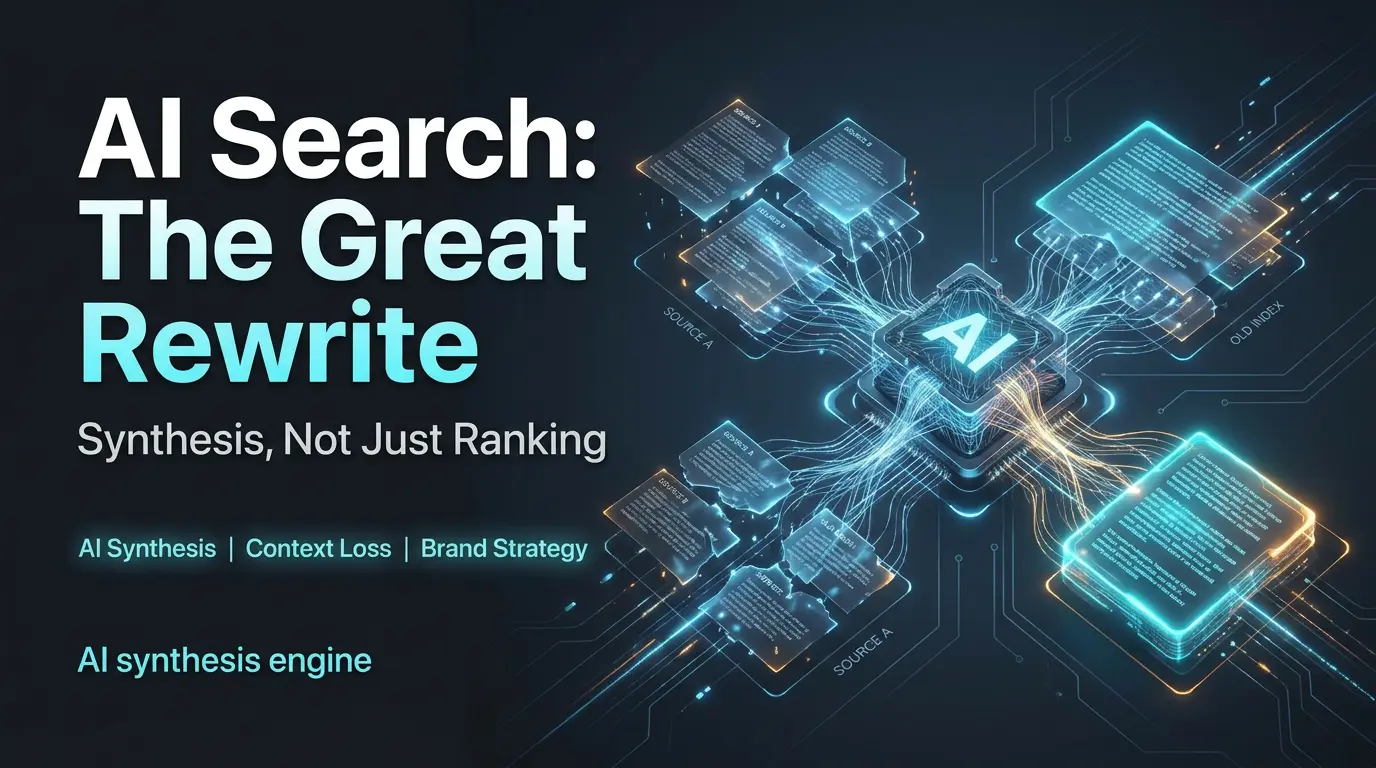
For decades, search engines ranked information.
They crawled pages, built indexes, compared signals, and returned a list of results. The user still had to open links, inspect sources, compare claims, and assemble meaning.
AI search changes that pattern.
It does not only find information. It rewrites information into an answer.
That is the real shift.
Traditional search mostly asked:
Which pages should be ranked for this query?
AI search asks something closer to:
Which pieces of information should be selected, compressed, combined, and narrated back to the user?
This is why AI search is not just a new interface for old search. It changes the unit of visibility. A page may still be crawled, indexed, and ranked, but the user may experience it only as one ingredient inside a synthesized answer.
If the earlier web was organized around retrieval, the AI search web is organized around synthesis. AIvsRank's guide to AI search engines covers the mechanics of this shift. This article focuses on the editorial consequence: once AI rewrites information, content teams are no longer competing only to be found. They are competing to be represented accurately inside a generated narrative.
Retrieval finds information. Synthesis changes it.
Retrieval and synthesis are related, but they are not the same job.
Retrieval is the act of finding candidate material. A search engine can retrieve a page, a paragraph, a product page, a document, a forum thread, a paper, or a dataset. Retrieval asks whether something is relevant enough to enter the source pool.
Synthesis is the act of turning selected material into a new answer. It chooses what to include, what to omit, how to connect claims, how to phrase uncertainty, and which sources deserve attribution.
The difference matters because the final answer is not a neutral container. It is a transformation.
OpenAI described ChatGPT search as a way to get timely answers with links to relevant web sources, blending web information with a natural language interface (OpenAI). Google Search Central describes AI Mode and AI Overviews as systems that may use query fan-out, issue multiple related searches across subtopics and data sources, and generate a comprehensive response with supporting links (Google Search Central).
Those descriptions show the new shape of search:
- the query can be expanded into sub-questions;
- the system can retrieve across multiple sources;
- the answer is composed from selected material;
- links are supporting evidence, not the whole interface.
This is why AI search is closer to an editor than a directory. It does not merely point at information. It decides how information should be arranged.
That editorial layer is where visibility changes. In traditional SEO, a high-ranking page could still speak for itself. In AI search, the AI may speak for the page.
The old goal was ranking. The new risk is rewriting.
Classic SEO is built around rank.
The practical questions are familiar:
- Can the page be crawled?
- Can it be indexed?
- Does it match the query?
- Does it earn authority?
- Does it win clicks?
Those questions still matter. But AI search adds a second layer: after retrieval, the system may rewrite what it found.
That creates new questions:
- Did the AI preserve the original claim?
- Did it compress away an important caveat?
- Did it merge your position with a competitor's position?
- Did it cite your page for something your page does not actually say?
- Did it turn a narrow recommendation into a broad one?
- Did it shape the user's next question before the user ever visits your site?
AIvsRank's article on why traditional SEO falls short in the AI answer era is useful here because it separates ranking from answer inclusion. Ranking is about where a page appears. Answer inclusion is about whether the page's meaning survives the model's selection and synthesis process.
That survival problem is not theoretical. It is now part of how information moves.
Context compression decides what survives.
Every AI answer compresses context.
Even when an AI system retrieves many documents, the final response cannot carry every detail. It has to reduce. It must decide which sentences, facts, examples, and caveats are central enough to preserve.
That compression is useful. Users ask AI search because they do not want to read every source manually.
But compression is also where meaning can shift.
A page may say:
This method works for early-stage SaaS companies with enough query volume, but it is less useful for local service businesses with sparse data.
An AI answer may compress that into:
This method works for SaaS companies.
That shorter version is not entirely false, but it is less precise. The caveat disappeared. The scope widened. The answer became easier to read and less faithful to the original.
Research on long-context language models makes this concern concrete. In "Lost in the Middle", Liu et al. found that model performance can degrade when relevant information appears in the middle of long contexts, even for models designed to handle long inputs. That does not mean every AI answer fails in the middle of a document. It means position, structure, and context management matter.
For publishers, the lesson is practical: do not hide the important caveat in a buried paragraph. If a claim has a condition, state the condition close to the claim. If a definition has a boundary, make the boundary visible. If a conclusion depends on methodology, keep the method near the conclusion.
AI search rewards content that can survive compression without becoming misleading.
Hallucination is not just invention. It can be bad synthesis.
People often use "hallucination" to mean that an AI made something up from nowhere.
That happens, but it is not the only risk.
In search, hallucination can also come from bad synthesis:
- the system retrieves real sources but combines them incorrectly;
- it cites a real URL that does not support the specific claim;
- it treats a weak source as stronger than it is;
- it overwrites uncertainty with a confident answer;
- it fills a missing step in the argument with a plausible guess.
OpenAI's 2025 research note on why language models hallucinate argues that hallucinations remain hard to eliminate partly because systems can be rewarded for guessing instead of acknowledging uncertainty. That matters for AI search because a search answer often feels more trustworthy when it includes links, even if the synthesis itself is wrong.
The Tow Center for Digital Journalism at Columbia Journalism Review tested ChatGPT Search by asking it to identify the source of 200 article quotes from publishers. The system returned partially or entirely incorrect responses in 153 cases and rarely admitted uncertainty (Columbia Journalism Review).
That is the dangerous version of AI search: not an answer without sources, but a confident answer with sources that do not quite prove what the answer says.
For brands and publishers, the problem is no longer simply "Can we be cited?" It is "Can we be cited accurately, for the right claim, in the right context?"
Narrative shaping is the new search surface.
Search results used to be relatively modular. Ten blue links could disagree with each other. The user saw a range of options and decided what to read.
AI search often collapses that range into one narrative.
That narrative may include multiple sources, but the user reads it as a single answer. The model decides the order, emphasis, framing, and conclusion.
This is narrative shaping.
It affects how users understand a category:
- which criteria matter;
- which brands are grouped together;
- which trade-offs are emphasized;
- which caveats are treated as minor;
- which source becomes the authority;
- which competitor appears first;
- which next question feels natural.
This is why answer visibility without click visibility matters. A brand can influence the user's judgment inside the answer even if the user never clicks. The reverse is also true: a brand can be omitted, misclassified, or framed poorly without seeing a clear signal in analytics.
In traditional search, a user might see your official page, your competitor's page, a review site, a Reddit thread, and a documentation page as separate options.
In AI search, the system may blend those sources into a single comparison. Your positioning is no longer only what your page says. It is also what the AI says after reading your page next to other sources.
Internal links should support interpretation, not promotion.
Internal links matter more in this environment, but not because every article should become a product brochure.
They matter because AI search needs a clear source map.
If an article argues that AI search rewrites information, it should give readers a natural path into related ideas. The concept path might point to a broader explanation of AI search engines, a discussion of the new citation-selection layer in AI Search Is Entering Its PageRank Moment, or a practical guide on how to optimize for AI search engines.
The diagnostic path should appear only where the reader has a diagnostic question. If the problem is crawler access, an AI crawler access checker is relevant. If the problem is whether a page is eligible for AI Overview-style treatment, an AI Overview eligibility checker fits. If the reader is unsure where to begin, the broader free tools page is a reasonable starting point.
The measurement path belongs where the article discusses representation. A public AI visibility leaderboard can help readers understand category-level answer visibility, while AIvsRank features are more relevant when the question shifts from one-off inspection to recurring monitoring. For teams turning GEO into a repeatable workflow, AIvsRank Docs and the geoskills documentation are better follow-ups than another conceptual link.
The rule is simple: every internal link should answer the reader's next question. If it does not, it weakens the article.
What content teams should do.
AI search does not make original content less important. It makes source clarity more important.
The content that survives synthesis usually has five qualities.
First, the claim is explicit. The page should say what it believes early, in plain language. If the AI has to infer the core point from scattered paragraphs, the risk of misrepresentation goes up.
Second, the scope is visible. If a recommendation applies only to a certain industry, use case, region, model, or time period, say so near the recommendation. Scope hidden at the end of a section is easy to compress away.
Third, the evidence is close to the claim. Do not make the reader, or the model, connect a statistic five paragraphs later to the statement it supports. Source proximity improves interpretability.
Fourth, the structure is stable. Clear headings, durable URLs, descriptive slugs, and internally linked topic clusters help both humans and AI systems understand where a page belongs.
Fifth, the page leaves behind quotable units. A good paragraph can be extracted without losing meaning. A good definition can stand alone. A good comparison names the criteria instead of relying on vague judgment.
This does not mean writing for robots. It means writing so that your argument remains intact after retrieval, compression, and synthesis.
The new content question.
Search engines used to rank information.
AI now rewrites it.
That does not mean the web is over. It means the web's role is changing. Pages are becoming source material for generated answers, and generated answers are becoming the user's first version of the story.
For content teams, the question is no longer only:
Can this page be found?
It is also:
Can this page be rewritten without losing its meaning?
That is a harder standard. It requires clearer claims, better source structure, visible caveats, closer evidence, and direct monitoring of how AI systems describe the brand or topic.
In traditional SEO, weak content might fail to rank.
In AI search, weakly structured content may rank, be retrieved, be compressed, and then be rewritten into something less precise than the original.
That is the new risk.
The future of search visibility is not only about earning attention. It is about preserving meaning after the machine retells the story.
FAQ: AI Search, Synthesis, and Rewritten Information
How is AI search different from traditional search?
Traditional search mainly ranks links and lets the user choose which pages to read. AI search retrieves sources, compresses context, synthesizes an answer, and often presents that answer before the user clicks. The difference is not only interface design; it is a shift from ranking documents to generating a response from selected information.
What is the difference between retrieval and synthesis?
Retrieval finds candidate information. Synthesis turns selected information into a new answer. In AI search, a page can be retrieved but not cited, cited but misunderstood, or included in the answer without being clicked. That is why retrieval visibility and answer visibility need to be measured separately.
Why does AI search sometimes rewrite information incorrectly?
AI search can rewrite information incorrectly when it compresses too much context, misses a caveat, combines sources with different scopes, or guesses when evidence is incomplete. Hallucination is not always a fake source; sometimes it is a real source used in the wrong way.
What is context compression in AI search?
Context compression is the process of reducing many sources, paragraphs, or facts into a shorter answer. It helps users move faster, but it can also remove scope, uncertainty, methodology, or exceptions. Content that states claims and caveats clearly is more likely to survive compression accurately.
How can a website optimize for AI synthesis?
Write pages that are easy to retrieve, interpret, extract, and verify. Use clear headings, direct definitions, evidence near claims, visible caveats, stable URLs, and strong internal links between related pages. The goal is not to stuff keywords into the page; it is to make the page difficult to misread.
Do citations prevent AI hallucinations?
No. Citations make an answer easier to inspect, but they do not guarantee correctness. An AI system can cite a real URL while misrepresenting what the page says. Publishers should check whether AI systems cite the right page for the right claim, not only whether they cite the site at all.
Why does narrative shaping matter for SEO and GEO?
Narrative shaping matters because AI answers can frame a market before the user visits any website. The answer may decide which criteria matter, which brands are comparable, which source is authoritative, and which next step feels natural. GEO extends SEO by measuring that answer-layer representation, not only rankings and clicks.